Situation Summary
Tajikistan remains a lower-tier global security concern (composite threat score 5), with no verified acute incidents reported in the past 24–48 hours. Dushanbe, the capital, carries significantly elevated risk (31.3) relative to other regions, driven by political concentration and demonstration activity. The broader country profile reflects endemic border tensions (particularly with Kyrgyzstan and Afghanistan), periodic protest activity, and institutional fragility, but no imminent destabilization signal is apparent from current open-source intelligence.
Key Developments
- 2026-06-22 · Demonstration/Rally · Dushanbe – A public gathering was reported; purpose, scale, and outcome remain unconfirmed in available sources. No security incidents, dispersals, or injuries documented.
- 2026-06-23 · Public Statement · United States vs. Tajikistan – A U.S. government statement addressing Tajikistan was issued; content and policy implications not yet detailed in accessible reporting. Monitor for bilateral diplomatic or sanctions-related announcements.
- 2026-06-23 · Public Statement · World Bank vs. Tajikistan – An institutional statement from the World Bank concerning Tajikistan appeared; likely governance, development finance, or structural-reform related. Assess potential economic or fiscal stress signals.
Note: Web research covering border security, civil unrest, infrastructure outages, and regional media yielded no corroborated security incidents within the 24–48-hour window. Claims appearing on social media were either undated, older than stated period, or single-sourced without confirmation. Risk monitoring remains active; no acute threat emergence detected.
Highest-Risk Areas
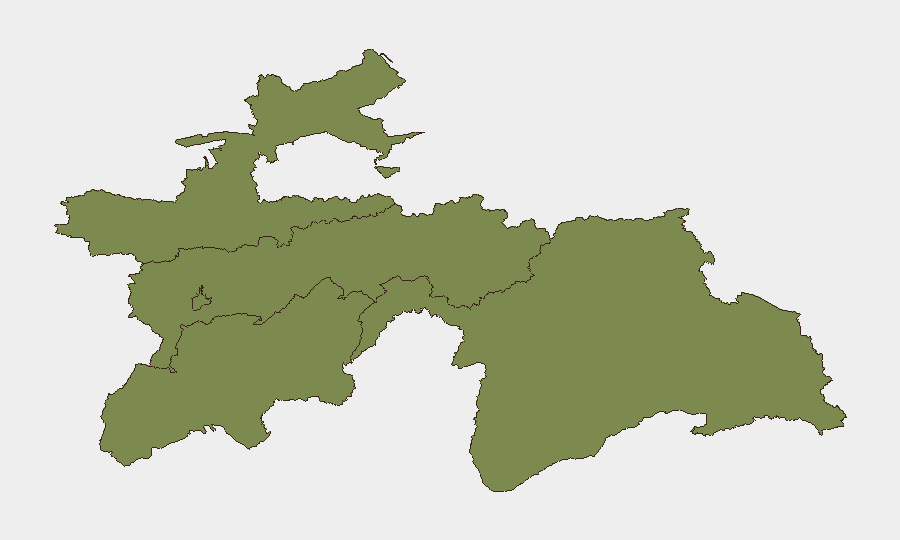
Dushanbe's risk score (31.3) dominates the country profile—a function of political decision-making authority, administrative density, and historical demonstration activity concentrated in the capital. The Districts of Republican Subordination (16.3) rank second, reflecting mixed governance and occasional spillover from central tensions. Sughd, Khatlon, and Gorno-Badakhshan (all 1.3) remain substantially lower-risk, though Gorno-Badakhshan's remote location and historical instability warrant continued monitoring. Border regions adjacent to Kyrgyzstan and Afghanistan carry persistent latent risk; no acute escalation is signaled at present.
How GeoBit Would Assist
Security teams with personnel or assets in Tajikistan should employ AOI Monitoring & Early Warning on Dushanbe and border districts to capture protest, clashes, or administrative disruptions in near-real time. Intel Sweep and X/Twitter & Telegram OSINT with multi-language and sentiment analysis enable detection of nascent unrest or cross-border incidents before mainstream reporting. Regime Stability and Network & Actor Analysis provide ongoing assessment of government resilience and political-actor movements that precede public events. Combined with Routing & Network Analysis, these capabilities support contingency planning for personnel movement if conditions deteriorate.
7-Day Outlook
No escalation or acute threat emergence is forecast over the next week absent new triggering events (e.g., border flare-up, major protest, or external political shock). Routine monitoring of U.S. and World Bank postures toward Tajikistan should continue, as policy shifts may signal governance stress or sanctions risk. Operational security postures should remain unchanged; heightened vigilance on Dushanbe gatherings and border-zone activity is warranted as standard practice.
Highest-Risk Areas — Ranked
| # | State / Region | Risk |
|---|---|---|
| 1 | Dushanbe | 31.3 |
| 2 | Districts of Republican Subordination | 16.3 |
| 3 | Sughd Region | 1.3 |
| 4 | Khatlon Region | 1.3 |
| 5 | Gorno-Badakhshan Autonomous Region | 1.3 |
Sources
Previous Daily Briefs
A new Tajikistan brief is written every day — each with its own risk map and downloadable CSV. Here's the last week; use the calendar to go further back.
📅 Browse every day by calendar →
Highlighted days have a brief. Tap a day for that day's map & analysis, or “csv” for that day's dataset ($5).