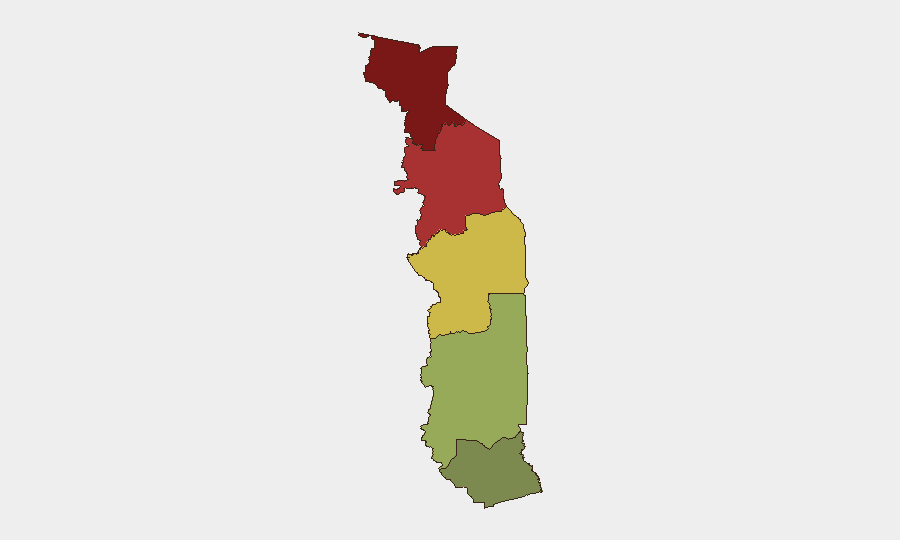
Situation Summary
Togo remains a stable, low-threat operating environment globally (rank #90), but faces emerging localized risks centered on northern regions and critical vulnerabilities in press freedom and journalist safety. The past week saw a high-profile abduction and assault of a journalist in the Kara Region, coupled with fuel price increases and organized crime activity, signaling compound pressure on civil society and transport infrastructure. Northern Savanes and Kara regions continue to drive disproportionate risk; meanwhile, digital surveillance concerns and state security expansion add a secondary layer of operational uncertainty for media and civil-society actors.
Key Developments
- Journalist abducted and assaulted, Guérin-Kouka (Kéran/Bassar area, Kara Region) – 5 Sept, reported 8–11 Sept: TAMPA TV reporter Roland Yaovi Kodjo was forcibly taken by men in civilian clothes and at least one person in police uniform, beaten during transport, and abandoned 55 km away. Assailants claimed mistaken identity, targeting the outlet's director. Incident triggered public condemnation by Syndicat des Journalistes Indépendants du Togo (SYNJIT), Patronat de la Presse Togolaise (PPT), and Committee to Protect Journalists (CPJ).
- Press organizations demand investigation and journalist protection – Lomé & national – 8–11 Sept: SYNJIT (8 Sept) framed the abduction as "an act of gangsterism" and a direct threat to press freedom. PPT (10 Sept) demanded prosecution of perpetrators and guaranteed safety for journalists on assignment outside the capital. CPJ (11 Sept) urged authorities to investigate, signaling international concern over press environment.
- Armed robbery network dismantled, Bassar area (Kara Region) – reported 10 Sept: Police operation targeted a network of armed robbers and receivers of stolen goods, with arrests across multiple localities. Reflects ongoing organized theft risk in the Bassar corridor.
- Serial murder investigation, Sotouboua (Centrale Region) – reported 10 Sept: Police identified a presumed main suspect in ongoing serial homicide case. Indicates active crime and elevated local law-enforcement activity.
- Fuel price increase and civil-society pressure, nationwide – 11–14 Sept: Super gasoline rose from 725 to 817 FCFA per liter (12.7% increase). Mouvement Martin Luther King (MMLK) publicly urged government to reduce toll fees and mitigate household cost pressures. Risk of transport sector unrest and demonstration around toll points remains latent.
- Digital surveillance and cybersecurity concerns highlighted – national – 9 Sept: Media reporting linked Togolese journalists to exposure to Pegasus-type spyware and broader state digital monitoring, coinciding with state rollout of 2024–2028 National Cybersecurity Strategy. Dual environment of security capability buildup and perceived digital risk for civil-society actors.
- Opposition political rhetoric on constitutional governance – Lomé – 9–10 Sept: Opposition figure Jean-Pierre Fabre advanced criticism of recent political reforms, calling for return of constitutional authority to citizens. No protest events reported, but rhetoric signals underlying governance friction.
Highest-Risk Areas
Savanes (risk 92) and Kara (risk 78) regions dominate the threat landscape, driven by proximity to Burkina Faso border, organized armed-robbery networks, and the abduction of journalist in Kéran/Bassar. Centrale Region (risk 65) shows elevated homicide activity. Maritime Region (risk 28) remains substantially lower risk and represents a relative safe zone for operations. Northern regions' remoteness, limited state oversight, and cross-border dynamics amplify vulnerability.
How GeoBit Would Assist
GeoBit's OSINT fusion (X/Twitter, Telegram, multi-language web monitoring) and entity extraction would track journalist safety incidents, civil-society messaging, and opposition rhetoric in near-real time. AOI Monitoring & Early Warning on Savanes and Kara regions would detect emerging protests, road blockages, and security incidents before operational impact. Network & Actor Analysis would map organized-crime and armed-robbery groups, and Economic & Trade tracking would monitor fuel-price volatility and transport-sector disruption risks.
7-Day Outlook
Journalist safety remains a primary concern; no further abductions are reported, but the incident underscores vulnerability of media outside Lomé and potential state or para-state involvement in suppression. Fuel-price pressures and toll-fee friction create conditions for transport-sector strikes or localized protests within 1–2 weeks, particularly around Lomé and major highway junctions. Opposition political messaging is likely to intensify ahead of medium-term electoral or constitutional discussions, without immediate threat of large-scale unrest.
Highest-Risk Areas — Ranked
| # | State / Region | Risk |
|---|---|---|
| 1 | Savanes Region | 92 |
| 2 | Kara Region | 78 |
| 3 | Centrale Region | 65 |
| 4 | Plateaux Region | 45 |
| 5 | Maritime Region | 28 |
Sources
Previous Weekly Briefs
A new Togo brief is written every Monday, covering the week — each with its own risk map and downloadable CSV. Use the calendar to go further back.
- September 8, 2026
- September 2, 2026
- August 31, 2026
- August 29, 2026
- August 27, 2026
- August 25, 2026
- August 23, 2026
📅 Browse past briefs by calendar →
Highlighted days have a brief. Tap a day for that day's map & analysis, or “csv” for that day's dataset ($5).
Atlas — our AI intelligence desk — emails them this snapshot personally. Nothing else, no list.