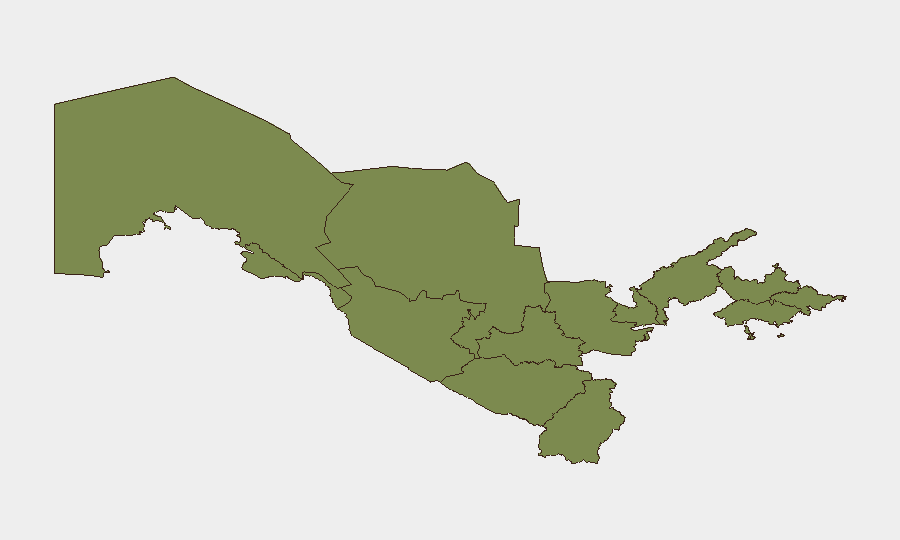
Situation Summary
Uzbekistan remains a low-threat environment globally (rank #184, composite score 3) with no verified security incidents or civil unrest in the past 24–48 hours. The country's threat profile is heavily concentrated in Navoiy Region, which accounts for the vast majority of tracked risk events; all other provinces score uniformly low. Current conditions reflect routine governance and international cooperation activity, with no indicators of imminent instability.
Key Developments
- No verified security incidents reported in the past 24–48 hours. Web research and OSINT monitoring confirmed only one Uzbekistan-specific activity: an EU-funded CADAP-8 workshop held in Tashkent on 23 June 2026 focused on drug-action and security cooperation—a policy initiative, not a security disruption.
- Recent event signals on record (23–24 June) include banking statements, investigation activity by US and Uzbek agencies, media disapproval statements, and diplomatic tension with Israel, but none have been verified as acute security or operational incidents affecting personnel or infrastructure.
- No travel warnings, infrastructure disruptions, or civil unrest alerts have been detected in major urban areas (Tashkent, Samarkand, Bukhara) or transportation hubs over the reporting period.
Highest-Risk Areas
Navoiy Region dominates the national threat profile with a composite risk score of 31.9—roughly six times higher than Tashkent (5.2) and more than 15 times higher than all other provinces combined (1.9 each). Navoiy's elevated risk reflects industrial and remote-area exposure factors; the region hosts significant uranium and mining operations, which may account for regulatory, environmental, or historical security event density. All remaining provinces—including major population centers and transit hubs—register uniformly low risk (1.9), indicating either robust stability or limited recent event recording. For personnel and asset operations, concentration of exposure mitigation should focus on Navoiy; broader Uzbekistan operations face baseline low-threat conditions.
How GeoBit Would Assist
Security and duty-of-care teams operating in Uzbekistan should employ AOI Monitoring & Early Warning to establish persistent watch over Navoiy Region and Tashkent, with alert thresholds configured for sudden shifts in event type or frequency. Intel Sweep and OSINT fusion (including Telegram, X/Twitter, and local-language sources) would provide continuous background monitoring to catch emerging civil, regulatory, or security signals before they escalate. For operational planning in Navoiy, Routing & Network Analysis capabilities enable identification of alternative transport corridors and safe-haven options in the event of localized disruption, and GIS & Spatial Analysis can map industrial-zone and populated-area separation to inform site-specific risk assessments.
7-Day Outlook
No acute threats are expected to materialize in the next 7 days. The persistent concentration of risk in Navoiy Region suggests underlying structural factors (industrial operations, remote logistics, uranium sector oversight) rather than triggered instability. Routine monitoring for diplomatic tension (recent US and Israel-related statements) and international investigations should continue, but no escalation to operational risk is indicated at this time.
Highest-Risk Areas — Ranked
| # | State / Region | Risk |
|---|---|---|
| 1 | Navoiy Region | 31.9 |
| 2 | Tashkent | 5.2 |
| 3 | Qashqadaryo Region | 1.9 |
| 4 | Surxondaryo Region | 1.9 |
| 5 | Fergana Region | 1.9 |
| 6 | Republic of Karakalpakstan | 1.9 |
| 7 | Xorazm Region | 1.9 |
| 8 | Bukhara Region | 1.9 |
| 9 | Jizzakh Region | 1.9 |
| 10 | Tashkent Region | 1.9 |
| 11 | Namangan Region | 1.9 |
| 12 | Sirdaryo Region | 1.9 |
Sources
Previous Daily Briefs
A new Uzbekistan brief is written every day — each with its own risk map and downloadable CSV. Here's the last week; use the calendar to go further back.
📅 Browse every day by calendar →
Highlighted days have a brief. Tap a day for that day's map & analysis, or “csv” for that day's dataset ($5).