Situation Summary
Argentina's composite threat score of 42 places it in the middle range of global security concern, with 845 tracked events indicating persistent underlying instability across multiple threat vectors. The past 48 hours show elevated activity concentrated in executive, legislative, and law-enforcement domains—including presidential statements, government position papers, parliamentary commentary, and investigative actions—suggesting a period of acute political or institutional tension. Córdoba Province significantly outpaces other regions in risk metrics, while Buenos Aires Province and northern provinces (Tucumán, Santa Fe, Misiones) remain secondary concern areas. The overall trajectory reflects chronic rather than acute crisis, though the density and type of official statements and enforcement actions warrant close monitoring.
Key Developments
- 2026-07-09, National Level: Presidential public statement issued regarding unspecified Argentine matter; concurrent investigative action by authorities signals potential inquiry into a governance or policy issue.
- 2026-07-09, National Level: Union sector formally rejected an unspecified proposal or directive, indicating labor or economic friction at the national level.
- 2026-07-09, National Level: Arrest or detention action carried out by Argentine authorities involving a prison-related matter; no specific location or victim profile confirmed in available reporting.
- 2026-07-08, Nationwide: Coordinated multi-institutional response observed: police deployed conventional force (nature and location unspecified), government and legislature issued competing or clarifying public statements, and central bank and intelligence agencies released statements, indicating a significant policy or security event requiring whole-of-government response.
- 2026-07-08, Nationwide: Population-led occupation of territory and demonstration/rally activity reported, with retired persons noted as participants; scale and specific location not yet geolocated.
Note: Specific locations, incident details, casualty counts, and underlying cause of the 2026-07-08 multi-agency response remain unconfirmed in available open-source reporting as of 2026-07-10 0800 UTC.
Highest-Risk Areas
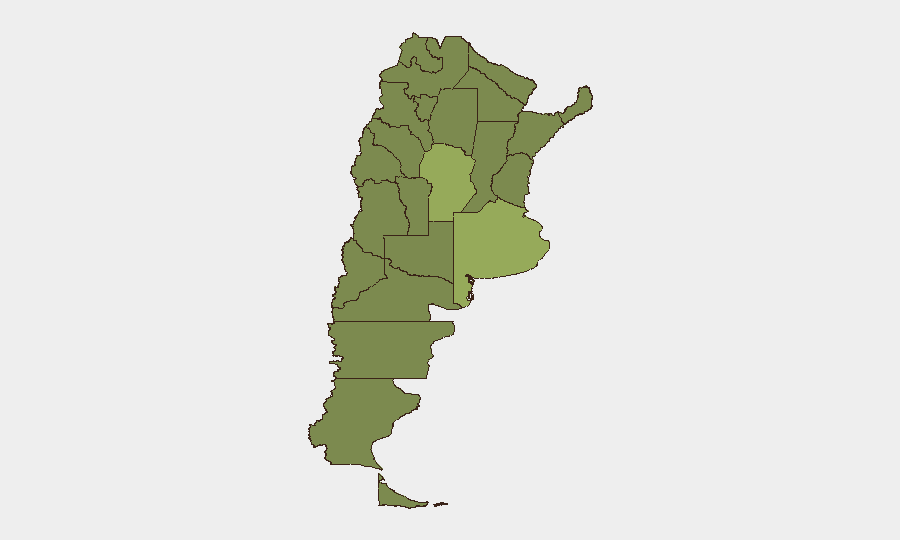
Córdoba Province dominates sub-national risk (59.5), more than 45% higher than the national average and double the score of Buenos Aires Province (40.8), indicating concentrated criminal, protest, or institutional instability in central Argentina. Buenos Aires Province, containing metropolitan Buenos Aires and surrounding industrial areas, ranks second and remains a persistent focal point for labor, crime, and political activity. The northern tier (Tucumán, Santa Fe, Misiones, Chaco, Salta) shows relatively uniform moderate-to-high risk in the 30–32 range, consistent with documented patterns of organized crime, informal economy activity, and border-region vulnerabilities. Southern provinces (Santa Cruz, Chubut, Neuquén) remain at baseline elevated risk (~30), likely reflecting hydrocarbon sector disputes and remote-area governance challenges.
How GeoBit Would Assist
Security teams operating in Argentina would deploy AOI Monitoring & Early Warning on Córdoba, Buenos Aires, and Tucumán to capture protest, crime, and police activity in real time. Intel Sweep and multi-language OSINT fusion—including X/Twitter, local news wires, and official channels—would provide incident-level confirmation and location detail within hours of occurrence, closing current gaps in specificity. Network & Actor Analysis combined with conflict mapping would clarify relationships among government, unions, police, and population groups driving the 2026-07-08 events and assess likelihood of escalation or recurrence.
7-Day Outlook
Political and labor friction evident in the past 48 hours is likely to persist or intensify if the underlying policy dispute remains unresolved. Córdoba and Buenos Aires Province should be treated as high-watch areas for follow-on protest, strikes, or police activity through mid-July. No indicators suggest imminent nationwide instability, but personnel and asset managers should maintain heightened situational awareness in provincial capitals and transport corridors.
Highest-Risk Areas — Ranked
| # | State / Region | Risk |
|---|---|---|
| 1 | Córdoba | 59.5 |
| 2 | Buenos Aires Province | 40.8 |
| 3 | Tucumán Province | 32.4 |
| 4 | Santa Fe Province | 31.6 |
| 5 | Misiones | 31.4 |
| 6 | Chaco Province | 30.6 |
| 7 | Santa Cruz Province | 30.4 |
| 8 | Entre Ríos Province | 30.4 |
| 9 | Salta Province | 30.3 |
| 10 | Chubut Province | 30.1 |
| 11 | Neuquén Province | 29.8 |
| 12 | Corrientes Province | 29.8 |
Sources
Previous Daily Briefs
A new Argentina brief is written every day — each with its own risk map and downloadable CSV. Here's the last week; use the calendar to go further back.
📅 Browse every day by calendar →
Highlighted days have a brief. Tap a day for that day's map & analysis, or “csv” for that day's dataset ($5).
Atlas — our AI intelligence desk — emails them this snapshot personally. Nothing else, no list.