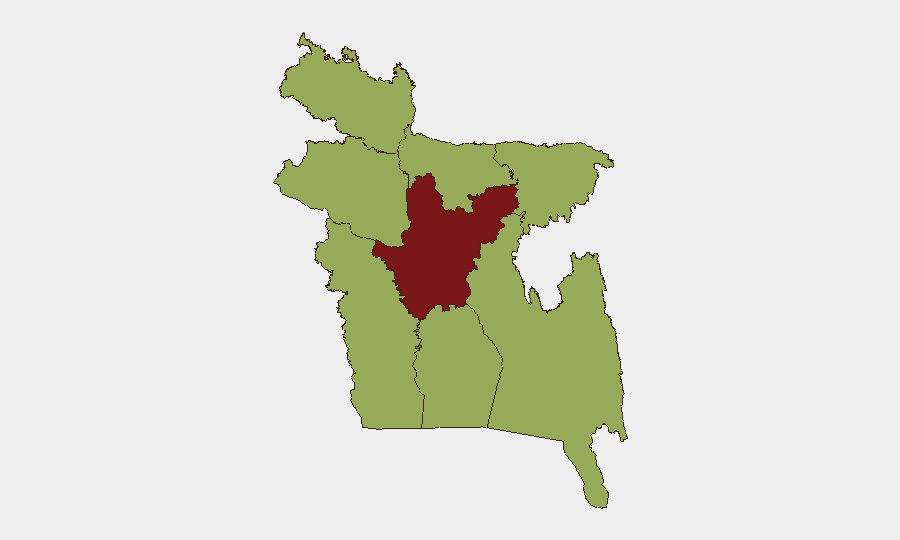
Situation Summary
Bangladesh faces a composite security threat ranking of 75 (globally #22) driven primarily by concentrated risk in Dhaka Division, where political unrest, student activism, and institutional friction continue to generate arrest, detention, and administrative actions. Recent signal activity indicates friction between the state and media, judiciary contestation, and border-sector incidents, though open-source reporting of discrete security events in the immediate 24–48-hour window remains sparse. The broader picture reflects ongoing political volatility and monsoon-season natural hazards, with Dhaka remaining the dominant locus of risk by a substantial margin.
Key Developments
- Nationwide floods and landslides (multiple districts: Chattogram, Bandarban, Cox's Bazar) – Within last 24 hours. Heavy monsoon rains have caused at least 51 deaths and displaced thousands; rescue and relief operations ongoing with persistent risk of further landslides and flood-related transport disruption.
- Cross-border shooting incident – Sylhet, Gowainghat sector (India–Bangladesh border) – Early Saturday (within 48 hours). Social reporting indicates a Bangladeshi youth killed by Indian nationals along the border; unconfirmed by major outlets but reflects elevated cross-border tension in this sector.
- Student arrests and detention activity – Dhaka Division (unspecified location) – 2026-07-11. Ongoing student-led uprising activity continues to result in arrests and detains; signals consistent with sustained political friction in the capital division.
- Administrative sanctions against media – Bangladesh (national scope) – 2026-07-12. State has imposed sanctions on media outlets; part of broader pattern of institutional pressure alongside journalist public statements and government disapprovals noted 2026-07-10.
- Border deportation and infiltration enforcement – India–Bangladesh frontier (unspecified location). Over past 48 hours: apprehension of Ukrainian and Bangladeshi nationals on illegal infiltration charges (India side); concurrent social reporting of anti-India protest sentiment and allegations of non-standard deportation channels by Indian BSF suggest heightened border friction and localized protest activity.
Highest-Risk Areas
Dhaka Division dominates the national risk profile at 82.6—more than 50% higher than all other divisions—reflecting the concentration of political, institutional, and administrative volatility in the capital and surrounding areas. Student activism, media-state friction, detention operations, and tribunal disputes are all primarily localized to or originating from Dhaka. The remaining seven divisions cluster tightly between 52.6 and 53.2, indicating dispersed but secondary baseline risk; Chittagong Division (53.2) edges slightly higher, consistent with its role as a secondary urban center and border-adjacent zone. Monsoon-season natural hazards (floods, landslides) currently affect multiple zones—particularly Chattogram, Cox's Bazar, and Bandarban—creating near-term displacement and transport risk, but do not alter the underlying political-stability hierarchy.
How GeoBit Would Assist
Corporate security teams should deploy AOI Monitoring & Early Warning on Dhaka Division to track ongoing detention, media, and student-unrest activity with sub-daily alerting; pair with Sentiment & Temporal Analysis on local media, social platforms, and journalist networks to detect emerging friction before operational disruption. Border & Disputed-Territory Search and Cross-Border Entity Network Analysis enable tracking of Sylhet and other frontier zones for infiltration, deportation, and cross-border armed incidents. Routing & Network Analysis supports real-time alternative journey planning around flood-affected districts (Chattogram, Cox's Bazar, Bandarban) to protect personnel and supply chains during the monsoon cycle.
7-Day Outlook
Political friction in Dhaka is likely to persist absent major institutional concessions; student activism and media-state tension should be treated as ongoing baseline risk. Monsoon flooding will remain acute across coastal and hilly districts through mid-week at minimum; travel and logistics disruption in Chattogram, Cox's Bazar, and Bandarban should be anticipated. Border sector incidents (Sylhet, India–Bangladesh frontier) may repeat; no de-escalation signal is visible.
Highest-Risk Areas — Ranked
| # | State / Region | Risk |
|---|---|---|
| 1 | Dhaka Division | 82.6 |
| 2 | Chittagong Division | 53.2 |
| 3 | Khulna Division | 52.6 |
| 4 | Barishal Division | 52.6 |
| 5 | Rangpur Division | 52.6 |
| 6 | Rajshahi Division | 52.6 |
| 7 | Mymensingh Division | 52.6 |
| 8 | Sylhet Division | 52.6 |
Sources
Previous Daily Briefs
A new Bangladesh brief is written every day — each with its own risk map and downloadable CSV. Here's the last week; use the calendar to go further back.
📅 Browse every day by calendar →
Highlighted days have a brief. Tap a day for that day's map & analysis, or “csv” for that day's dataset ($5).
Atlas — our AI intelligence desk — emails them this snapshot personally. Nothing else, no list.