Situation Summary
Bulgaria remains a low-threat environment globally (rank #157; composite score 6), but is experiencing a sharp spike in far-right extremism, youth radicalization, and associated violent crime that is driving elevated risk in major urban centers—particularly Plovdiv and Sofia-City. Recent incidents include a sadistic murder linked to neo-Nazi youth networks, a coordinated arrest of 18 individuals affiliated with the transnational "Blood and Honour" organization, and broader judicial handling of hate crimes that has triggered public controversy and calls for stricter enforcement. Infrastructure vulnerabilities—most recently an ammunition plant explosion and a cross-border drone incident—have also surfaced as secondary risk vectors, though no direct nexus to extremist activity has been established.
Key Developments
- Plovdiv: Neo-Nazi murder case escalates national debate (18 Aug 2026). A sadistic murder of a 37-year-old by five teenagers with far-right affiliations triggered intense coverage on 18 August; trade unions and political figures are demanding stricter youth discipline and anti-extremism enforcement, raising the profile of radicalization as a policy and security concern.
- Plovdiv: "Blood and Honour" network raid and charges (16–18 Aug 2026). Police and State Agency for National Security (DANS) arrested 18 individuals linked to the international neo-Nazi organization during a raid on a private club on 16 August; banned Nazi symbols and propaganda were recovered, and at least one detainee is connected to prior ethnically motivated violence against Nepalese citizens. Formal charges are expected.
- Judicial-extremism feedback loop in Plovdiv (17 Aug 2026). Updated reporting confirms that students previously arrested for attacks on Nepalese citizens were released by courts; at least one was later identified among the "Blood and Honour" detainees, fueling public perception that the judiciary is insufficiently responsive to hate crimes and feeding local social tension.
- Belitsa (Tryavna municipality): Ammunition plant fire and explosions (10–11 Aug, reviewed 18 Aug). An EMCO ammunition factory fire triggered warehouse detonations and a state of emergency; security reviews published 18 August highlight the incident as part of a broader pattern of infrastructure vulnerability on Bulgaria's Eastern Flank, raising questions about resilience against potential cross-border or intentional threats.
- Trakia motorway: Bribery attempt and road policing intensification (17 Aug 2026). A Montenegrin truck driver was detained for attempting to bribe traffic police with €20 during a large-scale linear enforcement operation, underscoring ongoing corruption and road safety risks on major transit corridors.
Highest-Risk Areas
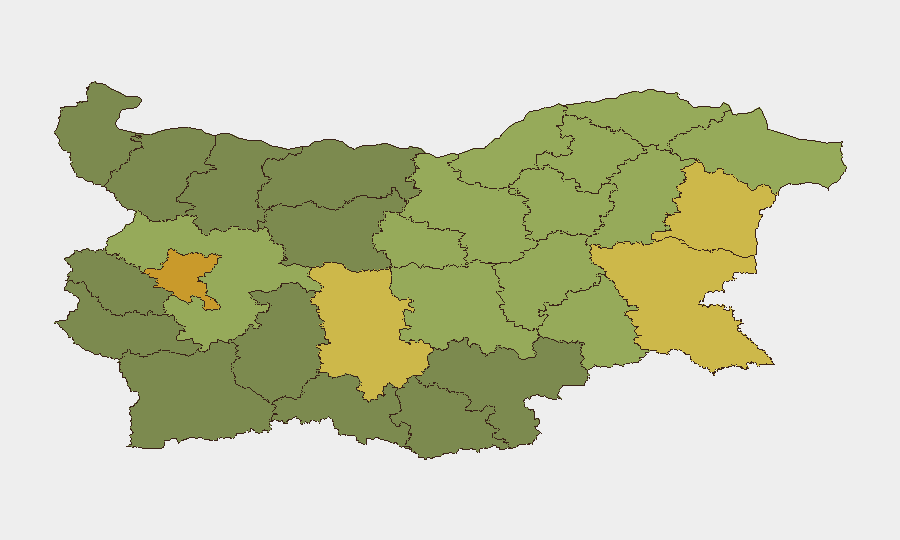
Sofia-City, Plovdiv, and Varna dominate the sub-national ranking (scores 72, 68, 65 respectively), driven primarily by urban density, organized crime presence, and—as of this week—the concentration of far-right extremist networks and youth radicalization in Plovdiv. Plovdiv's escalating neo-Nazi activity, coupled with judicial delays in prosecuting hate crimes, has created a feedback loop that amplifies both actual threat and public anxiety. Sofia-City's elevated risk reflects typical metropolitan crime, organized crime networks, and proximity to critical government and diplomatic infrastructure; Varna and Burgas carry maritime-trafficking and organized-crime dimensions linked to the Black Sea corridor.
How GeoBit Would Assist
Corporate teams with personnel or assets in Plovdiv and Sofia-City should employ AOI Monitoring & Early Warning on identified extremist gathering sites and Network & Actor Analysis to map neo-Nazi recruitment and radicalization pathways. OSINT Fusion (X/Twitter, Telegram, YouTube) and Sentiment & Temporal Analysis on far-right forums and channels will provide early indicators of planned activity or escalation. Routing & Network Analysis supports alternative journey planning to avoid high-risk transit zones during periods of heightened social tension or police operations.
7-Day Outlook
Far-right extremism and judicial response will remain the dominant domestic security narrative; expect continued arrests, media coverage, and potential for copycat or retaliatory incidents in Plovdiv and secondary urban centers. Infrastructure incidents (drone intrusions, industrial accidents) are likely to remain isolated unless a coordinated pattern emerges. Road policing intensity will remain elevated, affecting freight and personnel mobility on interstate corridors.
Highest-Risk Areas — Ranked
| # | State / Region | Risk |
|---|---|---|
| 1 | Sofia-City | 72 |
| 2 | Plovdiv | 68 |
| 3 | Varna | 65 |
| 4 | Burgas | 62 |
| 5 | Sofia | 58 |
| 6 | Ruse | 55 |
| 7 | Stara Zagora | 52 |
| 8 | Sliven | 50 |
| 9 | Shumen | 48 |
| 10 | Razgrad | 47 |
| 11 | Yambol | 45 |
| 12 | Dobrich | 44 |
Sources
Previous Daily Briefs
A new Bulgaria brief is written every day — each with its own risk map and downloadable CSV. Here's the last week; use the calendar to go further back.
- August 16, 2026
- August 14, 2026
- August 12, 2026
- August 10, 2026
- August 8, 2026
- August 6, 2026
- August 5, 2026
📅 Browse every day by calendar →
Highlighted days have a brief. Tap a day for that day's map & analysis, or “csv” for that day's dataset ($5).
Atlas — our AI intelligence desk — emails them this snapshot personally. Nothing else, no list.