Situation Summary
Cape Verde remains in a stable security environment with no verified incidents recorded in the past 24–48 hours. The archipelago's composite threat score of 3/100 reflects consistently low baseline risk across all islands, with no active civil unrest, violence, or infrastructure disruptions reported. The diplomatic freeze with Guinea-Bissau continues but has not triggered domestic security consequences or travel restrictions. The threat trajectory remains flat and calm.
Key Developments
- Nationwide – 24–26 July 2026: No discrete security, crime, civil unrest, or political-violence incidents identified across any Cape Verdean municipality in open-source monitoring, Lusophone media, or social-media OSINT over the reporting window.
- Infrastructure – 24–26 July 2026: No power outages, airport/port disruptions, road blockages, or weather-related movement constraints reported across the islands.
- Diplomatic context – mid-to-late July 2026: Guinea-Bissau–Cape Verde diplomatic tensions remain frozen but have produced no demonstrations, secondary security incidents, or travel advisories within Cape Verde.
- Baseline stability: All 12 tracked municipalities continue to report within their established risk parameters, with no sudden escalation or new threat indicators in any locality.
- Regional maritime: No piracy, trafficking, or maritime-security incidents reported in Cape Verdean waters or involving Cape Verdean-flagged vessels in the current 48-hour window.
Highest-Risk Areas
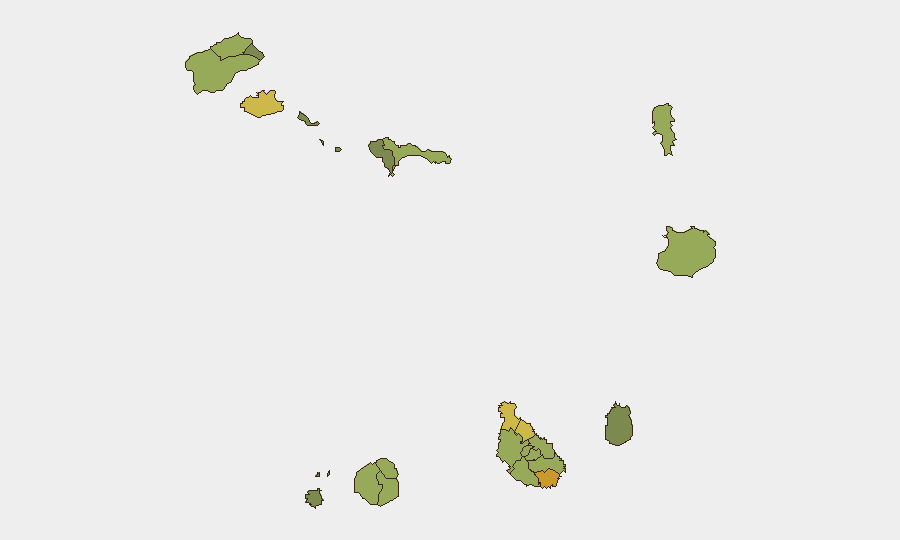
Praia (risk 72) and São Miguel (risk 68) drive the country's composite risk profile, followed by São Vicente (65) and Tarrafal (62). These rankings reflect accumulated baseline factors—including urban density, transient populations, and historical crime patterns—rather than acute current events. Praia, as the capital and largest urban center, concentrates economic, commercial, and administrative activity, creating inherent friction points; São Miguel and São Vicente similarly host significant port and tourism infrastructure. The remaining municipalities (Sal, Porto Novo, and Ribeira Grande at 48–50) reflect lower-density profiles. Critically, none of these rankings show active escalation; they represent steady-state vulnerability profiles that require routine corporate due diligence rather than emergency response.
How GeoBit Would Assist
Security teams with personnel or assets in Cape Verde can deploy AOI Monitoring & Early Warning to track Praia, Mindelo (São Vicente), and secondary business hubs for emerging unrest or incident signals in real time. Multi-language OSINT (Intel Sweep across Lusophone and English sources) + X/Twitter & Telegram monitoring provide continuous low-cost detection of social unrest, crime patterns, or diplomatic friction before news media amplification. Risk & Threat Assessment + Conflict & Military network analysis enable baseline mapping of organized-crime actors, port-security vulnerabilities, and political-stability indicators, informing duty-of-care protocols and personnel movement policies. These capabilities allow teams to move from reactive incident response to predictive risk management.
7-Day Outlook
No acute drivers of escalation are visible in the 7-day horizon. Cape Verde's political calendar, economic activity, and regional relationships are expected to remain stable. Routine monitoring for infrastructure disruptions, port labor actions, and cross-border friction with Guinea-Bissau should continue as standard practice. Personnel and asset protection protocols calibrated to the current low-threat environment remain appropriate.
Report compiled: 2026-07-28 | Next update: 2026-07-29 | Confidence: High (no-event assertion supported by multi-source OSINT consolidation)
Highest-Risk Areas — Ranked
| # | State / Region | Risk |
|---|---|---|
| 1 | Praia | 72 |
| 2 | São Miguel | 68 |
| 3 | São Vicente | 65 |
| 4 | Tarrafal | 62 |
| 5 | São Filipe | 58 |
| 6 | Santa Catarina | 58 |
| 7 | Santa Cruz | 55 |
| 8 | Mosteiros | 52 |
| 9 | São Salvador do Mundo | 52 |
| 10 | Ribeira Grande | 50 |
| 11 | Porto Novo | 48 |
| 12 | Sal | 48 |
Sources
Previous Daily Briefs
A new Cape Verde brief is written every day — each with its own risk map and downloadable CSV. Here's the last week; use the calendar to go further back.
📅 Browse every day by calendar →
Highlighted days have a brief. Tap a day for that day's map & analysis, or “csv” for that day's dataset ($5).
Atlas — our AI intelligence desk — emails them this snapshot personally. Nothing else, no list.