Situation Summary
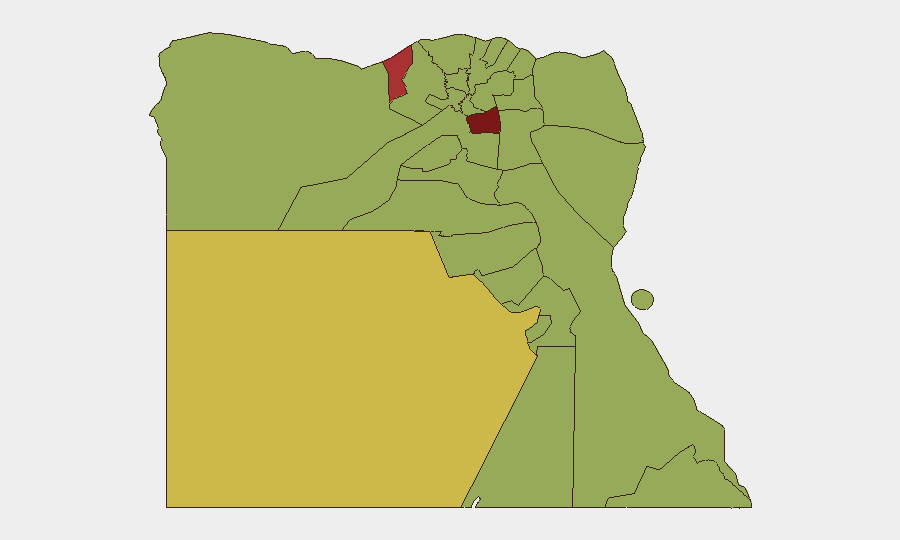
Egypt maintains a composite threat score of 75 (global rank #26), with 106 tracked security events, reflecting persistent challenges across terrorism, sectarian tensions, and regional spillover. Cairo and Alexandria dominate the risk landscape with scores of 82.5 and 77.4 respectively, driven by urban concentration, protest activity, and law-enforcement operations. Recent event signals point to diplomatic friction, investigative activity, and detention operations, though substantive domestic security incidents in the last 24–48 hours remain unclear from available open sources. The country's trajectory remains cautious: stability is maintained, but underlying vulnerabilities to extremist activity and sectarian flashpoints persist.
Key Developments
- 2026-07-14 · Cairo / Doha: President Sisi held talks with Qatar's emir; diplomatic engagement reflects continued regional positioning but carries no direct security implications for corporate operations.
- 2026-07-14 · Egypt (National): Foreign ministry condemned Iranian attacks on Gulf shipping and regional infrastructure; underscores Egypt's alignment with Gulf partners and potential indirect exposure to regional escalation.
- 2026-07-14 · Alexandria: Arrest/detention of caregiver reported; context and nature of offense unclear, but consistent with ongoing law-enforcement activity in Egypt's second-largest city.
- 2026-07-13–14 · Cairo: Public statements by judges and officials; specific content unavailable, but timing coincides with investigative and detention signals suggesting potential legal or administrative proceedings.
- 2026-07-12–14 · Egypt (National): Threaten, reduce relations, and arrest/detain signals; granularity limited, but pattern suggests elevated judicial/law-enforcement tempo without confirmed targeting of foreign nationals or corporate entities.
Note: Confirmable discrete security incidents (crime, civil unrest, terrorism) in the last 24–48 hours are not identifiable from current open research. Sectarian attack in Minya (Tal al-Qibliya, 2026-07-08) falls outside the brief window and should be monitored for follow-up, not treated as current.
Highest-Risk Areas
Cairo (82.5) and Alexandria (77.4) command the largest risk premium due to population density, protest potential, and concentration of law-enforcement and judicial activity. The Sinai Peninsula zones (North, South: 52.5 each) and New Valley (64) remain persistent terrorism hotspots, though operationally segmented from major commercial hubs. Remote border regions (Halaib Triangle, Matruh, Red Sea coast) present lower day-to-day corporate exposure but carry kidnapping and smuggling risks for isolated supply chains. Suez (53.1) and Kafr El Sheikh (53.1) occupy a middle tier—economically significant but less volatile than Cairo and Alexandria.
How GeoBit Would Assist
Corporate security teams should deploy AOI Monitoring & Early Warning on Cairo, Alexandria, and the Suez Canal corridor to detect protest escalation, security operations, or supply-chain disruption in real time. Intel Sweep (event feeds, X/Telegram OSINT, multi-language search) combined with entity extraction and sentiment analysis will parse judicial/law-enforcement signals and civil unrest sentiment ahead of mass disruption. Routing & Network Analysis should model alternative supply and staff-movement corridors around high-risk zones, enabling duty-of-care teams to pre-position contingencies. Satellite & Imagery analysis can monitor Sinai and border regions for militant activity that might signal spillover into commercial zones.
7-Day Outlook
No immediate escalation is forecast; however, judicial and law-enforcement activity in Cairo and Alexandria warrants close monitoring, as sudden arrests or trials involving political or sectarian figures can trigger secondary unrest. Regional tension (Iran–Gulf shipping, Israeli–Hamas activity) creates ambient risk but does not directly destabilize Egypt's domestic security posture. Expect continued routine diplomatic engagement and humanitarian operations; recommend maintaining elevated vigilance on Sinai-adjacent supply lines and monitoring for cascading effects from any sectarian incidents outside major cities.
Highest-Risk Areas — Ranked
| # | State / Region | Risk |
|---|---|---|
| 1 | Cairo | 82.5 |
| 2 | Alexandria | 77.4 |
| 3 | New Valley | 64 |
| 4 | Kafr El Sheikh | 53.1 |
| 5 | Suez | 53.1 |
| 6 | North Sinai | 52.5 |
| 7 | Qena | 52.5 |
| 8 | South Sinai | 52.5 |
| 9 | Red Sea | 52.5 |
| 10 | Halaib Triangle | 52.5 |
| 11 | Matruh | 52.5 |
| 12 | The Lake | 52.5 |
Sources
Previous Daily Briefs
A new Egypt brief is written every day — each with its own risk map and downloadable CSV. Here's the last week; use the calendar to go further back.
📅 Browse every day by calendar →
Highlighted days have a brief. Tap a day for that day's map & analysis, or “csv” for that day's dataset ($5).
Atlas — our AI intelligence desk — emails them this snapshot personally. Nothing else, no list.