Situation Summary
Georgia remains at composite threat rank #null globally (score 20) with baseline security conditions stable across the country over the last 24–48 hours. No verifiable incidents—attacks, civil unrest, cross-border activity, or major crimes—have been confirmed in major news feeds, official channels, or social media within this window. Frozen-conflict zones in Abkhazia and South Ossetia show no new force posturing or escalations. Risk concentration in Shida Kartli (score 31.3) and Tbilisi (18.4) reflects persistent underlying vulnerabilities rather than acute active incidents.
Key Developments
- Countrywide – July 20–21, 2026: No discrete security incidents, civil unrest, or crime events meeting incident criteria have been confirmed in the last 24–48 hours across major reporting channels and social media; conditions remain stable at baseline risk levels.
- Abkhazia and South Ossetia border regions – July 20–21, 2026: No new cross-border military activity, force posturing, or escalations reported within the current 24–48-hour window; frozen-conflict status unchanged.
- Tbilisi and major commercial centers – July 20–21, 2026: No acute security incidents or civil unrest confirmed; routine policing and public-safety operations continue under stable conditions.
- Flood events (recent, timing unspecified): Two flood incidents logged in Georgia (IDs 1104018, 1103979) remain under monitoring; specific location, impact scope, and current status require detailed source corroboration and on-ground verification.
- Recent signal activity (July 19–20, 2026): Public statements by U.S. entities, company rejections, student disapproval, and protester demonstrations recorded in event signals but lack specific incident-level details, locations, and corroboration in open-source reporting.
Highest-Risk Areas
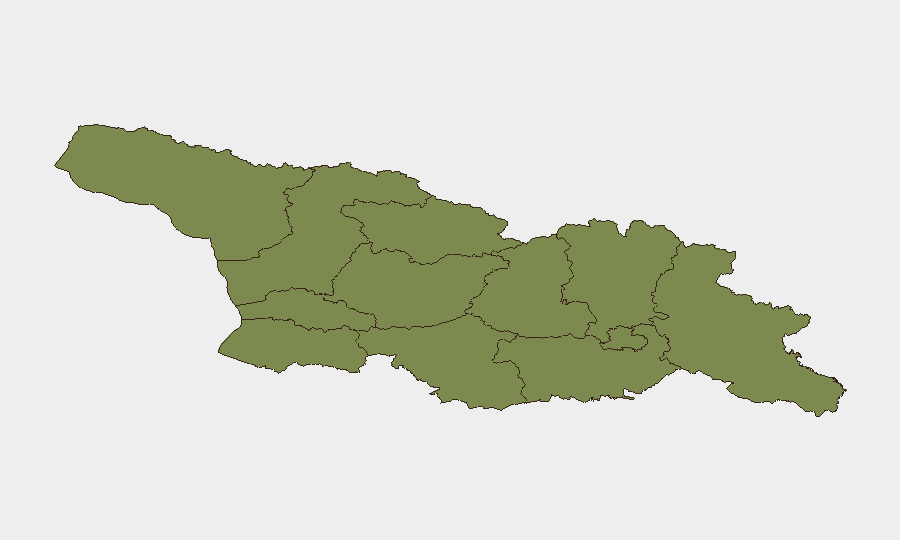
Shida Kartli's composite score of 31.3—more than 70% higher than Tbilisi's 18.4—positions it as Georgia's primary risk concentration, driven by proximity to South Ossetia, historical conflict dynamics, and persistent territorial ambiguity. Tbilisi's secondary ranking reflects urban-scale political volatility, commercial density, and soft-target accessibility. Samegrelo-Upper Svaneti (9.8) shows elevated but moderate risk, likely linked to Abkhazia proximity and remote-area infrastructure challenges. All remaining regions score 1.3, indicating either baseline stability or insufficient event data to surface material differentiation.
How GeoBit Would Assist
Security teams with personnel or assets in Georgia should deploy AOI Monitoring & Early Warning on Shida Kartli and border regions to detect force posturing, cross-border activity, or civil unrest in real time. Intel Sweep (global event feeds, multi-language OSINT fusion, X/Twitter and Telegram monitoring, entity extraction, and sentiment analysis) provides continuous corroboration of public statements, protests, and political activity across Tbilisi and commercial centers. Routing & Network Analysis enables identification of alternative transport corridors in high-risk zones, and Environmental & Health monitoring tracks flood impacts and infrastructure disruption for continuity planning.
7-Day Outlook
Absent new force mobilization, political destabilization, or weather escalation, Georgia is likely to remain at current baseline risk levels. Shida Kartli and Tbilisi warrant sustained passive monitoring for early-warning signals; border regions should be assumed elevated but stable. Flood recovery and event-signal developments in the political sphere merit 24–48-hour re-evaluation to confirm trajectory.
Highest-Risk Areas — Ranked
| # | State / Region | Risk |
|---|---|---|
| 1 | Shida Kartli | 31.3 |
| 2 | Tbilisi | 18.4 |
| 3 | Samegrelo-Upper Svaneti | 9.8 |
| 4 | Mtskheta-Mtianeti | 1.3 |
| 5 | Lower Kartli | 1.3 |
| 6 | Kakheti | 1.3 |
| 7 | Autonomous Republic of Abkhazia | 1.3 |
| 8 | Guria | 1.3 |
| 9 | Autonomous Republic of Adjara | 1.3 |
| 10 | Racha-Lechkhumi and Kvemo Svaneti | 1.3 |
| 11 | Imereti | 1.3 |
| 12 | Samtskhe-Javakheti | 1.3 |
Previous Daily Briefs
A new Georgia brief is written every day — each with its own risk map and downloadable CSV. Here's the last week; use the calendar to go further back.
📅 Browse every day by calendar →
Highlighted days have a brief. Tap a day for that day's map & analysis, or “csv” for that day's dataset ($5).
Atlas — our AI intelligence desk — emails them this snapshot personally. Nothing else, no list.