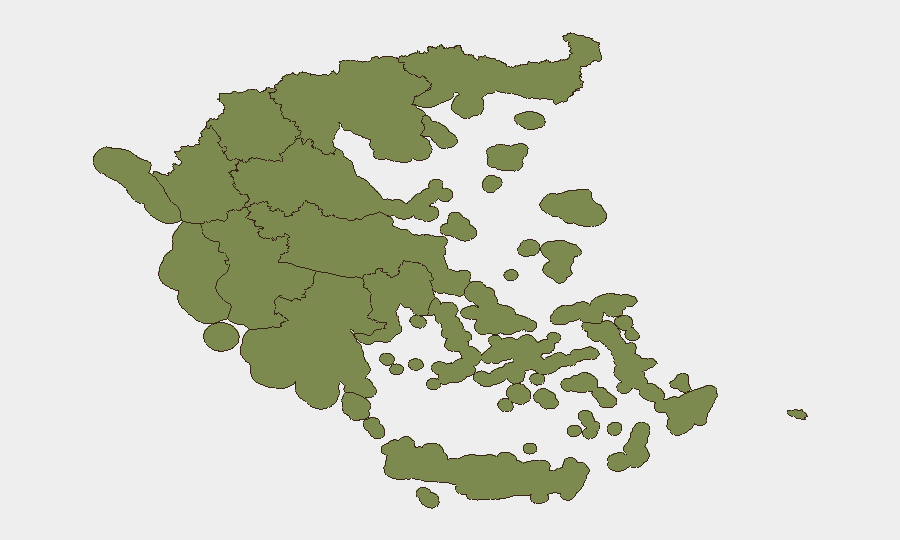
Situation Summary
Greece faces a compound security picture dominated by political violence, active criminal investigations, and natural hazards. Counterterrorism operations in Athens continue following July 1 bombings and arrests spanning both current and historical attacks; simultaneously, wildfires and a recent moderate earthquake in the Peloponnese are disrupting infrastructure and communities. Central Greece's disproportionately high risk score (31.5) reflects concentrated threat activity, while Attica (Athens and surroundings) remains a secondary but significant focus. The trajectory indicates sustained law-enforcement intensity rather than deescalation.
Key Developments
- Athens, July 10–12 – Greek counterterrorism police arrested three suspects in connection with a series of bomb attacks against New Democracy party members that occurred July 1, which killed one and injured four. A separate arrest of two suspects in connection with a 2010 firebomb attack on a Marfin bank (three killed) was also reported in the last 48 hours, signaling renewed prosecutorial focus on political violence.
- Thessaloniki, July 12 – A prosecutor filed homicide charges against three individuals over a fatal arson attack that killed Vagia Nestora; charging decision reported within the last 24–48 hours and reflects ongoing serious criminal proceedings in the city.
- Thessaloniki, July 12 – A Ryanair aircraft en route to Memmingen, Germany experienced rapid depressurization after a window panel partially dislodged in flight. The passenger cabin was compromised and the aircraft returned to Greece for emergency landing. No fatalities reported, but the incident underscores aviation safety risks and potential operational disruptions.
- Northern Greece, July 12 – Intensifying wildfires prompted evacuations across multiple locations; firefighting operations continue on multiple fronts with ongoing disruption to affected communities and transport corridors.
- Laconia, Peloponnese, July 12 (late) – A magnitude 3.8 earthquake struck near Asopos; no major damage or casualties immediately reported, but relevant to infrastructure stability and transport-route risk assessment in the region.
Highest-Risk Areas
Central Greece's composite risk score of 31.5—nearly four times that of Attica (9.7)—is the dominant driver of national threat ranking. This disparity reflects concentrated political violence, arson, and criminal activity centered on Thessaloniki and surrounding areas. Attica remains secondary but significant due to sustained counterterrorism operations and bomb-attack investigations in Athens. The Peloponnese (6.0) adds moderate risk from seismic activity and infrastructure vulnerability. All other regions score below 3.0 and pose minimal acute threat to corporate personnel and assets, though natural hazards (wildfire, seismic) warrant routine monitoring in northern zones.
How GeoBit Would Assist
Security teams should deploy AOI Monitoring & Early Warning on Thessaloniki and Athens to track protest activity, arrest developments, and police operations in real time via event feeds and Telegram/X OSINT. Network & Actor Analysis would map relationships among arrested suspects and ongoing prosecutorial targets to anticipate secondary arrests or retaliation. Routing & Network Analysis enables identification of alternate travel routes and venue access around active crime scenes and wildfire zones, while Satellite & Imagery analysis provides current visibility of evacuation boundaries and infrastructure damage in northern Greece.
7-Day Outlook
Political-violence investigations and prosecutions are likely to continue at current intensity, with possible secondary arrests or charges emerging as cases develop. Wildfire operations in the north may persist through the week depending on weather and firefighting capacity, creating localized transport and personnel disruption. No imminent escalation is signaled, but volatility around court appearances and media reporting on the July 1 bombings may drive episodic tension in Athens.
Highest-Risk Areas — Ranked
| # | State / Region | Risk |
|---|---|---|
| 1 | Central Greece | 31.5 |
| 2 | Attica | 9.7 |
| 3 | Peloponnese Region | 6 |
| 4 | South Aegean | 2.8 |
| 5 | Western Macedonia | 1.5 |
| 6 | Central Macedonia | 1.5 |
| 7 | Eastern Macedonia and Thrace | 1.5 |
| 8 | Western Greece | 1.5 |
| 9 | Thessaly | 1.5 |
| 10 | Autonomous Monastic State of the Holy Mountain | 1.5 |
| 11 | Northern Aegean | 1.5 |
| 12 | Crete | 1.5 |
Sources
Previous Daily Briefs
A new Greece brief is written every day — each with its own risk map and downloadable CSV. Here's the last week; use the calendar to go further back.
📅 Browse every day by calendar →
Highlighted days have a brief. Tap a day for that day's map & analysis, or “csv” for that day's dataset ($5).
Atlas — our AI intelligence desk — emails them this snapshot personally. Nothing else, no list.