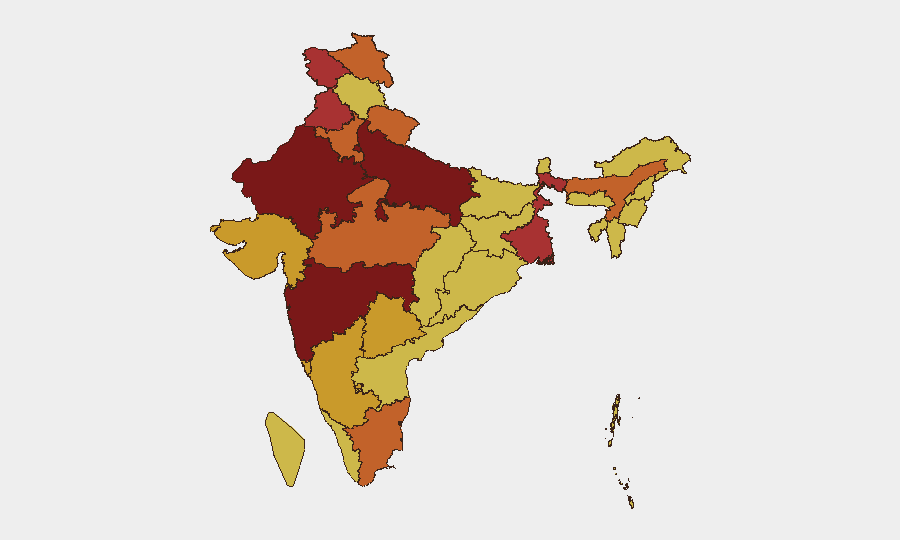
Situation Summary
India remains the third-highest-threat environment globally, with 1,090 tracked security events as of 1 July 2026. The current threat landscape is shaped by persistent terrorism concerns in Kashmir and the northwest, elevated diplomatic tensions with Pakistan (particularly regarding regional airstrikes and cross-border security), and dispersed civil-unrest signals across major urban centers. The risk profile is stable but tense, with near-term volatility concentrated in border states and pilgrimage-route corridors rather than widespread destabilization.
Key Developments
- Kathua, Jammu & Kashmir – 30 June 2026: Police arrested a "top terror facilitator" for Pakistani terrorist networks allegedly supporting logistics ahead of the Amarnath Yatra pilgrimage. Counter-terror deployments and enhanced security checkpoints are now active on pilgrimage routes in Jammu region.
- New Delhi (Foreign Ministry) – 30 June 2026: Foreign Secretary Vikram Misri dismissed reports of Track-2 dialogue with Pakistan as unofficial, reaffirming diplomatic rigidity and signaling no near-term diplomatic thaw on cross-border issues.
- New Delhi (MEA Statement) – 29–30 June 2026: India's Ministry of External Affairs publicly condemned Pakistan's recent air strikes in Afghanistan, citing "huge civilian casualties" and flagging regional instability as a concern for cross-border security posture.
- Off Mangaluru Coast, Karnataka – 29 June 2026: Indian Coast Guard conducted a search-and-rescue operation, extracting six crew from fishing vessel *Manju Matha* after hull damage in rough seas; survivors transferred to New Mangalore port, indicating localized maritime emergency-response activity.
- Maharashtra – 30 June 2026: A physical assault incident was recorded, consistent with ongoing civil-order pressures in the highest-risk state.
- Sikh and student-related disapproval signals – 28 June 2026: Open-source monitoring detected community disapproval events, suggesting underlying social friction in Punjab and university areas, though no large-scale unrest materialized in the 48-hour window.
Highest-Risk Areas
Maharashtra (risk score 100) and Delhi (92) drive the composite threat ranking, reflecting concentrated urban density, mass-migration corridors, and political sensitivity. Uttar Pradesh, Rajasthan, and Jammu & Kashmir (scores 81.7–78.3) add persistent terrorism, inter-communal tensions, and border-security pressures. The northern tier—Punjab, Uttarakhand, Ladakh, and Haryana—reflects religious-pilgrimage volatility and regional separatism legacies. Collectively, the top five states account for the majority of tracked events; corporate and NGO operations in these zones face elevated exposure to both deliberate security threats and secondary disruption (checkpoints, curfews, route closures).
How GeoBit Would Assist
Intel Sweep and OSINT fusion across social media, news feeds, and Telegram channels enable rapid detection of emerging threats (e.g., pre-attack chatter, community mobilization) before incidents scale. AOI (Area-of-Interest) Monitoring with persistent alerting on Maharashtra, Delhi, Jammu & Kashmir, and pilgrimage corridors provides 24/7 early warning of security incidents, protest activity, and checkpoint deployments affecting staff mobility. Routing & Network Analysis supports real-time alternative journey planning when primary corridors (Amarnath Yatra routes, border crossings, key highways) face heightened checks or temporary closure due to counter-terror operations or civil unrest.
7-Day Outlook
Enhanced security operations around the Amarnath Yatra are expected to persist through early July, with tightened checkpoints and potential minor delays on Jammu-region routes. Diplomatic tension with Pakistan is unlikely to escalate to direct military action in the near term, but cross-border terrorism risk remains elevated. Localized civil-order incidents and protest activity should be monitored in Maharashtra, Delhi, and Punjab, with no indication of national-scale destabilization.
Highest-Risk Areas — Ranked
| # | State / Region | Risk |
|---|---|---|
| 1 | Maharashtra | 100 |
| 2 | Delhi | 92 |
| 3 | Uttar Pradesh | 81.7 |
| 4 | Rajasthan | 80.4 |
| 5 | Jammu and Kashmir | 78.3 |
| 6 | Punjab | 77.1 |
| 7 | West Bengal | 76.5 |
| 8 | Madhya Pradesh | 75.8 |
| 9 | Assam | 74.2 |
| 10 | Haryana | 73.9 |
| 11 | Ladakh | 73.7 |
| 12 | Uttarakhand | 73.4 |
Sources
Previous Daily Briefs
A new India brief is written every day — each with its own risk map and downloadable CSV. Here's the last week; use the calendar to go further back.
📅 Browse every day by calendar →
Highlighted days have a brief. Tap a day for that day's map & analysis, or “csv” for that day's dataset ($5).