Situation Summary
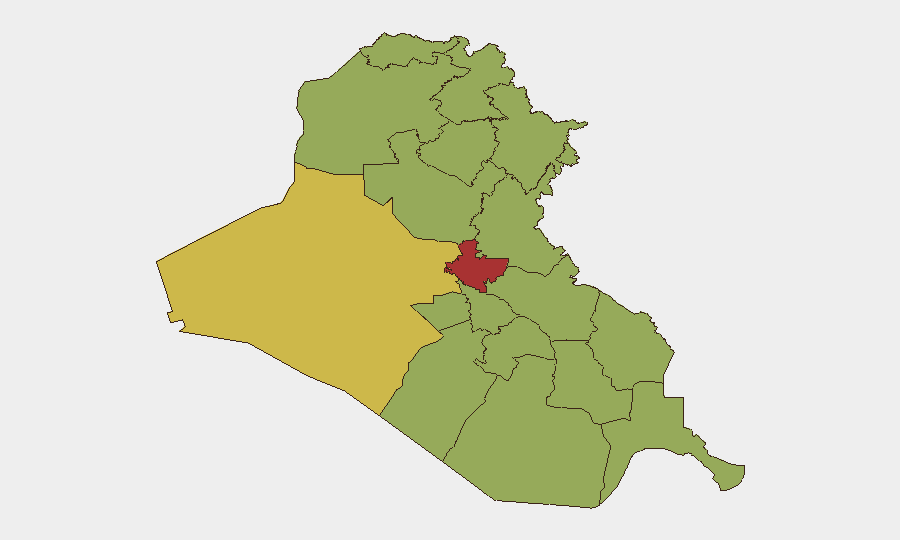
Iraq's security environment has deteriorated markedly over the past 48 hours, marked by a sharp escalation in regional military posturing, cross-border tensions, and internal governance instability. Baghdad Governorate remains the focal point of risk (79.8), with cascading conventional military exchanges reported between Iraq, Iran, and other regional actors as of 20 June. A high-profile security leadership reshuffle on 19 June signals Baghdad's attempt to reassert central control over armed factions amid rising factional fragmentation and external pressure. The composite national threat score of 71 reflects this acute phase.
Key Developments
- Baghdad Governorate, 20 June: Multiple conventional military force incidents reported involving Iraqi state forces; simultaneous reports of physical assault between Iraqi and Iranian actors indicate direct bilateral escalation beyond rhetoric.
- Iraq–Iran Border, 20 June: Confirmed reports of conventional military force exchanges (Iran vs. Iraq, Iraq vs. Iran) within a 24-hour cycle, alongside physical assault incidents, suggesting active cross-border military activity or incursion.
- Al-Basra Governorate, 20 June: Conventional military force incident recorded; southern Iraq has historically served as a staging ground for Iranian-backed militia operations and warrants close monitoring.
- Iraq–Kuwait Border, 20 June: Conventional military force activity reported involving Iraqi and Kuwaiti actors, indicating potential border-area instability or territorial posturing.
- Baghdad Security Leadership, 19 June: Prime minister conducted surprise reshuffle of top security officials, removing senior figures in an apparent push to centralize control and reduce armed-faction autonomy—a governance shift with implications for internal security coherence and inter-factional relations.
- U.S.–Iraq Military Engagement, 19 June: Small arms combat reported involving U.S. and Iraqi forces, reflecting continued tension within the U.S.–Iraq security partnership and possible uncontrolled militia activity.
- Diplomatic Signal, 20 June: A "Reduce Relations" event recorded, suggesting formal diplomatic deterioration; concurrent with military escalation, this indicates a breakdown in de-escalation channels.
Highest-Risk Areas
Baghdad Governorate (79.8) dominates the risk landscape and serves as the center of gravity for national security. Its elevated score reflects the convergence of political power, security leadership turbulence, conventional military incidents, and exposure to cross-border Iranian activity. Al-Anbar Governorate (63.9) remains the second-highest-risk zone, historically linked to militant and tribal activity; recent military force reports underscore its continued volatility. The remaining ten governorates cluster at 49.8–50.3, indicating a broad geographic risk floor across the country. This pattern suggests that while Baghdad faces acute, compound threats, risk is diffused nationally—critical for organizations operating outside the capital.
How GeoBit Would Assist
Security teams should deploy Intel Sweep and global event-feed monitoring paired with X/Twitter and Telegram OSINT to capture real-time faction communications, military statements, and cross-border militia signaling. Battle mapping and force-structure tracking will clarify the disposition and intent of Iraqi state units, Iranian-backed militias, and U.S. forces to forecast flashpoint escalation. AOI (Area-of-Interest) monitoring and early-warning alerting on Baghdad, Al-Basra, and border zones will provide persistent watch and threshold-based notifications before incidents affect personnel or assets.
7-Day Outlook
Military posturing and cross-border incidents are expected to persist over the next 7 days absent rapid diplomatic intervention. Baghdad's security reshuffle may temporarily reduce governance coordination, increasing the risk of uncontrolled militia action. Organizations should assume heightened volatility in Baghdad and the southern belt and consider contingency activation for non-essential personnel in high-risk zones.
Highest-Risk Areas — Ranked
| # | State / Region | Risk |
|---|---|---|
| 1 | Baghdad Governorate | 79.8 |
| 2 | Al-Anbar Governorate | 63.9 |
| 3 | Al-Basra Governorate | 50.3 |
| 4 | Babil Governorate | 49.8 |
| 5 | Wasit Governorate | 49.8 |
| 6 | Al-Qadisiyah Governorate | 49.8 |
| 7 | Dhi Qar Governorate | 49.8 |
| 8 | Al-Muthanna Governorate | 49.8 |
| 9 | Maysan Governorate | 49.8 |
| 10 | Al-Najaf Governorate | 49.8 |
| 11 | Saladin Governorate | 49.8 |
| 12 | Erbil Governorate | 49.8 |
Sources
Previous Daily Briefs
A new Iraq brief is written every day — each with its own risk map and downloadable CSV. Here's the last week; use the calendar to go further back.
📅 Browse every day by calendar →
Highlighted days have a brief. Tap a day for that day's map & analysis, or “csv” for that day's dataset ($5).