Situation Summary
Israel remains under active multi-front threat as of 23 June 2026, with a composite threat score of 100 (rank #1 globally). The conflict continues to drive 544 tracked events, with tensions evident across military, civilian, and diplomatic channels. Recent signals include internal Israeli friction (Israeli-on-Israeli military and political events on 21 June), cross-border fire with Lebanon, and strained U.S.–Israel relations. The trajectory remains volatile with no clear de-escalation indicators.
Key Developments
- North District / Lebanon border (20–21 June): Hezbollah conducted overnight rocket fire (50+ rounds reported) toward northern Israel; Israeli strikes in southern Lebanon reportedly killed 20+ in the Nabatieh area during the same period, signaling continued cross-border exchange despite ceasefire claims.
- Northern front (20–22 June): Ceasefire on the Israel–Lebanon border was reported holding with no new Hezbollah claims of attacks on Israeli forces and no Israeli casualties in southern Lebanon for >24 hours as of 22 June—a stability signal but fragile.
- Internal Israeli military / political tension (21 June): Signals include Israeli-on-Israeli conventional military force events and public disapproval statements, suggesting internal command or policy disagreements over operational scope or conduct.
- Israel–U.S. diplomatic friction (21–22 June): U.S. rejected an Israeli position (21 June); Israeli officials threatened or made confrontational statements toward the U.S. (22 June), reflecting strain on the allied relationship and potential constraints on Israeli operational freedom.
- Militant activity (21 June): Militant-on-Israeli conventional military force event recorded, indicating active armed opposition operations beyond the northern front.
- Public health alert (20 June): A suspected Ebola case was transferred to isolation in Israel, representing a secondary but notable duty-of-care consideration for personnel in healthcare and crowded settings.
Highest-Risk Areas
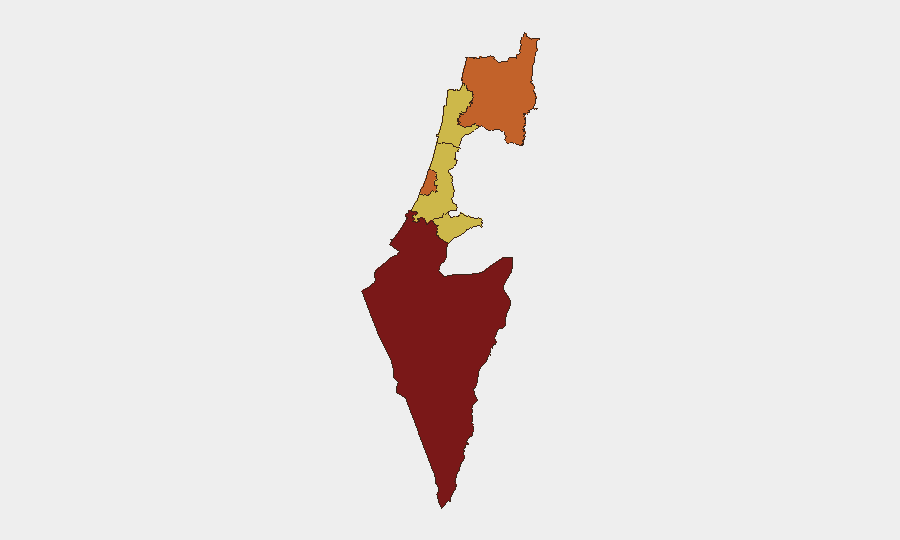
The South District dominates the risk landscape (score 100), driven by ongoing active military operations and militant activity. The North District (73.5) and Tel-Aviv District (73.3) follow closely, with the north affected by Lebanon border fire and the Tel-Aviv metro by accumulated militant and internal security pressure. Haifa, Center, and Jerusalem Districts (70.1–70.9) face elevated but slightly lower composite risk, reflecting secondary exposure to cross-border effects, internal instability, and protest/political activity. Personnel and assets in the South and North face the most immediate physical threat; Tel-Aviv's risk stems from density, symbolic targeting, and social fracture.
How GeoBit Would Assist
Corporate security and duty-of-care teams should deploy AOI Monitoring & Early Warning on the South, North, and Tel-Aviv Districts to receive real-time alerts on military movement, rocket fire, and militant activity. Intel Sweep and X/Telegram OSINT capabilities enable continuous tracking of Israeli military statements, militant claims, and diplomatic escalation language, allowing teams to anticipate operational changes before they occur. Conflict & Military (force structure and weapons-capability tracking) and Network & Actor Analysis provide insight into militant group capacity and Israeli command intentions, supporting scenario planning and evacuation decision-making.
7-Day Outlook
The northern border ceasefire may hold tactically but remains contingent on U.S.–Israel diplomatic resolution and Hezbollah restraint; any violation risks rapid escalation. Internal Israeli political and military friction over operational conduct suggests continued policy turbulence. South District threat levels are likely to remain at or near current intensity over the next 7 days, with no imminent broad de-escalation expected.
Highest-Risk Areas — Ranked
| # | State / Region | Risk |
|---|---|---|
| 1 | South District | 100 |
| 2 | North District | 73.5 |
| 3 | Tel-Aviv District | 73.3 |
| 4 | Haifa District | 70.9 |
| 5 | Center District | 70.1 |
| 6 | Jerusalem District | 70 |
Sources
Previous Daily Briefs
A new Israel brief is written every day — each with its own risk map and downloadable CSV. Here's the last week; use the calendar to go further back.
📅 Browse every day by calendar →
Highlighted days have a brief. Tap a day for that day's map & analysis, or “csv” for that day's dataset ($5).