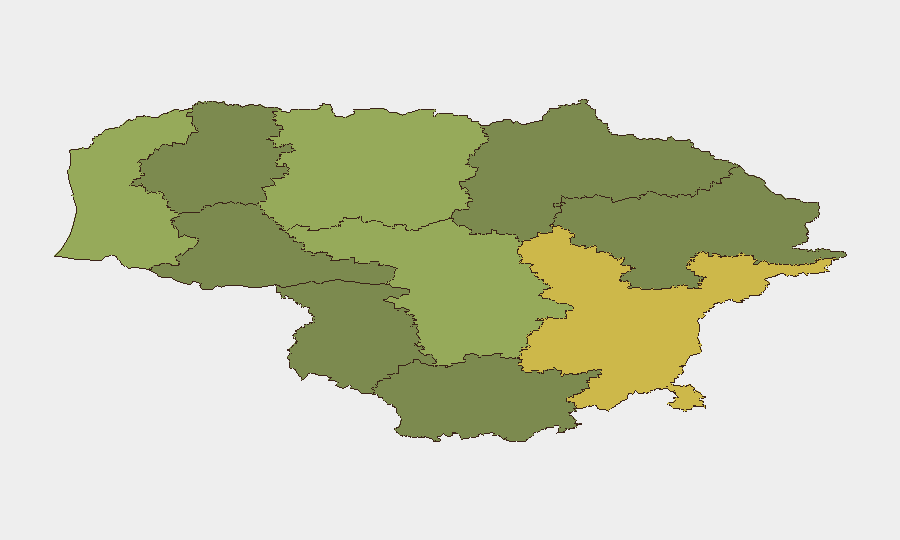
Situation Summary
Lithuania remains a low-threat environment at the national level (global rank #122, composite score 10), with no discrete security incidents recorded in the current tracking window. However, institutional credibility in border management has been tested by ongoing investigations into migrant-related violence and alleged reporting failures, while broader regional discourse—including drone incursions over neighbouring Latvia and Russian sabotage warnings—underscores persistent cross-border instability and potential spillover risk. Vilnius County dominates sub-national risk exposure, driven by governance concentration and proximity to Belarusian border pressures.
Key Developments
- Border Guard Service leadership change – Vilnius, 17 Aug 2026. Interior Minister Martynas Katelynas announced the resignation of State Border Guard Service (VSAT) head Rustamas Liubajevas following scrutiny over how the service reported and handled a violent migrant incident at the Kapčiamiestis border post in late July. A deputy assumes interim command while criminal and disciplinary investigations continue, creating a potential governance and operational gap in border management.
- Public sex-offender registry proposal advances – Vilnius, 17 Aug 2026. Justice Ministry renewed calls for a national public registry of individuals convicted of sexual offences against children, following recent prosecutions of two priests. A special parliamentary meeting on 17 Aug produced a formal proposal responding to high-profile cases, signalling legislative movement on a sensitive security and child-protection issue.
- Investigation escalation into border-guard incident – Kapčiamiestis/Varėna, ongoing as of 16–17 Aug. Prosecutors expanded their examination of the 26–27 July migrant attack at the Kapčiamiestis border post, now including scrutiny of border guard officers' own conduct. Allegations centre on whether violence and coercion (migrants attempting to drag an officer into Belarus) were downplayed or concealed in initial reporting; this remains a live investigative and institutional-integrity matter.
- Regional drone and provocation threat discourse – Lithuania/Latvia border, 17 Aug. Prime Minister Mindaugas Sinkevičius publicly acknowledged Lithuanian intelligence warnings of possible Russian false-flag drone provocations in the Baltic region, following a drone shot down over Latvia on 14 Aug by NATO jets. Explicitly framed as a destabilization risk and potential spillover threat to Lithuanian airspace and border security.
- Russia-linked sabotage network reporting – multi-location Lithuania, current as of 17 Aug. Media investigation into alleged Russia-linked sabotage involving filming drones and arson attacks on vehicles remains under active public and journalistic scrutiny, sustaining elevated threat perception around foreign intelligence operations and critical infrastructure vulnerability.
Highest-Risk Areas
Vilnius County (risk score 68) and Kaunas County (58) account for the majority of sub-national risk, reflecting administrative concentration, population density, and Vilnius's role as the seat of governance during an institutional credibility challenge at the border service. Klaipeda County (52) and Siauliai County (42) maintain elevated exposure due to their proximity to the Belarusian frontier and sensitivity to migrant-route and cross-border infiltration pressures. The southern border zone (Varėna/Kapčiamiestis) remains operationally stressed despite lower composite risk scoring, owing to the active investigation and leadership transition in border management.
How GeoBit Would Assist
Intel Sweep and OSINT Fusion & Corroboration capabilities would enable continuous monitoring of border-service communications, prosecutorial filings, and regional security announcements to track the investigation's direction and leadership succession timeline. AOI Monitoring & Early Warning on Vilnius, Varėna, and the Latvia border would flag escalations in drone activity, migrant incidents, or official response changes. Network & Actor Analysis would map relationships among prosecutorial, ministerial, and border-service stakeholders to anticipate governance impacts on operational capability.
7-Day Outlook
The border-service leadership vacuum and ongoing investigation are likely to create 7–10 days of organizational uncertainty and potential operational friction in migrant-incident reporting and border enforcement. Regional drone and sabotage discourse will remain elevated pending any incident recurrence or formal NATO/Lithuanian threat clarification. Expect continued media and parliamentary scrutiny of child-protection and institutional-accountability issues, with limited direct security impact but sustained reputational and governance focus.
Highest-Risk Areas — Ranked
| # | State / Region | Risk |
|---|---|---|
| 1 | Vilnius County | 68 |
| 2 | Kaunas County | 58 |
| 3 | Klaipeda County | 52 |
| 4 | Siauliai County | 42 |
| 5 | Panevezys County | 38 |
| 6 | Taurage County | 35 |
| 7 | Utena County | 33 |
| 8 | Alytus County | 32 |
| 9 | Telsiai County | 28 |
| 10 | Marijampole County | 25 |
Sources
Previous Daily Briefs
A new Lithuania brief is written every day — each with its own risk map and downloadable CSV. Here's the last week; use the calendar to go further back.
- August 15, 2026
- August 13, 2026
- August 11, 2026
- August 9, 2026
- August 7, 2026
- August 5, 2026
- August 4, 2026
📅 Browse every day by calendar →
Highlighted days have a brief. Tap a day for that day's map & analysis, or “csv” for that day's dataset ($5).
Atlas — our AI intelligence desk — emails them this snapshot personally. Nothing else, no list.