Situation Summary
Mauritania remains a low-frequency but persistently fragmented threat environment, ranked #135 globally with composite threat score 7. The security picture is dominated by transnational criminality (drug trafficking, smuggling) in the capital and regional hubs, combined with endemic instability in the eastern border zones. No major incident activity has been recorded in the current 24-48 hour window; law-enforcement operations against trafficking networks represent routine criminal-justice activity rather than emerging acute risk.
Key Developments
- Nouakchott West, Nouakchott — 2026-08-11/12 — Mauritanian gendarmerie dismantled a drug-trafficking network operating in the capital following an intelligence-led investigation. Multiple arrests and asset seizures were reported by domestic outlets.
- Atar, Adrar region — 2026-08-11/12 — Gendarmerie announced dismantling of two drug-distribution networks with 13 arrests and seizures of cannabis resin and Indian cannabis. This operation reflects continued law-enforcement activity against organized trafficking in the resource-rich but volatile northeast.
- No active protest or civil unrest confirmed — The most recent civil disturbance on record in the open-source window occurred 2026-07-30 in Nouakchott (outside the current 24-48 hour assessment period). No new incidents of political violence, infrastructure disruption, or mass mobilization have been confirmed.
- Mali–Mauritania diplomatic file remains diplomatic — Mauritania continues engagement with Mali on release of detained nationals (incident date 2026-08-03); no escalation or cross-border security spillover has been reported in the last 48 hours.
Highest-Risk Areas
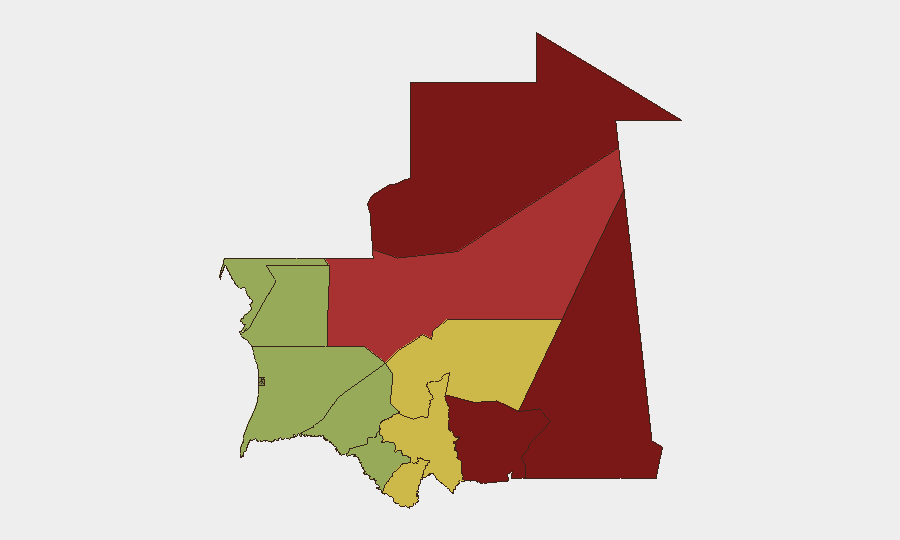
Eastern and southern border regions drive the country's composite risk profile. Tiris Zemmour (risk 95) and Hodh Ech Chargui (risk 85) dominate because of persistent ungoverned-space vulnerability, historical militant activity, and porous frontiers with Mali and Algeria; organized trafficking networks exploit these zones. Hodh El Gharbi (risk 80) and Adrar (risk 78) show similar patterns. The capital Nouakchott and coastal regions remain lower-risk but remain vectors for transnational crime and require monitoring. No single acute flashpoint has emerged, but fragmentation across these regions creates operational friction for corporate mobility and supply-chain continuity.
How GeoBit Would Assist
Teams with Mauritania operations would employ AOI Monitoring & Early Warning to maintain persistent watch on the highest-risk regions (Tiris Zemmour, Hodh Ech Chargui) and flag any surge in militant, trafficking, or political activity. Intelligence & OSINT (multi-language search, Telegram/X monitoring, entity extraction) would enable real-time tracking of organized-crime networks, enforcement actions, and regime-stability signals. Routing & Network Analysis would support secure travel planning for personnel and supply routes, avoiding high-risk corridor concentration, while Conflict & Military mapping and Network & Actor Analysis would clarify the operational landscape of non-state actors and trafficking cells.
7-Day Outlook
No acute deterioration is expected over the next seven days. Ongoing law-enforcement operations against trafficking indicate functional state capacity in the capital; however, fragility in the east and south remains structural. Corporate risk management should maintain baseline heightened vigilance for eastern-region travel and assume persistent transnational criminality as the primary operational constraint rather than anticipate political upheaval.
Highest-Risk Areas — Ranked
| # | State / Region | Risk |
|---|---|---|
| 1 | Tiris Zemmour | 95 |
| 2 | Hodh Ech Chargui | 85 |
| 3 | Hodh El Gharbi | 80 |
| 4 | Adrar | 78 |
| 5 | Tagant | 68 |
| 6 | Guidimaka | 65 |
| 7 | Assaba | 62 |
| 8 | Gorgol | 58 |
| 9 | Trarza | 55 |
| 10 | Inchiri | 52 |
| 11 | Brakna | 48 |
| 12 | Dakhlet Nouadhibou | 45 |
Sources
Previous Daily Briefs
A new Mauritania brief is written every day — each with its own risk map and downloadable CSV. Here's the last week; use the calendar to go further back.
📅 Browse every day by calendar →
Highlighted days have a brief. Tap a day for that day's map & analysis, or “csv” for that day's dataset ($5).
Atlas — our AI intelligence desk — emails them this snapshot personally. Nothing else, no list.