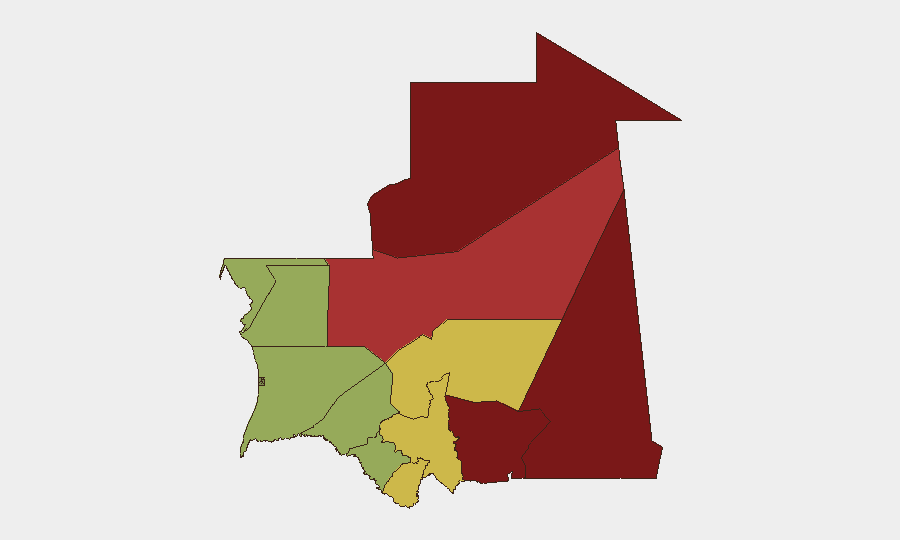
Situation Summary
Mauritania's overall threat environment remains moderate (global rank #138, composite score 7.0) with no confirmed security incidents documented in open reporting for 15–16 August 2026. The country faces persistent structural risks concentrated in the eastern and northern border regions—chiefly Tiris Zemmour, Hodh Ech Chargui, and Hodh El Gharbi—where transnational criminal networks and extremist groups exploit porous frontiers and limited state presence. Recent activity (through 13 August) included a drug-trafficking network dismantling in Nouadhibou and a traffic fatality in Néma; the security trajectory remains one of localized instability rather than acute nationwide deterioration.
Key Developments
- No new, clearly documented security incidents have surfaced in open-source reporting for 15–16 August 2026. Web and social channels show no reliably sourced Mauritania-specific unrest, crime, infrastructure failure, or travel-risk events in the last 24–48 hours.
- Background context (11–13 August, outside current window): Mauritanian gendarmerie dismantled a significant drug-trafficking operation and arrested its leader in Nouadhibou (14 August); a traffic incident involving an ATTM public-works truck struck a police control post in Néma, resulting in one fatality; and a political party criticized ongoing electricity shortages in the capital region. These do not constitute current (24–48h) developments but reflect recent operational and infrastructure stressors.
- Regional activity outside Mauritania (15–16 August): Reporting has focused on Morocco–Ceuta migration operations and maritime incidents in the Strait of Hormuz; no cross-border spillover into Mauritanian territory has been reported.
Highest-Risk Areas
The eastern and northern regions dominate risk exposure. Tiris Zemmour (score 95) and Hodh Ech Chargui (85) face the most acute threats from transnational crime, irregular migration, and extremist activity; Hodh El Gharbi (80) and Adrar (78) present similar vulnerabilities tied to porous Mali and Algeria borders and weak state capacity. These regions account for the majority of Mauritania's composite risk; southern and western zones (Brakna, Dakhlet Nouadhibou) remain lower-risk but warrant continued monitoring for spillover. The drug-trafficking dismantling in Nouadhibou and checkpoint incidents in Néma signal that security operations are active, but the underlying conditions—underfunded frontier policing, competing jurisdictions, and limited infrastructure—persist.
How GeoBit Would Assist
Teams with personnel or assets in Mauritania should employ AOI Monitoring & Early Warning on the highest-risk regions (especially Tiris Zemmour and Hodh Ech Chargui) to detect emerging incidents in real time and alert duty officers before mainstream media coverage. Intel Sweep, multi-language search, and X/Telegram OSINT would provide persistent visibility of criminal and extremist network activity, particularly in border zones where official reporting gaps are wide. Routing & Network Analysis can identify secure alternative routes for supply chains and personnel movement, avoiding known conflict and trafficking corridors. Conflict & Military and Entity Extraction capabilities help track cross-border militant groups and organized crime hierarchies.
7-Day Outlook
No acute security escalation is anticipated in the next seven days based on current signals. However, the transition period from August into September historically sees increased cross-border trafficking and migration pressure as seasonal patterns shift. Continuous monitoring of the Hodh and Tiris Zemmour regions remains essential for early detection of any deterioration.
Highest-Risk Areas — Ranked
| # | State / Region | Risk |
|---|---|---|
| 1 | Tiris Zemmour | 95 |
| 2 | Hodh Ech Chargui | 85 |
| 3 | Hodh El Gharbi | 80 |
| 4 | Adrar | 78 |
| 5 | Tagant | 68 |
| 6 | Guidimaka | 65 |
| 7 | Assaba | 62 |
| 8 | Gorgol | 58 |
| 9 | Trarza | 55 |
| 10 | Inchiri | 52 |
| 11 | Brakna | 48 |
| 12 | Dakhlet Nouadhibou | 45 |
Sources
Previous Daily Briefs
A new Mauritania brief is written every day — each with its own risk map and downloadable CSV. Here's the last week; use the calendar to go further back.
- August 14, 2026
- August 12, 2026
- August 10, 2026
- August 8, 2026
- August 6, 2026
- August 5, 2026
- August 4, 2026
📅 Browse every day by calendar →
Highlighted days have a brief. Tap a day for that day's map & analysis, or “csv” for that day's dataset ($5).
Atlas — our AI intelligence desk — emails them this snapshot personally. Nothing else, no list.