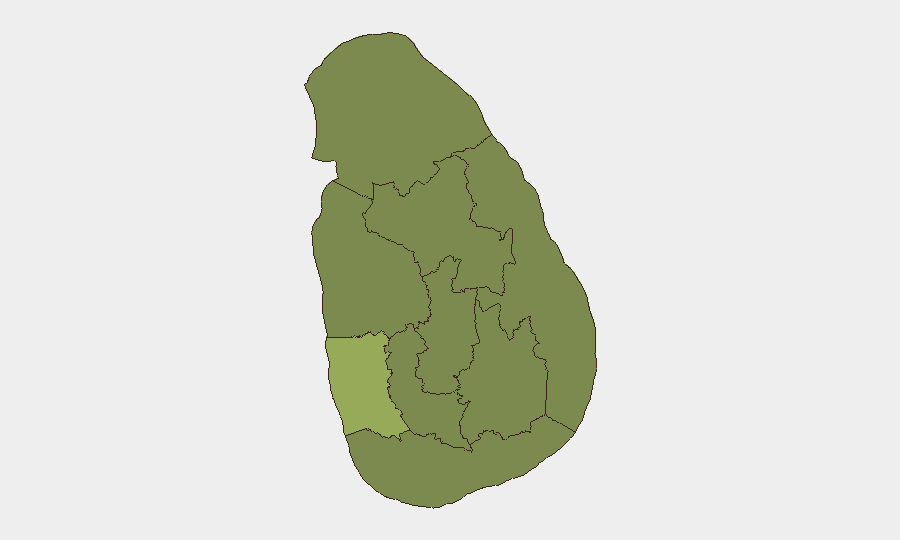
Situation Summary
Sri Lanka remains at moderate composite threat level (rank #49 globally, score 36/100) with dispersed security risks across multiple domains: demonstrations, terrorism, crime, and institutional friction. The Western Province—encompassing Colombo and the commercial heartland—carries significantly elevated risk (55.1) relative to all other regions, driven by political activity, business-sector tension, and judicial-system stress. No major escalation in the last 24–48 hours has been independently confirmed; however, recent signals point to ongoing institutional strain and law-enforcement activity.
Key Developments
Recent event signals indicate sustained institutional and governance friction rather than discrete security incidents:
- 2026-07-04 | Judicial System / Colombo. Public statements and rejection orders from the Chief Justice and government officials signal ongoing tension over judicial independence and due process, consistent with known detention and custodial-treatment controversies. Operational impact on corporate compliance and rule-of-law environment remains fluid.
- 2026-07-04 | Police Investigation / Nationwide. Police investigation signals continue, reflecting routine law-enforcement activity; no specific criminal event has been independently time-stamped to the last 48 hours in available sources.
- 2026-07-02 | Government Investigation / Nationwide. Government investigation activity reported; context and scope unclear from available intelligence.
- 2026-07-02 | Criminal Investigation / Business Sector. Reported criminal investigation involving companies; details insufficient to assess impact on specific corporate operations.
- Overseas Deployment (framed as imminent, not a domestic incident). Sri Lanka's announced deployment of 1,132 military and police personnel to Haiti under UN auspices may reduce domestic security-force capacity in coming weeks, potentially affecting response times to routine incidents.
- Standing Advisory Risks (ongoing, not new). Canadian and UK travel advisories remain active, citing persistent risk of demonstrations, terrorism, sudden road closures, and petty-to-serious crime across the country. These reflect structural, not acute, risk.
Highest-Risk Areas
The Western Province dominates the risk landscape with a composite score of 55.1—nearly 1.6× the national average and >60% higher than the next-ranked region (Northern Province, 34.8). This concentration reflects Colombo's role as the political, commercial, and judicial center; recent signals of institutional friction, business-sector disapproval, and government-judicial tension are localized there. Northern Province ranks second but at notably lower risk (34.8), with residual conflict-related tensions and criminal activity. All other provinces cluster between 25–29, indicating a relatively even baseline of crime, petty unrest, and routine law-enforcement activity outside the capital.
How GeoBit Would Assist
AOI Monitoring & Early Warning on Colombo and the Western Province would enable corporate security teams to detect demonstrations, roadblocks, and police activity in real time via OSINT fusion (X, local media, police/military channels) and automated alerting. Routing & Network Analysis would support rapid alternative-journey planning for personnel or supply chains disrupted by checkpoints or closures. Risk & Threat Assessment with entity-network analysis would track judicial and government actors signaling institutional friction, allowing in-house compliance and legal teams to anticipate regulatory or due-process shifts affecting operations.
7-Day Outlook
No acute escalation is forecast in the immediate term. Institutional tension over judicial independence will likely persist at current levels, and routine crime and demonstrations remain probable across the Western Province and other urban centers. The announced military/police deployment to Haiti may slightly reduce domestic incident-response capacity by late July, marginally increasing response times to security events—a secondary consideration for corporate operations but relevant to evacuation or crisis-management planning.
Highest-Risk Areas — Ranked
| # | State / Region | Risk |
|---|---|---|
| 1 | Western Province | 55.1 |
| 2 | Northern Province | 34.8 |
| 3 | Uva Province | 29 |
| 4 | North Central Province | 26.4 |
| 5 | North Western Province | 25.1 |
| 6 | Central Province | 25.1 |
| 7 | Eastern Province | 25.1 |
| 8 | Sabaragamuwa Province | 25.1 |
| 9 | Southern Province | 25.1 |
Sources
Previous Daily Briefs
A new Sri Lanka brief is written every day — each with its own risk map and downloadable CSV. Here's the last week; use the calendar to go further back.
📅 Browse every day by calendar →
Highlighted days have a brief. Tap a day for that day's map & analysis, or “csv” for that day's dataset ($5).
Atlas — our AI intelligence desk — emails them this snapshot personally. Nothing else, no list.