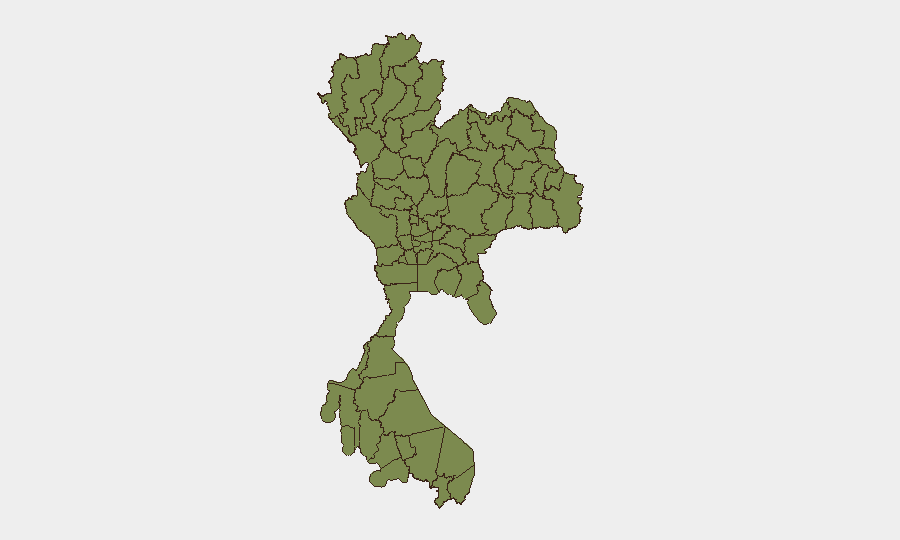
Situation Summary
Thailand remains broadly stable at national level (global rank #68, composite threat score 22) but faces acute localised security pressures in the deep south and routine organised-crime enforcement across major urban centres. A significant armed attack on a paramilitary checkpoint in Narathiwat on 23 July killed five rangers and wounded six civilians, triggering heightened security operations and official designation as a terrorist act. Outside the southern insurgency-affected zone and isolated criminal incidents, the risk environment is geographically fragmented rather than systemic, with infrastructure disruptions (rail, power, water) and emerging fraud threats adding secondary layers of concern for corporate operations.
Key Developments
- Narathiwat province, Ra-ngae district, 23 July evening: Approximately 10 armed assailants attacked Buketa Sami paramilitary checkpoint with gunfire and pipe bombs, killing five rangers and injuring six civilians (including children aged 3 and 10). Attackers stole weapons, body armour and communications equipment before abandoning and burning their vehicle 21 km away. Authorities are investigating the use of motorcycle scouts for intelligence gathering against security forces.
- Narathiwat province, multiple locations, 24 July: Thai security forces launched coordinated manhunt and investigative operations across the province following the checkpoint attack. Prime Minister Anutin and senior officials publicly designated the assault a terrorist act and pledged rapid apprehension of perpetrators, signalling elevated operational tempo in the southern border region.
- Bangkok, Airport Rail Link, 24 July: Full normal service (05:30–00:00) resumed after engineers repaired a faulty track switch at Makkasan/Klong Tan maintenance depot. Service disruption highlighted infrastructure vulnerability in critical transport corridors serving the capital and Suvarnabhumi Airport.
- Multi-province operation, 24 July: Department of Special Investigation dismantled a large illegal Bitcoin mining network linked to Chinese organised crime and corrupt officials under "Operation Silent Vault," seizing approximately 2,000 machines and disrupting an estimated 22 million baht monthly electricity theft. Operation underscores organised-crime penetration of critical infrastructure.
- Bangkok, Huai Khwang area, 23–24 July: Police raided an illegal pub linked to drug distribution, arresting 11 suspects and seizing narcotics and assets. Enforcement action reflects ongoing criminal activity in central Bangkok entertainment districts.
- Northeast provinces (Nakhon Phanom, Mukdahan and others), 23–24 July: Thai authorities issued flood warning for five northeastern provinces following increased water discharge from Laos's Nam Theun 1 dam, projecting Mekong River rise of approximately 1.3 metres. Alert poses short-term risk to low-lying communities and cross-border transport routes.
- Thailand, nationwide, 24 July: New online scam targeting university students and parents using fake overseas exchange programmes reported, with documented losses of up to 700,000 baht per victim. Emerging cyber-fraud trend affecting student population and family finances.
Highest-Risk Areas
Bangkok (risk 33.6) dominates Thailand's threat profile due to concentration of organised crime, infrastructure criticality, and protest/political activity. Chiang Rai Province (24.4) faces persistent drug-trafficking and cross-border criminal networks. The deep south—Narathiwat, Yala, and Pattani—remains the acute flashpoint despite lower sub-national rankings here; the 23 July checkpoint attack exemplifies the insurgency-linked armed threat that drives official security concern and operational tempo. Secondary urban centres (Samut Prakan, Nonthaburi, Phuket) show moderate risk concentrated in drug distribution, petty crime, and infrastructure exposure.
How GeoBit Would Assist
Security teams should deploy AOI Monitoring & Early Warning on Narathiwat, Yala and Pattani provinces to detect emerging attack patterns and force movements; Routing & Network Analysis to plan secure staff transit avoiding checkpoint concentrations; and Intel Sweep (X/Telegram OSINT, multi-language feeds) to track insurgent messaging and recruitment in real time. Conflict & Military capabilities (force-structure, weapons tracking) would provide early intelligence on armed-group capability shifts, while Economic & Trade analysis of the Bitcoin and drug networks would inform operational-security decisions around infrastructure and vendor relationships.
7-Day Outlook
Security operations in the deep south will remain elevated for 7–10 days as authorities pursue the Narathiwat attackers, likely resulting in additional checkpoints and movement restrictions in Narathiwat and Yala. Bangkok and provincial urban centres will continue routine enforcement against organised crime and fraud networks. Absent a major new incident or political trigger, national-level stability is expected to hold; however, the southern insurgency remains capable of striking asymmetrically and should be monitored continuously.
Highest-Risk Areas — Ranked
| # | State / Region | Risk |
|---|---|---|
| 1 | Bangkok | 33.6 |
| 2 | Chiang Rai Province | 24.4 |
| 3 | Trang Province | 11.6 |
| 4 | Samut Prakan Province | 9.4 |
| 5 | Nonthaburi Province | 5.8 |
| 6 | Phuket Province | 5.4 |
| 7 | Lamphun Province | 5.4 |
| 8 | Nakhon Ratchasima Province | 5 |
| 9 | Surat Thani Province | 4.5 |
| 10 | Pathum Thani Province | 4.5 |
| 11 | Ranong Province | 4.1 |
| 12 | Phitsanulok Province | 4.1 |
Sources
Previous Daily Briefs
A new Thailand brief is written every day — each with its own risk map and downloadable CSV. Here's the last week; use the calendar to go further back.
📅 Browse every day by calendar →
Highlighted days have a brief. Tap a day for that day's map & analysis, or “csv” for that day's dataset ($5).
Atlas — our AI intelligence desk — emails them this snapshot personally. Nothing else, no list.