Situation Summary
Turkmenistan remains a low-threat environment relative to global standards (rank #175), with a composite threat score of 4 and 37 tracked events. The country's security posture is characterized by centralized state control and limited transparency rather than acute instability, civil unrest, or active conflict. No credible security incidents, infrastructure failures, or travel-risk escalations have been reported in the past 24–48 hours. The current trajectory reflects structural stability under authoritarian governance, with routine diplomatic and economic activity proceeding as normal.
Key Developments
- No acute incidents reported (4–5 July 2026). Live web research across open-source channels, social media, and news feeds has yielded no corroborated reports of attacks, unrest, arrests, infrastructure failures, or civil disorder in the last 24–48 hours.
- TAPI pipeline cooperation underway. On 5 July 2026, Herat provincial officials met with Turkmen counterparts to discuss acceleration of the Turkmenistan–Afghanistan–Pakistan–India gas pipeline and joint trade exhibitions at the Torghundi–Serhatbat border crossing—a routine diplomatic and economic initiative with no security implications.
- Digital repression remains structural policy. Earlier reporting (not time-stamped to the last 48 hours) documents fines and tightened controls over social media activity; this reflects long-standing regime practice but does not constitute a near-term incident.
- China–Ashgabat diplomatic signal (4 July 2026). A public statement involving China and Ashgabat was flagged in GeoBit event signals; specific content and implications require further monitoring, though no escalation is evident in subsequent reporting.
Highest-Risk Areas
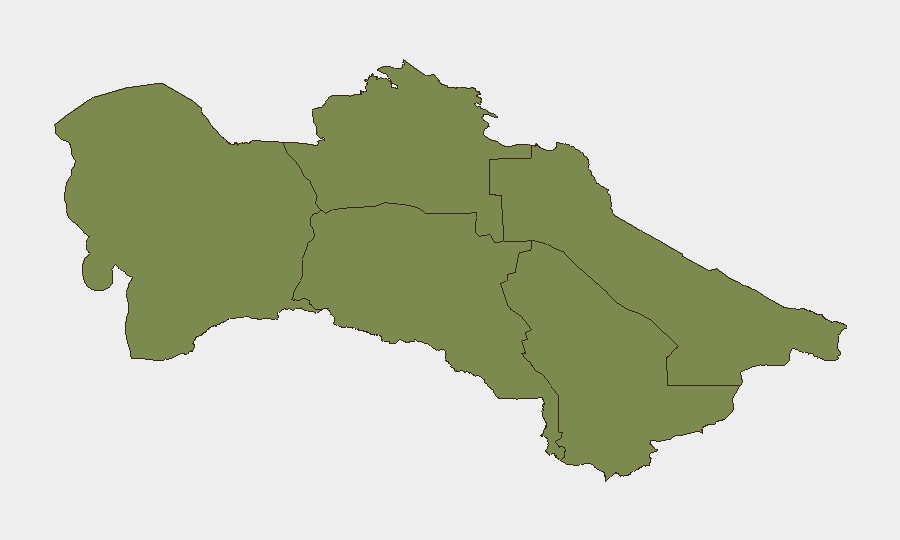
Ashgabat City dominates the sub-national risk ranking at 31.4, reflecting capital-city concentration of political activity, state security apparatus, and international diplomatic presence. The remaining five regions—Dashoguz, Balkan, Lebap, Ahal, and Mary—all register identical risk scores of 1.4, indicating distributed baseline threats without regional hotspots. Ashgabat's elevated risk is attributable to standard capital-city dynamics (government institutions, potential protest sites, expatriate communities) rather than active conflict or instability. For corporate teams, this geography means Ashgabat remains the primary focus for duty-of-care monitoring, while field operations in remote provinces carry lower incident risk but may face logistical or communications constraints.
How GeoBit Would Assist
Corporate security teams with personnel or assets in Turkmenistan should leverage GeoBit's Intel Sweep and global event feeds for real-time incident detection, combined with multi-language OSINT and social media monitoring (X, Telegram) to identify early warning signals of unrest or infrastructure disruption. AOI Monitoring & Early Warning on Ashgabat and critical infrastructure (energy, border crossings, airports) provides persistent alerting; Routing & Network Analysis supports contingency planning for overland travel or supply-chain rerouting around border areas. Regime-stability and sanctions-compliance search help track policy shifts that may affect business operations or visa/export controls.
7-Day Outlook
No imminent escalation is anticipated. Routine diplomatic and economic activity is proceeding normally, and the structural stability under centralized state control is unlikely to shift rapidly. Security teams should maintain standard monitoring protocols, with particular attention to any further signals from the China–Ashgabat engagement and any changes to digital-control or border-crossing policies that could affect personnel movement or supply chains.
Highest-Risk Areas — Ranked
| # | State / Region | Risk |
|---|---|---|
| 1 | Ashgabat City | 31.4 |
| 2 | Dashoguz Region | 1.4 |
| 3 | Balkan Region | 1.4 |
| 4 | Lebap Region | 1.4 |
| 5 | Ahal Region | 1.4 |
| 6 | Mary Region | 1.4 |
Sources
Previous Daily Briefs
A new Turkmenistan brief is written every day — each with its own risk map and downloadable CSV. Here's the last week; use the calendar to go further back.
📅 Browse every day by calendar →
Highlighted days have a brief. Tap a day for that day's map & analysis, or “csv” for that day's dataset ($5).
Atlas — our AI intelligence desk — emails them this snapshot personally. Nothing else, no list.