Situation Summary
Uzbekistan's national security environment remains stable with no confirmed significant incidents reported in the last 24–48 hours. Open-source monitoring and social media surveillance indicate routine activity across major population centers and administrative zones. The country's composite threat score of 3 (rank #184 globally) reflects low acute risk, though sub-national disparities—particularly in the Fergana Valley—warrant continued monitoring. No travel advisories, infrastructure disruptions, or civil unrest have been documented in current reporting windows.
Key Developments
No significant security incidents were confirmed in the last 24–48 hours (26–27 June 2026). Open-source feeds, X/Twitter monitoring, and major news aggregators show no credible reports of:
- Armed clashes, cross-border incidents, or military mobilization
- Public protests, demonstrations, or civil disorder affecting public safety
- Terrorist attacks or politically motivated violence
- Cyber incidents impacting critical infrastructure
- Major transport disruptions (aviation, rail, or road networks)
Routine economic and developmental announcements (e.g., World Bank project documentation, 25 June) and sports-related content (World Cup matches and fan engagement) dominate recent open-source reporting. No acute security event signals have been identified in this reporting period.
Highest-Risk Areas
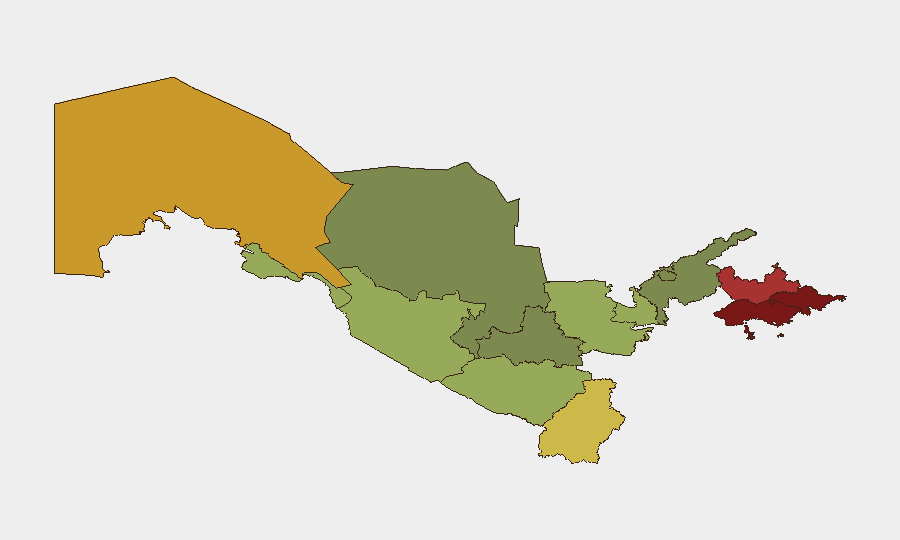
The Fergana Valley—comprising Andijan (risk 88), Fergana (risk 82), and Namangan (risk 78) regions—remains the country's primary security concern, driven by historical patterns of ethnic and religious tension, cross-border proximity to Tajikistan and Kyrgyzstan, and a legacy of militant recruitment networks. Karakalpakstan (risk 72) and Surxondaryo (risk 65) rank fourth and fifth, respectively, reflecting border vulnerabilities and socioeconomic pressures. Conversely, Tashkent and central regions (Samarqand, Bukhara, Navoiy) show substantially lower composite scores (35–42), indicating more stable governance and security infrastructure. Corporate and personnel deployments should apply heightened situational awareness protocols in northern and eastern zones while maintaining standard precautions in capital and southern administrative areas.
How GeoBit Would Assist
Security and risk teams operating in Uzbekistan should deploy AOI (Area-of-Interest) Monitoring & Early Warning on Fergana Valley hotspots to capture emerging unrest or cross-border incidents in real time. Intel Sweep capabilities—combining global event feeds, X/Twitter and Telegram OSINT, and multi-language search—enable continuous baseline tracking of political statements, military activity, and cyber threats. Conflict & Military mapping and Network & Actor Analysis support identification of transnational militant or opposition networks that may pose indirect risk to corporate interests. Routing & Network Analysis can provide alternative journey planning to avoid high-risk zones during personnel movements.
7-Day Outlook
No imminent destabilizing events are indicated in current intelligence signals or forecast models. Seasonal stability is expected to persist through early July, contingent on no major regional escalation (Tajik–Kyrgyz border tensions) or domestic political developments. Monitoring cadence should remain standard for lower-risk zones; northern regions warrant weekly threat-update reviews given structural vulnerabilities and historical volatility patterns.
Next Update: 2026-06-29 | Data Sources: OSINT fusion, X/Twitter monitoring, open-source event feeds, satellite & imagery analysis | Classification: CORPORATE
Highest-Risk Areas — Ranked
| # | State / Region | Risk |
|---|---|---|
| 1 | Andijan Region | 88 |
| 2 | Fergana Region | 82 |
| 3 | Namangan Region | 78 |
| 4 | Republic of Karakalpakstan | 72 |
| 5 | Surxondaryo Region | 65 |
| 6 | Qashqadaryo Region | 58 |
| 7 | Sirdaryo Region | 55 |
| 8 | Jizzakh Region | 48 |
| 9 | Xorazm Region | 45 |
| 10 | Bukhara Region | 42 |
| 11 | Navoiy Region | 38 |
| 12 | Samarqand Region | 35 |
Sources
Previous Daily Briefs
A new Uzbekistan brief is written every day — each with its own risk map and downloadable CSV. Here's the last week; use the calendar to go further back.
📅 Browse every day by calendar →
Highlighted days have a brief. Tap a day for that day's map & analysis, or “csv” for that day's dataset ($5).