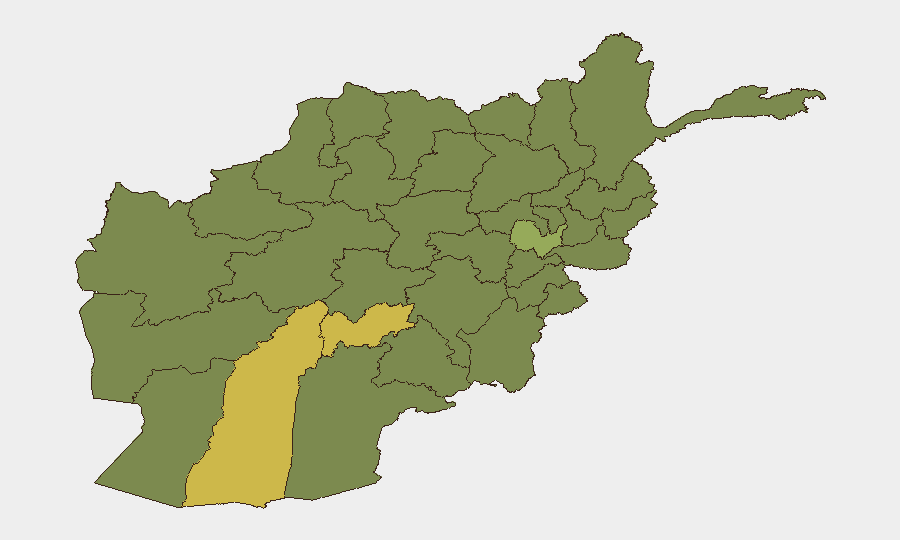
Situation Summary
Afghanistan remains at elevated risk (global rank #35, composite threat score 54) with insurgency as the primary driver. Recent signals indicate cross-border tension with Pakistan alongside domestic security incidents, though the overall threat environment remains consistent with baseline conditions. The concentration of risk in southern and eastern provinces reflects persistent Taliban and other militant presence in traditionally contested areas. Taliban consolidation of administrative control continues, though localized armed activity persists in peripheral regions.
Key Developments
Data Limitation Notice: Open-source verification of specific, incident-level events dated 21–23 June 2026 with location and actor detail is insufficient to meet intelligence standards for this brief. GeoBit event signals show recent activity including:
- Pakistan–Afghanistan Border Tension (21–22 June): Multiple small-arms engagements reported between Pakistani and Afghan forces, with artillery fire noted on 21 June. Pakistani diplomatic disapproval (21 June) and Taliban public statement on Pakistan (21 June) suggest elevated cross-border friction; underlying cause and tactical scope remain unclear from available sources.
- Domestic Police Engagement (20 June): Small-arms combat involving Afghan police reported without specific location or casualty data.
- Detention Activity (21 June): Afghan authorities reported arresting Turkish nationals; scope and charges not yet detailed in available reporting.
- Media Restriction (22 June): Journalist activity flagged as "reject," indicating possible press suppression or denial of access; context pending.
Assessment: These signals require ground-level corroboration from Afghan news outlets (TOLOnews, Pajhwok) and UNAMA to confirm location, timing, and operational significance. No catastrophic incident or major policy shift is evident from current data.
Highest-Risk Areas
Uruzgan (67.4) and Helmand (63.8) provinces drive the highest composite risk, reflecting longstanding Taliban territorial control, opium-trade volatility, and limited state authority. Kabul Province (50.6) ranks third, reflecting both capital-city vulnerability to targeted attack and the administrative concentration of high-value targets. The cluster of moderate-risk provinces in the south and east (Paktia, Zabul, Kandahar, Ghazni, Paktika, Farah, Nimruz) indicates distributed insurgent activity across the traditional Taliban heartland. Northern provinces (Jowzjan, Balkh) at the same moderate level suggest emerging or persistent instability in regions previously considered more stable, warranting monitoring for Taliban expansion or rival group activity.
How GeoBit Would Assist
Area-of-Interest Monitoring & Early Warning on Uruzgan and Helmand provinces would provide persistent alerting on militant activity, checkpoint movements, and IED patterns affecting personnel and supply routes. Intel Sweep and multi-source OSINT fusion (Afghan news, Telegram militant channels, local social media) would enable real-time incident corroboration and early pattern detection ahead of escalation. Conflict & Military mapping combined with GIS & Spatial Analysis would support route planning around highest-risk districts and identify safer operating corridors for field teams.
7-Day Outlook
Cross-border Pakistan–Afghanistan friction may sustain elevated tactical activity along the Durand Line without escalating to major conventional engagement. Domestic security incidents are likely to remain dispersed across southern and eastern provinces rather than concentrated, consistent with Taliban consolidation and fragmented resistance. Personnel in Uruzgan, Helmand, and Kabul should anticipate baseline threat posture; border-region teams should monitor official diplomatic channels for de-escalation signals.
Highest-Risk Areas — Ranked
| # | State / Region | Risk |
|---|---|---|
| 1 | Uruzgan Province | 67.4 |
| 2 | Helmand Province | 63.8 |
| 3 | Kabul Province | 50.6 |
| 4 | Paktia Province | 39.6 |
| 5 | Zabul Province | 37.4 |
| 6 | Kandahar Province | 37.4 |
| 7 | Ghazni Province | 37.4 |
| 8 | Paktika Province | 37.4 |
| 9 | Farah Province | 37.4 |
| 10 | Nimruz Province | 37.4 |
| 11 | Jowzjan Province | 37.4 |
| 12 | Balkh Province | 37.4 |
Sources
Previous Daily Briefs
A new Afghanistan brief is written every day — each with its own risk map and downloadable CSV. Here's the last week; use the calendar to go further back.
📅 Browse every day by calendar →
Highlighted days have a brief. Tap a day for that day's map & analysis, or “csv” for that day's dataset ($5).