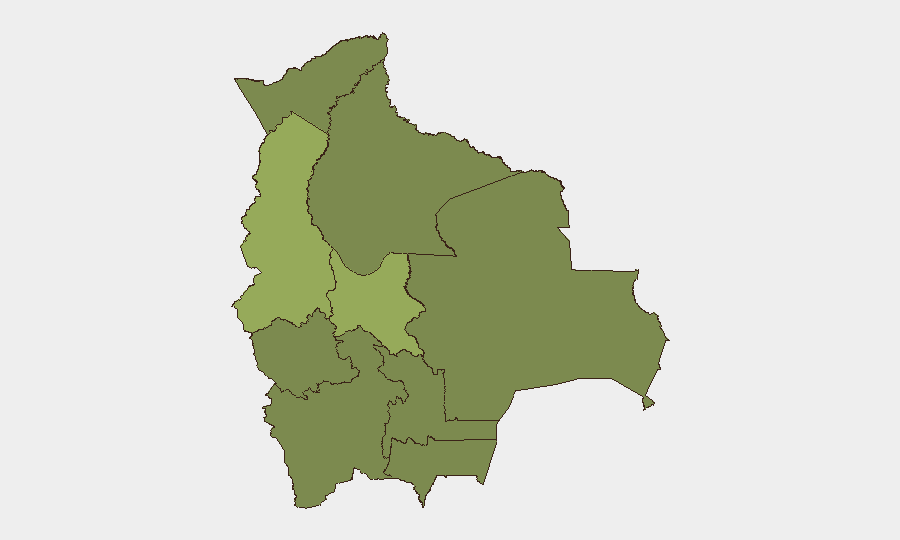
Situation Summary
Bolivia is experiencing a sharp escalation in civil unrest and state militarization following President Rodrigo Paz's declaration of a nationwide state of emergency on 20 June 2026. The emergency decree authorizes expanded military and police deployment to forcibly clear road blockades that have persisted for approximately 50 days and severely disrupted supply chains for fuel, food, and medical goods. Security forces have begun large-scale clearing operations using heavy machinery, creating direct confrontation risk between armed personnel and entrenched protest movements. The composite threat environment has intensified markedly in the past 48 hours, with simultaneous indicators of military force deployment, territorial occupation, and institutional tension (military-government disagreement signals).
Key Developments
- La Paz, 20 June 2026: President Rodrigo Paz declared a state of emergency across Bolivia, authorizing military and police to restore order and clear blockades that have paralyzed economic activity and created critical shortages of fuel, food, and medical supplies.
- La Paz & Cochabamba highways, 20 June 2026: Government security forces (soldiers, police, heavy machinery including bulldozers) deployed to actively dismantle anti-government roadblocks on key national routes, marking the transition from administrative crisis to militarized crowd-control operations.
- Multiple highway corridors, 20 June 2026: Clashes reported between protesters and security personnel during blockade-clearing operations, with tensions escalating as authorities leveraged emergency powers to force removal of barricades.
- La Paz and urban centers, 20 June 2026: Large-scale street demonstrations continued despite the state of emergency, with protesters demanding presidential resignation, wage increases, and resolution of fuel and currency shortages—indicating sustained mobilization despite military presence.
- National supply routes (La Paz, Santa Cruz), 20 June 2026: Ongoing and recently cleared blockades continue to disrupt logistics networks, sustaining critical shortages that are cited as the justification for the emergency decree and military deployment.
- Countrywide security posture, 20 June 2026: Expanded enabling legislation for internal armed-forces deployment signals heightened risk of militarized checkpoints, curfews, and forceful dispersal operations across multiple regions in coming days.
Highest-Risk Areas
La Paz dominates the risk landscape at 56.2, reflecting simultaneous government declarations, military operations, and large protest movements concentrated in and around the capital. Cochabamba (40.9) follows as a secondary flashpoint, with active highway-clearing operations and protest activity. These two departments account for the majority of current threat signals; the remaining seven departments cluster at or below 26.2, indicating that acute risk is territorially concentrated in the western highlands where political power, supply-chain chokepoints, and protest constituencies overlap. The sharp divergence between La Paz/Cochabamba and other regions suggests that corporate and security assets in Santa Cruz, Tarija, and Beni face lower near-term acute risk than those in the capital region.
How GeoBit Would Assist
Teams should deploy AOI Monitoring & Early Warning on La Paz, Cochabamba highways, and supply corridors to detect real-time clashes, checkpoint establishment, and blockade status; Conflict & Military force-structure and deployment tracking to monitor military unit movements and presence; and Routing & Network Analysis to identify passable corridors and alternative supply/evacuation routes around active unrest zones. Intel Sweep and OSINT fusion on government communications, military radio SIGINT, and protest-movement Telegram/social channels will provide early signals of curfew imposition, further force escalation, or negotiated de-escalation.
7-Day Outlook
The emergency decree and initial military clearing operations will likely intensify confrontations over the next 3–5 days as security forces encounter entrenched protest infrastructure and organized resistance. Risk of serious injury, detention of foreign nationals caught in clashes, or supply-chain collapse affecting corporate operations remains elevated. Escalation to sustained curfews, widespread checkpoints, or military occupation of urban centers is plausible if protests do not rapidly disperse or if government-military coordination fractures (note: 21 June signals show military-government disagreement).
Highest-Risk Areas — Ranked
| # | State / Region | Risk |
|---|---|---|
| 1 | La Paz | 56.2 |
| 2 | Cochabamba | 40.9 |
| 3 | Oruro | 36.1 |
| 4 | Potosí | 26.2 |
| 5 | Tarija | 26.2 |
| 6 | Pando | 26.2 |
| 7 | Beni | 26.2 |
| 8 | Chuquisaca | 26.2 |
| 9 | Santa Cruz | 26.2 |
Previous Daily Briefs
A new Bolivia brief is written every day — each with its own risk map and downloadable CSV. Here's the last week; use the calendar to go further back.
📅 Browse every day by calendar →
Highlighted days have a brief. Tap a day for that day's map & analysis, or “csv” for that day's dataset ($5).