Situation Summary
Bulgaria remains a low-threat country (global rank #158) with a stable composite threat score of 6 and no tracked active escalation. However, recent 48-hour developments reveal emerging infrastructure vulnerabilities (GPS jamming in Sofia), ongoing violent crime, organized trafficking, and elevated counter-terrorism monitoring tied to Iran-linked threats. The security posture is operationally responsive but fragmented across multiple concurrent incidents rather than a unified national crisis.
Key Developments
- Sofia, Dragalevtsi district – GPS jamming operation – 21–22 Aug 2026
Bulgarian security services (DANS), the Communications Regulation Commission, and Sofia Police conducted a multi-agency operation starting Friday afternoon to locate and neutralize a GPS jammer affecting Sofia, including Sofia Airport and TV tower signals. The transport minister confirmed GPS interference occurred on 21 Aug but stated no impact to aviation or critical infrastructure safety. The complex operator denied finding any device, suggesting operational ambiguity.
- Sofia – Citywide GPS signal disruption – 21 Aug 2026
Navigation system failures were reported across parts of Sofia during the active jamming window, creating temporary but measurable infrastructure and navigation risk to residents and travelers before mitigation.
- Plovdiv – Neo-Nazi organization arrests – 18 Aug 2026
Police arrested 18 suspects in a multi-country operation targeting the 'Krav i Chest' (Blood and Honour) neo-Nazi organization, indicating active law-enforcement pressure on extremist networks with transnational reach.
- National – Cannabis cultivation raid – 19 Aug 2026
Authorities seized 3,215 kg of marijuana and 1,546 cannabis plants in a large-scale illegal cultivation operation; investigation ongoing under the Blago organized-crime framework.
- National – Violent crime incidents – 19 Aug 2026
A 21-year-old male was discovered dismembered in four bags; a former police officer was detained as suspect. A fatal two-vehicle collision near Pleven and a pedestrian fatality on the AM Hemus motorway were also recorded, indicating concurrent violent and traffic fatalities.
- Belitsa & national – Iran-linked counter-terrorism assessment – 21 Aug 2026
Interior Minister Demerdzhiev stated that Bulgarian services are "constantly monitoring" potential threats from Iran and Hezbollah-linked actors, and that all necessary counter-measures have been taken. This reflects elevated but reportedly managed vigilance tied to prior Hezbollah terrorism against Bulgarian targets.
- Bezmer Air Base – U.S. KC-135 departure – 21 Aug 2026
Two U.S. Air Force tanker aircraft departed the southeastern air base after roughly one month of deployment. The defence minister emphasized training-only operations and stated no direct national security threats are present, suggesting Iran-related tension is currently contained.
- Sofia – Social media and youth crime policy discussion – 21 Aug 2026
Interior Minister Demerdzhiev indicated government discussion of restricting social media access and introducing legislative changes to counter rising antisocial behavior by minors, signaling potential near-term digital regulation changes.
Highest-Risk Areas
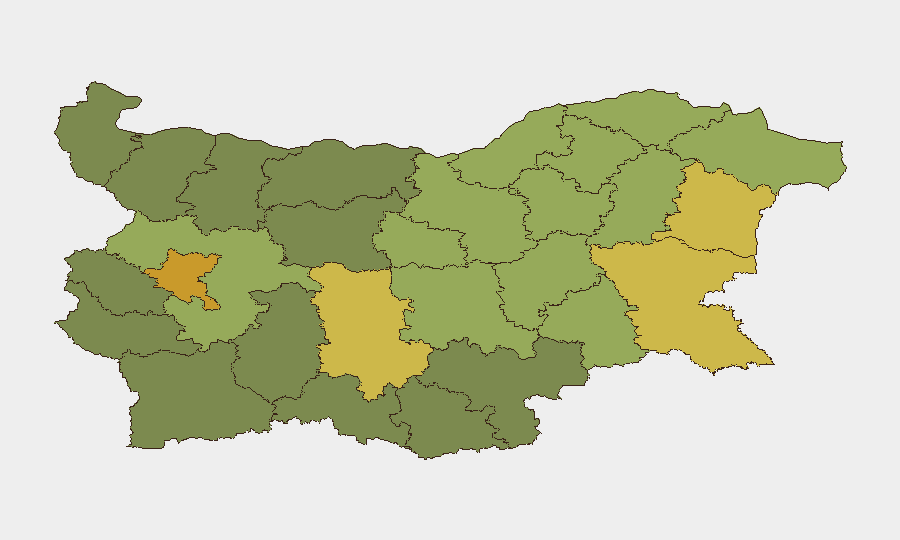
Sofia-City (risk 72) and Plovdiv (risk 68) dominate the sub-national landscape, driven by urban density, organized crime activity, extremist networks, and infrastructure vulnerabilities. The coastal cities of Varna (65) and Burgas (62) follow, reflecting trafficking and cross-border crime routes. The clustering of four highest-risk zones in the western and central regions indicates that Bulgaria's security burden concentrates in major metropolitan and transport hubs rather than diffusing nationwide.
How GeoBit Would Assist
Security teams should deploy AOI Monitoring & Early Warning over Sofia-City, Plovdiv, Varna, and Burgas to detect re-emergence of infrastructure jamming, extremist mobilization, or trafficking logistics. Network & Actor Analysis would map the reach and structure of organized-crime and neo-Nazi networks. Routing & Network Analysis provides real-time alternative journey planning around Sofia and motorway disruptions, while Intel Sweep and OSINT fusion track emerging counter-terrorism posture changes and policy announcements affecting corporate operations.
7-Day Outlook
No major escalation is forecast; however, the GPS jamming incident indicates a novel vulnerability in Sofia's critical infrastructure requiring closer monitoring. Counter-terrorism operations will likely intensify under elevated Iran-threat posture, potentially affecting travel, communications, or checkpoint procedures. Ongoing violent crime and trafficking enforcement should be expected to generate routine operational disruptions in high-risk cities.
Highest-Risk Areas — Ranked
| # | State / Region | Risk |
|---|---|---|
| 1 | Sofia-City | 72 |
| 2 | Plovdiv | 68 |
| 3 | Varna | 65 |
| 4 | Burgas | 62 |
| 5 | Sofia | 58 |
| 6 | Ruse | 55 |
| 7 | Stara Zagora | 52 |
| 8 | Sliven | 50 |
| 9 | Shumen | 48 |
| 10 | Razgrad | 47 |
| 11 | Yambol | 45 |
| 12 | Dobrich | 44 |
Sources
Previous Daily Briefs
A new Bulgaria brief is written every day — each with its own risk map and downloadable CSV. Here's the last week; use the calendar to go further back.
- August 20, 2026
- August 18, 2026
- August 16, 2026
- August 14, 2026
- August 12, 2026
- August 10, 2026
- August 8, 2026
📅 Browse every day by calendar →
Highlighted days have a brief. Tap a day for that day's map & analysis, or “csv” for that day's dataset ($5).
Atlas — our AI intelligence desk — emails them this snapshot personally. Nothing else, no list.