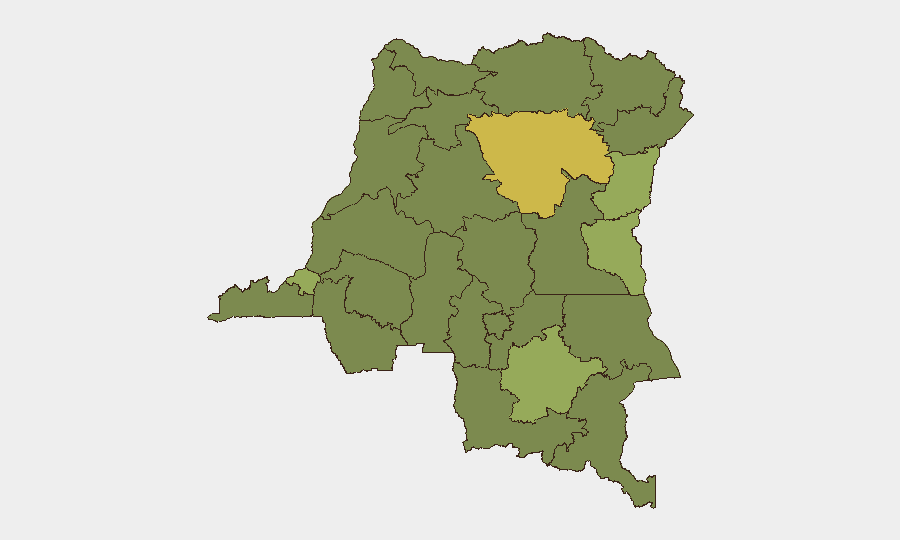
Situation Summary
DR Congo remains the 31st-highest-risk country globally, with a composite threat score of 68 driven primarily by ongoing civil conflict across eastern and north-central provinces. Armed-group activity persists at baseline levels in North Kivu and Tshopo, while an Ebola outbreak in Ituri Province (782 confirmed cases as of 13 June) continues to constrain humanitarian and corporate operations. No major security incidents with confirmed timestamps have been reported in the last 24–48 hours, though the underlying conflict dynamics and disease threat remain operationally significant.
Key Developments
Open-source monitoring over the last 24–48 hours has not yielded independently confirmed, time-specific security or travel-risk incidents in DR Congo. Armed-group activity in eastern provinces (North Kivu, Tshopo) continues without reported major new clashes or displacement events in this window. No newly timestamped urban crime or civil-unrest incidents have been confirmed in Kinshasa despite the capital's elevated baseline risk profile. Border areas in Sud-Ubangi and Nord-Ubangi remain persistently unstable, though no fresh cross-border incursions or displacement events have been reported in the last two days. The Ebola outbreak remains an operational constraint; however, the most recent confirmed case count (782 confirmed, 181 deaths, as of 13 June) falls outside the strict 48-hour reporting window and does not represent a new development by today's date.
Highest-Risk Areas
Tshopo Province ranks as the single highest-risk region (68.7), driven by active armed-group presence and ongoing conflict-related insecurity. North Kivu, Kinshasa, Haut-Lomami, and South Kivu follow closely (risk scores 40.9), each presenting distinct threats: North Kivu combines armed-group activity with cross-border instability; Kinshasa faces urban crime and civil-unrest risk; Haut-Lomami and South Kivu experience resource-driven conflict and armed-group operations. A second tier of provinces—Maniema, Sud-Ubangi, Équateur, Nord-Ubangi, Mongala, Lower Uele, and Tshuapa—all score 38.7, reflecting persistent baseline instability, border vulnerabilities, and low-intensity conflict. Organizations with people or assets in Tshopo and North Kivu face the highest exposure to armed-group activity; those in Kinshasa should prioritize civil-unrest and crime risk management.
How GeoBit Would Assist
Security teams should deploy Area-of-Interest (AOI) Monitoring & Early Warning on Tshopo, North Kivu, and Kinshasa to detect emerging armed-group activity, displacement events, or civil unrest with real-time alerting. Conflict & Military capabilities—including battle mapping and force-structure tracking—allow analysts to distinguish routine militia operations from escalating clashes that could threaten personnel or supply chains. OSINT fusion across social media (X, Telegram), local news, and specialist feeds provides corroborated incident reporting and actor intent; Routing & Network Analysis enables alternative journey planning around high-risk areas or checkpoints.
7-Day Outlook
Armed-group activity in eastern provinces is likely to remain at current baseline levels absent major external triggering events. Kinshasa and other urban centers face continued low-intensity crime and sporadic civil unrest linked to economic and political grievances. The Ebola outbreak trajectory will be a key operational constraint; escalation in confirmed cases or geographic spread would materially affect humanitarian access and corporate mobility across Ituri and adjacent provinces.
Highest-Risk Areas — Ranked
| # | State / Region | Risk |
|---|---|---|
| 1 | Tshopo | 68.7 |
| 2 | North Kivu | 40.9 |
| 3 | Kinshasa | 40.9 |
| 4 | Haut-Lomami | 40.9 |
| 5 | South Kivu | 40.9 |
| 6 | Maniema | 38.7 |
| 7 | Sud-Ubangi | 38.7 |
| 8 | Équateur | 38.7 |
| 9 | Nord-Ubangi | 38.7 |
| 10 | Mongala | 38.7 |
| 11 | Lower Uele | 38.7 |
| 12 | Tshuapa | 38.7 |
Sources
Previous Daily Briefs
A new DR Congo brief is written every day — each with its own risk map and downloadable CSV. Here's the last week; use the calendar to go further back.
📅 Browse every day by calendar →
Highlighted days have a brief. Tap a day for that day's map & analysis, or “csv” for that day's dataset ($5).