Situation Summary
Georgia faces a composite threat score of 16 (ranking #null globally) driven by four tracked security events in the past 24–48 hours. Law enforcement conducted significant interdiction operations against weapons smuggling, large-scale narcotics trafficking, and psychotropic drug distribution, while anti-government protests continue in central Tbilisi after 570+ consecutive days. The threat environment is dominated by organized crime and transnational smuggling rather than active violence, though political tensions around EU integration and the "foreign agents" law sustain background civil-unrest risk.
Key Developments
- Sarpi border crossing & Poti Sea Port (July 24): Georgian law enforcement intercepted a major weapons shipment containing ~500 live rounds, 2 pneumatic sporting firearms, 2,000+ cartridge cases, 900 bullets, and 2.5 kg of gunpowder; two suspects arrested including one foreign national. Criminal case opened under weapons-smuggling statutes.
- Tbilisi (July 24): Ministry of Finance Investigative Service announced criminal case involving illegal trade of psychotropic medications valued at 53+ million GEL, money laundering, and unlawful business activity. Multiple individuals and companies under investigation.
- Samegrelo–Zemo Svaneti region (July 24): Police arrested two Ukrainian citizens for illegal acquisition and possession of large quantities of narcotic substances. Prosecution expected under Georgian narcotics legislation for large-scale possession.
- Countrywide (July 24): Individual arrested for facilitating dozens of citizens' avoidance of compulsory military service via falsified medical documentation. Charges include document forgery and evasion of military obligations.
- Central Tbilisi (July 24): Anti-government protests linked to EU-integration demands and opposition to the "foreign agents" law continue, now exceeding 570 consecutive days of mobilization. Demonstrations remain largely peaceful but sustain political tension.
- Tbilisi political sphere (July 24): Government publicly signaled readiness to resume dialogue with the European Union and discuss the contested "foreign agents" transparency law, representing a potential pivot in governance risk trajectory.
Highest-Risk Areas
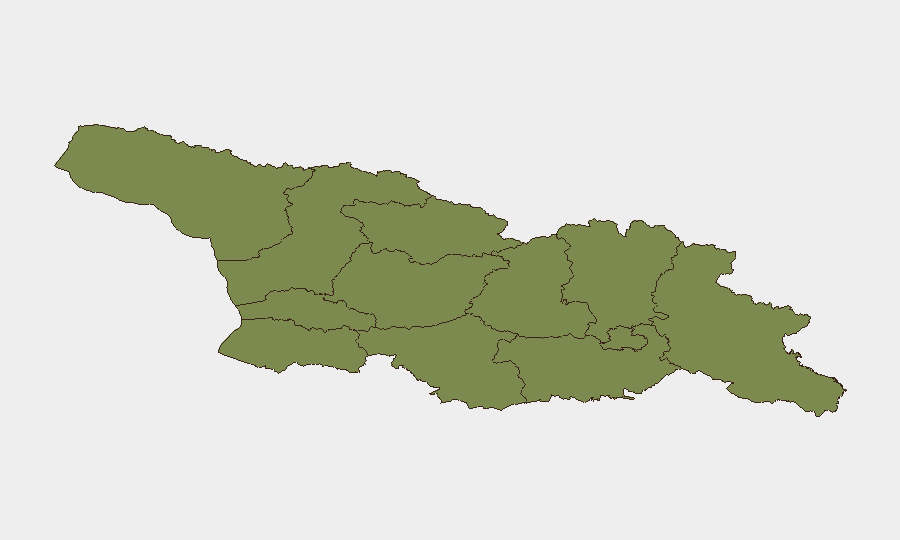
Four regions (Tbilisi, Lower Kartli, Racha-Lechkhumi and Kvemo Svaneti, and Imereti) are ranked at composite risk score 31.3—significantly above the national average—while eight remaining regions score 1.3. The elevated risk in the four highest-scoring areas reflects concentration of transnational smuggling operations (weapons, narcotics), organized-crime distribution networks, and in Tbilisi, sustained mass political mobilization. Border zones (Sarpi) and port infrastructure (Poti) appear to be primary vulnerability points for weapons and drug trafficking. The remaining eight regions, including disputed territories (Abkhazia, South Ossetia) and peripheral areas, score substantially lower, suggesting either lower criminal activity or reduced reporting/monitoring intensity.
How GeoBit Would Assist
Corporate security teams with personnel or assets in Georgia would benefit from AOI Monitoring & Early Warning focused on Tbilisi and port/border zones to detect organized-crime activity and protest-related disruption before operational impact. OSINT fusion (X/Telegram feeds, ministry communications, local media cross-corroboration) provides real-time visibility into law-enforcement operations and narcotics-trafficking patterns. Network & Actor Analysis helps map smuggling organizations and their supply chains to identify secondary risks to supply-chain partners or facilities in transit zones.
7-Day Outlook
Near-term trajectory depends on government–EU dialogue pace: successful resumption of talks may reduce protest intensity and political volatility, while stalled negotiations could sustain or amplify civil unrest in central Tbilisi. Transnational smuggling operations (weapons, narcotics) are likely to persist given Georgia's position as a transit hub; law-enforcement interdiction rates may increase tactically but are unlikely to degrade organized-crime capacity substantially. No imminent violent escalation is signaled, but cumulative protest fatigue and political polarization remain background risks.
Highest-Risk Areas — Ranked
| # | State / Region | Risk |
|---|---|---|
| 1 | Tbilisi | 31.3 |
| 2 | Lower Kartli | 31.3 |
| 3 | Racha-Lechkhumi and Kvemo Svaneti | 31.3 |
| 4 | Imereti | 31.3 |
| 5 | Mtskheta-Mtianeti | 1.3 |
| 6 | Kakheti | 1.3 |
| 7 | Autonomous Republic of Abkhazia | 1.3 |
| 8 | Samegrelo-Upper Svaneti | 1.3 |
| 9 | Guria | 1.3 |
| 10 | Autonomous Republic of Adjara | 1.3 |
| 11 | Samtskhe-Javakheti | 1.3 |
| 12 | Shida Kartli | 1.3 |
Sources
Previous Daily Briefs
A new Georgia brief is written every day — each with its own risk map and downloadable CSV. Here's the last week; use the calendar to go further back.
📅 Browse every day by calendar →
Highlighted days have a brief. Tap a day for that day's map & analysis, or “csv” for that day's dataset ($5).
Atlas — our AI intelligence desk — emails them this snapshot personally. Nothing else, no list.