Situation Summary
Germany remains a low-to-moderate threat environment globally (rank #139, composite score 5.0), but displays significant internal regional variance and emerging labor-sector tensions. The 170 tracked events reflect a mix of industrial action, infrastructure security concerns, and bilateral diplomatic friction. The concentration of threat signals in Thuringia—with a risk score 3.8× higher than the national average—indicates localized instability rather than systemic nationwide disruption.
Key Developments
- Leverkusen/Langenfeld, North Rhine-Westphalia — 11 July 2026: Railway line between Cologne and Düsseldorf sabotaged with incendiary devices; train services disrupted; Cologne police investigation ongoing; repairs expected to extend into 12 July.
- Germany (national) — 11 July 2026: Bilateral military posturing signal recorded (GREECE vs GERMANY, conventional military force category); nature and severity not yet clarified in available reporting.
- Germany (national) — 11 July 2026: Multi-party labor conflict escalated with mutual threats between company management, union representatives, and worker demonstrations; public statements issued by all sides; suggests active wage/condition negotiation with elevated rhetoric.
- Germany (national) — 11 July 2026: Government threat signal toward union representative; coordination and enforcement context unclear; warrants monitoring for labor-relations policy shift or enforcement action.
- Germany (national) — 12 July 2026: Property seizure or damage incident involving government and investor(s); insufficient detail in current reporting to assess scale or sector impact.
- Germany (national) — 12 July 2026: Federal IT security posture assessment; BSI reported continued tension in national cyber threat environment; no discrete new incident specified.
Highest-Risk Areas
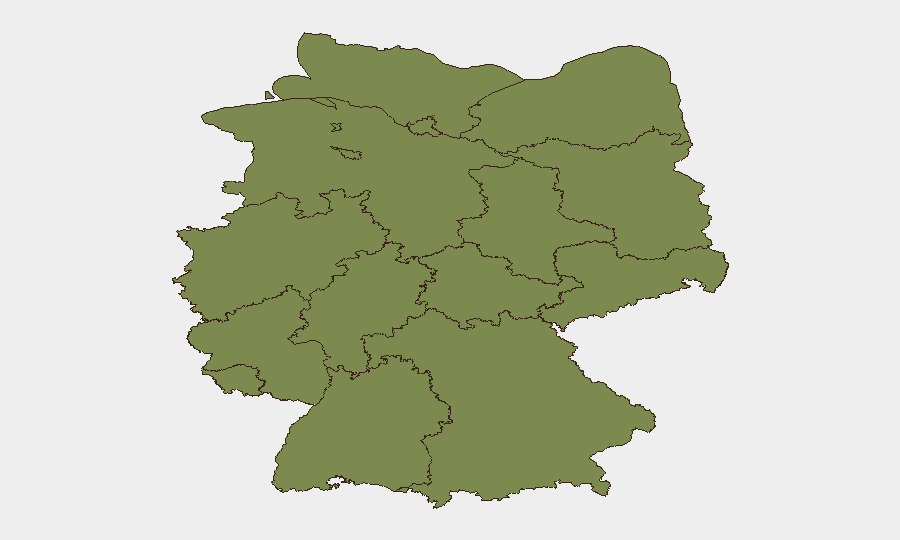
Thuringia's threat score of 32—nearly four times Bavaria's score of 8.3—makes it the clear outlier and primary concern for duty-of-care planning. This concentration likely reflects ongoing far-right political mobilization, migration-policy friction, and localized infrastructure vulnerability. Bavaria and Berlin follow as secondary foci, with Bavaria historically associated with extremist organizing and Berlin presenting the typical urban risk profile (demonstrations, property crime, transit-related incidents). The remaining nine states cluster below risk 6, indicating that 80% of Germany's tracked threat surface is geographically dispersed and manageable within standard corporate security posture.
How GeoBit Would Assist
Intel Sweep and multi-language OSINT would enable real-time correlation of labor-sector signals across media, social platforms, and official sources to predict strike timing and geographic spread. AOI Monitoring & Early Warning would allow persistent watch over Thuringia, major rail corridors (post-Leverkusen sabotage), and corporate sites in Bavaria and Berlin to detect pre-incident activity. Network & Actor Analysis would map union, political, and activist networks to identify flashpoint actors and likely escalation vectors in the coming 7–14 days.
7-Day Outlook
Labor tensions are likely to remain elevated through mid-July as wage negotiations continue; rail and transport disruption risk remains moderate pending sabotage investigation outcome and infrastructure hardening. Thuringia warrants heightened monitoring for spillover effects into adjacent regions; diplomatic friction with Greece and Czech signals should be tracked for any escalation into sanctions, trade action, or consular incident. Overall trajectory is toward stabilization absent fresh trigger events (e.g., major casualty incident, political announcement, or foreign-policy crisis).
Highest-Risk Areas — Ranked
| # | State / Region | Risk |
|---|---|---|
| 1 | Thuringia | 32 |
| 2 | Bavaria | 8.3 |
| 3 | Berlin | 7.6 |
| 4 | Lower Saxony | 5.5 |
| 5 | Hesse | 3.2 |
| 6 | Hamburg | 2.7 |
| 7 | Saxony | 2.6 |
| 8 | Mecklenburg-Vorpommern | 2.4 |
| 9 | Rhineland-Palatinate | 2.2 |
| 10 | Baden-Württemberg | 2.2 |
| 11 | Schleswig-Holstein | 2 |
| 12 | Saxony-Anhalt | 2 |
Sources
Previous Daily Briefs
A new Germany brief is written every day — each with its own risk map and downloadable CSV. Here's the last week; use the calendar to go further back.
📅 Browse every day by calendar →
Highlighted days have a brief. Tap a day for that day's map & analysis, or “csv” for that day's dataset ($5).
Atlas — our AI intelligence desk — emails them this snapshot personally. Nothing else, no list.