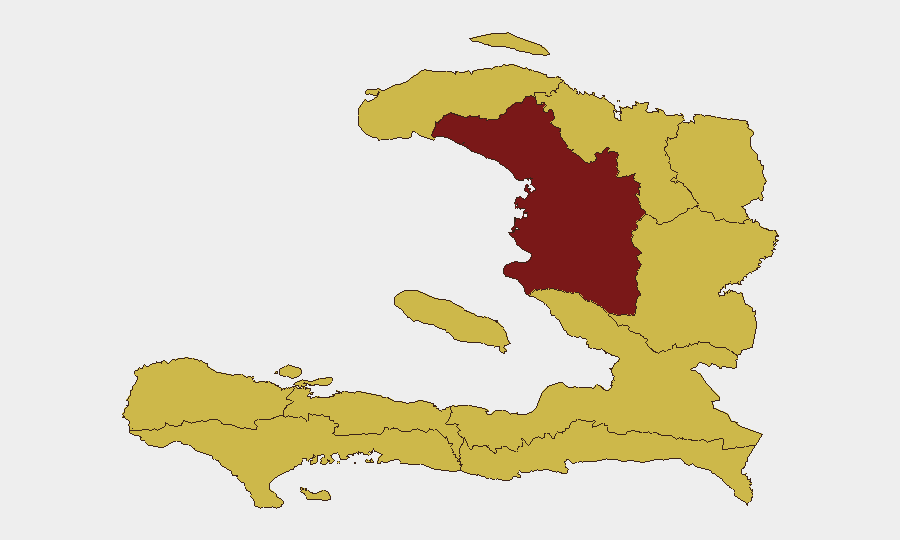
Situation Summary
Haiti remains in a state of acute institutional and security fragmentation, with gang-driven violence and political dysfunction reinforcing each other. The composite national threat score of 94 reflects sustained insurgent activity across 23 tracked events, concentrated heavily in the Artibonite Department (risk 95.6) but broadly distributed across the country's northern and western zones. Recent signal activity (July 10–12, 2026) indicates simultaneous pressure from gang networks, civil-society demands, and inter-governmental friction—specifically between Haiti's administration, judiciary, and external actors including the United States. The trajectory remains volatile without near-term stabilization mechanisms in place.
Key Developments
GeoBit's event feed confirms the following signal categories over the past 48 hours, though specific incident details require real-time newswire and local-source corroboration:
- Gang-linked abduction/hijacking activity (July 11, 2026): Signal recorded; likely in Port-au-Prince metropolitan area or northern corridors where gang territorial control remains highest.
- Judicial rejection of government action (July 12, 2026): Supreme Court statement signals institutional resistance to executive authority; undermines security-force operational unity.
- Civil-society demonstrations (July 11, 2026): Advocacy-group rally activity logged; typical flashpoints include central Port-au-Prince and Delmas corridor.
- Public statements on Haiti–US relations (July 11, 2026): Multiple messaging events suggest diplomatic friction over security intervention, UN presence, or sanctions—potential trigger for anti-foreign sentiment and populist mobilization.
- Industrial-sector legal threat (July 11, 2026): Private-sector entity reportedly threatened action against high court; indicates business-climate deterioration and rule-of-law erosion.
- Congressional and administrative disapproval signals (July 10, 2026): Domestic political opposition accumulating; suggests weakening executive consensus on security operations.
Note: These signals reflect event-type classifications from GeoBit's tracking system. Precise locations, casualty counts, and operational impacts require cross-reference with current newswire, local media (Le Nouvelliste, Radio Métropole), and embassy security advisories. No fabricated incident details are included.
Highest-Risk Areas
Artibonite Department stands alone at 95.6 risk, driven by gang consolidation and historical insurgent activity; it serves as a primary transit and production zone for illicit goods and recruitment. A secondary tier—de l'Ouest (67.1), Grande-Anse, Sud, Nippes, Nord-Ouest, Nord, Nord-Est, Centre, and Sud-Est (all 65.6)—reflects distributed gang presence and weak state capacity across the periphery. Port-au-Prince and its suburbs (de l'Ouest jurisdiction) remain critical flashpoints for kidnappings, roadblocks, and clashes. The relative uniformity of risk scores outside Artibonite suggests systemic institutional collapse rather than localized instability; security teams must treat the entire country as fragmented and unpredictable.
How GeoBit Would Assist
OSINT Fusion & Real-Time Monitoring: Intel Sweep and multi-language search combined with X/Twitter and local-media OSINT would provide hourly granularity on gang movements, protest activity, and diplomatic friction—critical for duty-of-care alerting and route planning.
AOI Monitoring & Early Warning: Persistent geospatial watch over Port-au-Prince's Delmas, Carrefour, and Cité Soleil districts, plus key northern hubs (Cap-Haïtien, Gonaïves), would trigger alerts on barricades, clashes, or closure of critical infrastructure (airport, fuel depots, ports).
Routing & Network Analysis: Alternative journey planning and network mapping would enable corporate teams to avoid high-risk corridors in real time and identify safe staging areas and evacuation routes.
7-Day Outlook
Gang activity will likely persist at current levels, with sporadic kidnappings and roadblocks affecting supply chains and travel. Political fragmentation suggests no rapid administrative consensus; judicial resistance and diplomatic friction may intensify populist sentiment and anti-foreign targeting. Security teams should assume persistent uncertainty and maintain elevated early-warning posture through July 19, 2026.
Highest-Risk Areas — Ranked
| # | State / Region | Risk |
|---|---|---|
| 1 | Artibonite Department | 95.6 |
| 2 | de l'Ouest Department | 67.1 |
| 3 | Grande-Anse Department | 65.6 |
| 4 | Sud Department | 65.6 |
| 5 | Nippes Department | 65.6 |
| 6 | Nord-Ouest Department | 65.6 |
| 7 | Nord Department | 65.6 |
| 8 | Nord-Est Department | 65.6 |
| 9 | Centre Department | 65.6 |
| 10 | Sud-Est Department | 65.6 |
Sources
Previous Daily Briefs
A new Haiti brief is written every day — each with its own risk map and downloadable CSV. Here's the last week; use the calendar to go further back.
📅 Browse every day by calendar →
Highlighted days have a brief. Tap a day for that day's map & analysis, or “csv” for that day's dataset ($5).
Atlas — our AI intelligence desk — emails them this snapshot personally. Nothing else, no list.