Situation Summary
Haiti's security environment remains critically unstable, with gang violence, kidnapping, and police anti-gang operations creating overlapping zones of acute risk across Port-au-Prince and western departments. The appointment of a new PNH Director General in mid-July has triggered intensified security sweeps nationwide, generating both enforcement activity and associated displacement in rural communes. Composite national threat ranking sits at 78/101 (global rank #25), with no indication of near-term de-escalation; kidnapping risk in the capital is assessed as elevated and immediate.
Key Developments
- Port-au-Prince, Martin Luther King Avenue / Route de Nazon (July 17–18): U.S. Embassy issued Security Alert specifically warning that kidnapping "may be rampant on and near" Martin Luther King Avenue over the coming days, advising avoidance and continuous monitoring of local media for violence and disruptions.
- Port-au-Prince metropolitan area (July 17, reporting on prior 4–6 weeks): PNH reported 391 arrests and eight firearms seized in anti-gang operations across capital neighborhoods, indicating sustained large-scale law-enforcement presence and active checkpoint/movement-restriction activity.
- Port-au-Prince & multi-regional (July 16–17): PNH announced "intensified" security operations against armed groups across "different regions of the country" under new Director General André Jonas Vladimir Paraison, signaling active enforcement posture and associated travel delays/checkpoints nationwide.
- Royal Caribbean operational decision (July 18): Cruise operator announced reduction of relations/operations, consistent with broader international reassessment of Haiti security following recent kidnapping alerts and gang violence.
- Dominican Republic–Haiti bilateral tension (July 18): Dominican authorities issued disapproval statement regarding Haitian migrants/security situation, reflecting regional anxiety about spillover risk and border stability.
- Ganthier and Kenscoff communes, West Department (July 1–8, impact continuing): Armed clashes and gang attacks displaced approximately 3,300 people from Ganthier (July 1) and 5,840 from Kenscoff (July 4–8), with Roben locality attacked July 7–8, forcing ongoing humanitarian and travel restrictions in southeast Port-au-Prince periphery.
Highest-Risk Areas
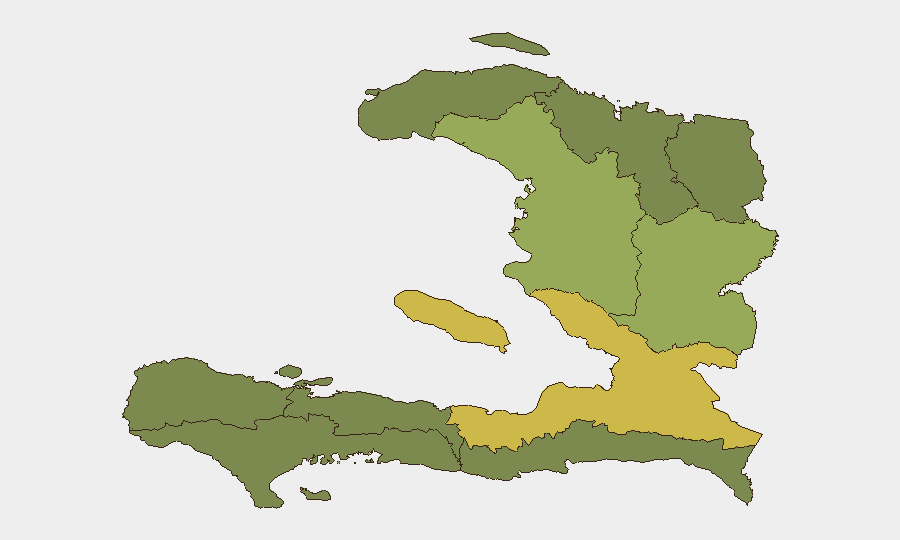
*de l'Ouest* Department (risk 64.1) dominates the national threat landscape, driven by gang territorial conflict, kidnapping networks, and recent displacement crises in Ganthier and Kenscoff. *Artibonite* (54.6) and *Centre* (51.7) departments present secondary concentration zones, likely reflecting gang activity corridors and police operation intensity. The capital's metropolitan area, embedded within *de l'Ouest*, functions as the primary kidnapping and violent-crime locus; remaining departments cluster at moderate-to-moderate-low risk (34–37), suggesting either lower gang density or less intensive enforcement reporting. International travel warnings and U.S. Embassy alerts consistently target the capital and western zone, corroborating the sub-national ranking.
How GeoBit Would Assist
Security teams with personnel or assets in Haiti should employ AOI Monitoring & Early Warning on Port-au-Prince neighborhoods (especially MLK Avenue corridor) and western departments to detect checkpoint density, police operation tempo, and gang activity signals in near real-time. Routing & Network Analysis would identify alternative transport corridors avoiding high-kidnapping-risk zones and police checkpoints, while OSINT fusion (X/Telegram, local news, PNH statements) would track daily shifts in gang territorial control and PNH enforcement intensity. Risk & Threat Assessment dashboards should ingest kidnapping incident data and bilateral Dominican-Haitian signals to forecast 7–14 day windows of elevated exposure.
7-Day Outlook
PNH anti-gang operations are expected to continue at heightened tempo, maintaining checkpoints and movement friction in Port-au-Prince and regional hubs through at least late July. Kidnapping risk in the capital's commercial and transit corridors remains acute; gang territorial disputes in *de l'Ouest* may trigger secondary displacement waves. International operators (cruise, NGO, diplomatic) are likely to further restrict or suspend activities in high-risk zones.
Highest-Risk Areas — Ranked
| # | State / Region | Risk |
|---|---|---|
| 1 | de l'Ouest Department | 64.1 |
| 2 | Artibonite Department | 54.6 |
| 3 | Centre Department | 51.7 |
| 4 | Sud Department | 37 |
| 5 | Grande-Anse Department | 34.1 |
| 6 | Nippes Department | 34.1 |
| 7 | Nord-Ouest Department | 34.1 |
| 8 | Nord Department | 34.1 |
| 9 | Nord-Est Department | 34.1 |
| 10 | Sud-Est Department | 34.1 |
Sources
Previous Daily Briefs
A new Haiti brief is written every day — each with its own risk map and downloadable CSV. Here's the last week; use the calendar to go further back.
📅 Browse every day by calendar →
Highlighted days have a brief. Tap a day for that day's map & analysis, or “csv” for that day's dataset ($5).
Atlas — our AI intelligence desk — emails them this snapshot personally. Nothing else, no list.