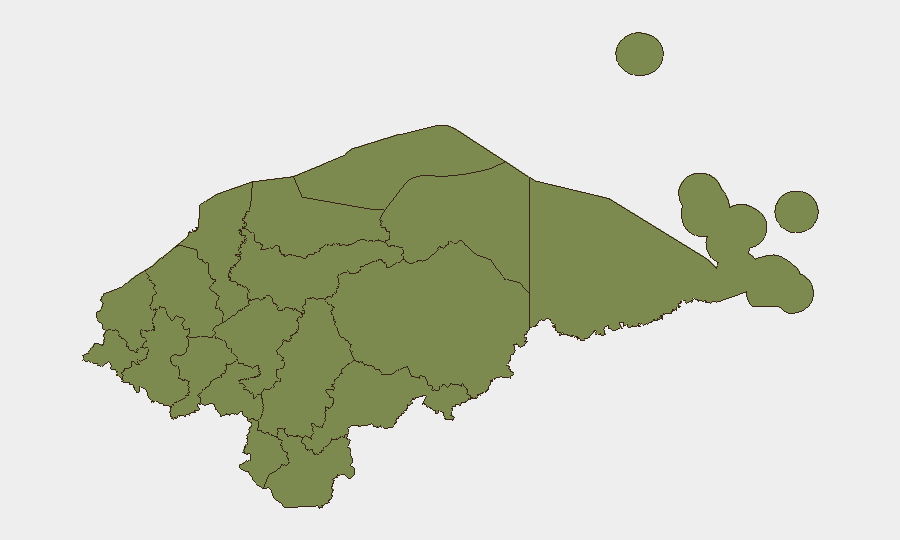
Situation Summary
Honduras remains at composite threat level 20 globally, with 4 tracked security events. The country is experiencing concurrent pressures: active anti-crime operations, drug-enforcement activity, and a wave of localized road-blocking protests that have generated police–protester confrontations in at least one location (Macuelizo). Francisco Morazán department—encompassing the capital region—carries significantly elevated risk (31.3) compared to all other departments. The trajectory suggests sustained operational police activity and sporadic civil unrest rather than systemic breakdown, though escalation risk exists at protest flashpoints.
Key Developments
- Multiple road blockades nationwide (24–25 July). At least seven protest mobilizations disrupted traffic in Germania (Tegucigalpa), El Conejo junction, Tocoa (Colón), and Macuelizo (Santa Bárbara). Tocoa protests involved ~300 people occupying the Sabá highway. Most remained peaceful; Macuelizo saw confrontation between residents and police attempting to re-open routes. National Police deployed traffic units and maintained preventive posture, prioritizing dialogue over force.
- Anti-crime sweep yields 86 detentions in Talanga, Francisco Morazán (last 72 hours, reported 20 July). National Police conducted mobile/fixed checkpoints, preventive patrols, and raids under the "Barrios y Comunidades Seguras" plan, resulting in arrests for illegal firearms and micro-trafficking. Travelers in the region should expect heightened police stops and checkpoint delays.
- Cocaine seizure in southern Honduras (~500 units, 23 July). Dirección de Lucha contra el Narcotráfico conducted search operations in the southern zone, indicating active counter-narcotics enforcement with associated armed police activity and possible neighborhood cordons.
- Investigation into gang-linked killing of four youths in La Ceiba, Atlántida (last 24–48 hours). Dirección Policial de Investigaciones pursuing suspected maras/pandilla involvement. Reflects recent lethal gang activity and elevated crime/retaliation risk in affected neighborhoods.
- National Police posture on protests emphasizes dialogue with readiness for order enforcement (current). Spokesperson Edgardo Barahona stated police privilege dialogue while applying use-of-force protocols to balance protest rights against free circulation. The Macuelizo confrontation underscores non-negligible risk of localized clashes if demonstrations intensify.
Highest-Risk Areas
Francisco Morazán department (composite risk 31.3)—home to Tegucigalpa and the capital region—drives the country's elevated threat profile, driven by concentrated anti-crime operations, protest activity, and gang-related homicides. All other tracked departments (El Paraíso, Copán, Ocotepeque, Cortés, Yoro, Santa Bárbara, Lempira, Intibucá, Comayagua, La Paz, Valle) register risk 1.3. Atlántida (La Ceiba) shows recent lethal gang activity outside the formal ranking. The concentration of police operations and civil friction in and around the capital makes that corridor the primary near-term concern for duty-of-care teams.
How GeoBit Would Assist
Corporate security teams should deploy AOI Monitoring & Early Warning on Francisco Morazán, La Ceiba, and southern border zones to track protest escalation, gang activity, and enforcement operations in real time. Routing & Network Analysis capabilities enable security teams to build live alternate routes around protest blockades and police checkpoints. OSINT fusion across X/Twitter, Telegram, local broadcast, and police statements provides continuous sentiment and temporal analysis of protest dynamics and operational tempo, supporting duty-of-care decision-making for personnel movement and asset positioning.
7-Day Outlook
Road blockades are expected to persist through the week unless underlying grievances are addressed through dialogue. Continued anti-crime and counter-narcotics operations will maintain police presence and checkpoint activity nationwide, particularly in Francisco Morazán and the south. Risk of localized escalation remains if protests spread geographically or police enforcement intensifies; monitoring protest organizer communications and police statements will be critical for early warning.
Highest-Risk Areas — Ranked
| # | State / Region | Risk |
|---|---|---|
| 1 | Francisco Morazán | 31.3 |
| 2 | El Paraíso | 1.3 |
| 3 | Copán | 1.3 |
| 4 | Ocotepeque | 1.3 |
| 5 | Cortés | 1.3 |
| 6 | Yoro | 1.3 |
| 7 | Santa Bárbara | 1.3 |
| 8 | Lempira | 1.3 |
| 9 | Intibucá | 1.3 |
| 10 | Comayagua | 1.3 |
| 11 | La Paz | 1.3 |
| 12 | Valle | 1.3 |
Sources
Previous Daily Briefs
A new Honduras brief is written every day — each with its own risk map and downloadable CSV. Here's the last week; use the calendar to go further back.
📅 Browse every day by calendar →
Highlighted days have a brief. Tap a day for that day's map & analysis, or “csv” for that day's dataset ($5).
Atlas — our AI intelligence desk — emails them this snapshot personally. Nothing else, no list.