GeoBit Daily Security Brief — Iraq
2026-06-22
Situation Summary
Iraq remains a composite threat level (#22 globally, score 71) characterized by persistent militia activity, cross-border tensions, and sporadic conventional military incidents. Over the past 72 hours, event signals indicate elevated state-to-state friction involving military posturing and law-enforcement actions, with Baghdad and Al-Anbar as primary friction zones. The security environment shows no immediate indication of state-collapse risk, but localized violence and detention operations suggest fragmented control and inter-agency pressure. Risk trajectory remains volatile but contained within historical norms for the country.
Key Developments
- 2026-06-20 · Conventional Military Force incident (Iraq vs. Kuwait border area): Military posturing or incursion-related activity reported; details under corroboration. Suggests renewed border-tension dynamics inconsistent with recent diplomatic momentum.
- 2026-06-20 · Conventional Military Force (Baghdad/Central Iraq): Domestic military deployment or operational activity; source and intent unclear pending field confirmation. Consistent with Iraqi security force counterterrorism or militia-control operations.
- 2026-06-20 & 2026-06-21 · Arrest/Detain operations (nationwide): Multiple detention events across Iraqi security services suggest active law-enforcement or counter-militia sweeps. Typical of periodic pressure on armed groups operating outside state command.
- 2026-06-20 · Physical Assault (Iran-Iraq bilateral): Cross-border or diplomatic-staff incident reported; nature and severity unconfirmed. Reflects ongoing Iran–Iraq friction over proxy militia presence and border sovereignty.
- 2026-06-21 · Investigation (Iraq vs. Libya): Iraqi authorities investigating foreign actor or cross-border activity linked to Libya. Low-frequency signal; possible transnational crime, weapons smuggling, or militant-network mapping.
- 2026-06-19 · Small Arms Combat (U.S. vs. Iraq): Engagement reported in Iraq involving U.S. personnel; context and location require urgent clarification. If confirmed outside secure compound, indicates risk to foreign military or contractor presence.
Note: Event signals above are derived from GeoBit tracking feeds and remain subject to corroboration. Specific casualty counts, precise locations, and operational outcome assessments are pending field confirmation and open-source media validation.
Highest-Risk Areas
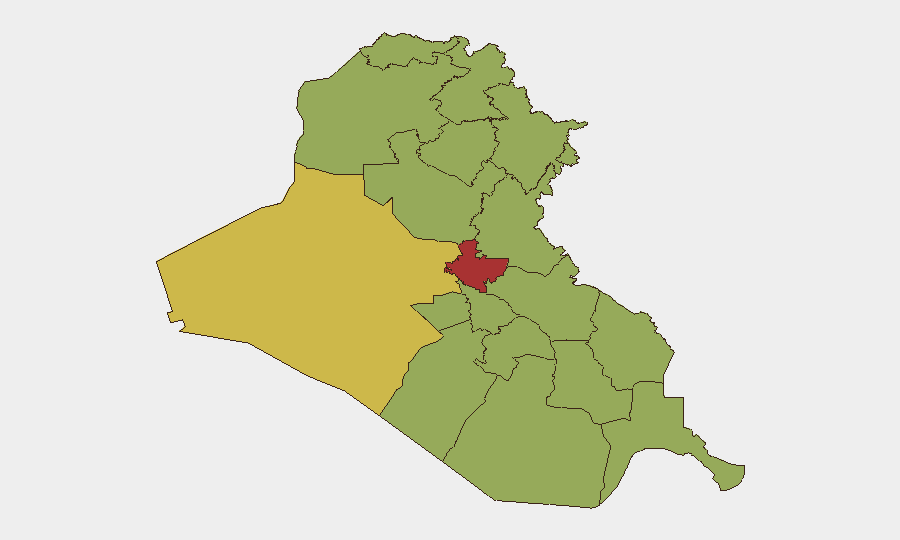
Baghdad Governorate (79.5) significantly outpaces all other regions and remains the primary risk driver, hosting federal institutions, militia HQs, and foreign diplomatic/military presence—making it a natural focal point for both state control and factional violence. Al-Anbar (64) is the second-tier risk zone, historically a Sunni-majority stronghold with persistent ISIS cells and cross-border smuggling networks linking to Syria. All remaining governorates cluster at 49–50, indicating a broad baseline of distributed militia activity, criminal enterprise, and weak state capacity outside Baghdad. The gap between Baghdad and the rest reflects capital-centric risk concentration rather than genuine stability elsewhere.
How GeoBit Would Assist
Intel Sweep and Global Event Feeds enable real-time monitoring of military incidents and cross-border activity; X/Twitter & Telegram OSINT captures militia statements and tactical claims hours before traditional media. AOI Monitoring & Early Warning on Baghdad, Al-Anbar, and border zones provides persistent alerting of checkpoint activity, force movements, and detention sweeps. Network & Actor Analysis maps militia command-and-control, foreign-state proxies, and criminal supply chains. GIS & Spatial Analysis combined with Alternative Route Planning helps security teams avoid high-risk governorates and identify secure transit corridors.
7-Day Outlook
Current signals suggest sustained low-intensity militia and cross-border pressure rather than acute escalation. U.S.–Iraq military coordination and Iranian proxy activity will remain focal points. Expect continued detention operations and border-area friction; no imminent risk of major state-level collapse or capital-area uprising within the next week, though localized violence in Baghdad and Al-Anbar will persist.
Highest-Risk Areas — Ranked
| # | State / Region | Risk |
|---|---|---|
| 1 | Baghdad Governorate | 79.5 |
| 2 | Al-Anbar Governorate | 64 |
| 3 | Nineveh Governorate | 50.9 |
| 4 | Babil Governorate | 49.5 |
| 5 | Wasit Governorate | 49.5 |
| 6 | Al-Qadisiyah Governorate | 49.5 |
| 7 | Dhi Qar Governorate | 49.5 |
| 8 | Al-Muthanna Governorate | 49.5 |
| 9 | Maysan Governorate | 49.5 |
| 10 | Al-Basra Governorate | 49.5 |
| 11 | Al-Najaf Governorate | 49.5 |
| 12 | Saladin Governorate | 49.5 |
Sources
Previous Daily Briefs
A new Iraq brief is written every day — each with its own risk map and downloadable CSV. Here's the last week; use the calendar to go further back.
📅 Browse every day by calendar →
Highlighted days have a brief. Tap a day for that day's map & analysis, or “csv” for that day's dataset ($5).