Situation Summary
Israel remains at the highest global threat level (composite score 100), with 572 tracked events reflecting active multi-front military engagement. The most acute pressure is along the northern Lebanon border, where sustained Hezbollah rocket barrages and Israeli cross-border operations have created a high-tempo exchange cycle over the past 24–48 hours. Parallel lower-intensity operations continue in Gaza, while internal political friction and civil-military tensions are evident in recent event signals. The trajectory indicates sustained elevated threat across northern and southern districts through the immediate term.
Key Developments
- Northern Israel–Lebanon border, June 23, 2026: Hezbollah conducted multiple rocket and explosive-UAV barrages targeting Upper Galilee and Mount Dov positions; IDF reported dozens of launches and interceptions, with localized brush fires near impact sites.
- Overnight rocket barrage, June 22–23, 2026: Hezbollah fired over 50 rockets into northern Israel (Upper Galilee and Golan); most were intercepted or fell in open areas, but widespread air-raid sirens and shelter directives were activated across border communities.
- Nabatieh al‑Fawqa incident, June 23, 2026: Israeli forces opened fire into the Lebanese town during border-security operations; Lebanon-based and Hezbollah sources reported at least two killed and several wounded.
- Israeli security-zone posture, June 23, 2026: Defense Minister Israel Katz stated the IDF will not withdraw from the security zone currently held in southern Lebanon opposite Metula and Kiryat Shmona, signaling intent for continued military presence and cross-border operations.
- Israeli retaliatory strikes, June 22–23, 2026: IDF conducted air and artillery strikes on Hezbollah-linked targets in southern Lebanon in response to rocket salvos; regional media and conflict-monitoring accounts reported visible explosions from Israeli border towns and temporary road closures near IDF positions.
- Northern front alert posture, June 23, 2026: IDF remained on heightened alert with senior officials drawing "red lines" on acceptable Hezbollah activity and signaling readiness to intensify operations if rocket fire persists; separate US-mediated talks with Iran were ongoing in Switzerland.
- Gaza-adjacent operations, recent days through June 23, 2026: IDF conducted targeted airstrikes in northern Gaza against Hamas operatives, including a reported Nukhba operative and three armed militants; while lower-tempo than northern operations, this maintains ongoing threat to Gaza-periphery Israeli communities.
Highest-Risk Areas
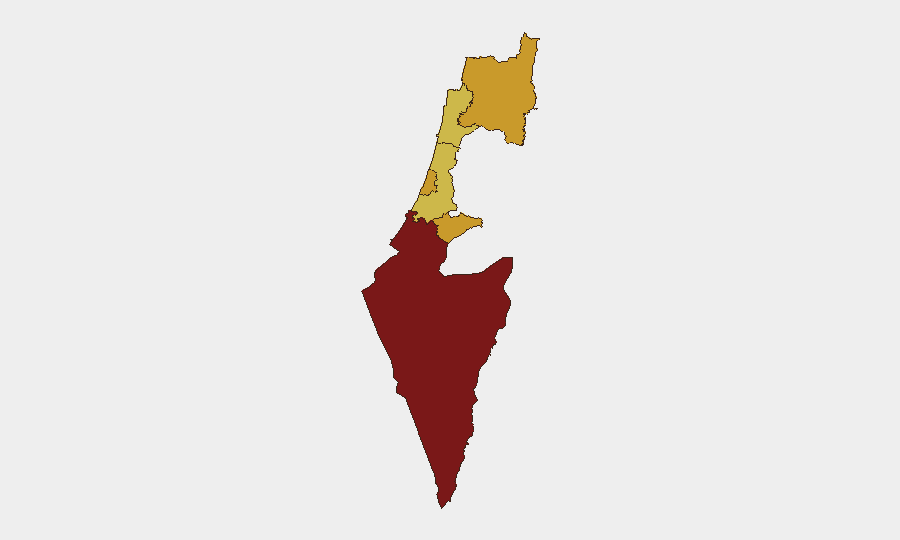
The South District (risk 100) and North District (risk 72.7) dominate the ranking. The South is driven by sustained Gaza-related military operations and infiltration risk; the North by the active Lebanon border fire exchange, Hezbollah rocket barrages, and Israeli cross-border presence in southern Lebanon. Tel-Aviv, Jerusalem, Haifa, and Center districts (scores 70.3–72.5) reflect secondary risk from residual military posture, internal political tensions, and potential secondary strike corridors. Northern communities (Metula, Kiryat Shmona, Upper Galilee) and southern periphery towns face the most direct daily tactical threat.
How GeoBit Would Assist
Security teams should deploy AOI Monitoring & Early Warning on the North District (Lebanon border corridor, Upper Galilee communities) and South District (Gaza periphery) to detect shifts in fire intensity or new militant activity in real time. Conflict & Military battle-mapping and force-structure tracking will clarify IDF disposition and Hezbollah operational tempo. Network & Actor Analysis linked to OSINT fusion (X/Telegram monitoring, YouTube/podcast intelligence, multi-language search) will track diplomatic signals, command statements, and emerging tactical intent from Israeli, Hezbollah, Hamas, and external actors (US, Iran, Lebanon).
7-Day Outlook
The northern border is expected to remain the primary flashpoint; sustained rocket exchanges and Israeli cross-border operations will likely persist through the week, with risk of escalation if either side sustains heavy casualties or hits strategic infrastructure. The South faces lower but continued threat from Gaza-targeted operations and infiltration risk. Diplomatic activity (US-Iran talks) may constrain but is unlikely to immediately reduce field-level fire exchanges.
Highest-Risk Areas — Ranked
| # | State / Region | Risk |
|---|---|---|
| 1 | South District | 100 |
| 2 | North District | 72.7 |
| 3 | Tel-Aviv District | 72.5 |
| 4 | Jerusalem District | 71.5 |
| 5 | Haifa District | 70.6 |
| 6 | Center District | 70.3 |
Sources
Previous Daily Briefs
A new Israel brief is written every day — each with its own risk map and downloadable CSV. Here's the last week; use the calendar to go further back.
📅 Browse every day by calendar →
Highlighted days have a brief. Tap a day for that day's map & analysis, or “csv” for that day's dataset ($5).