Situation Summary
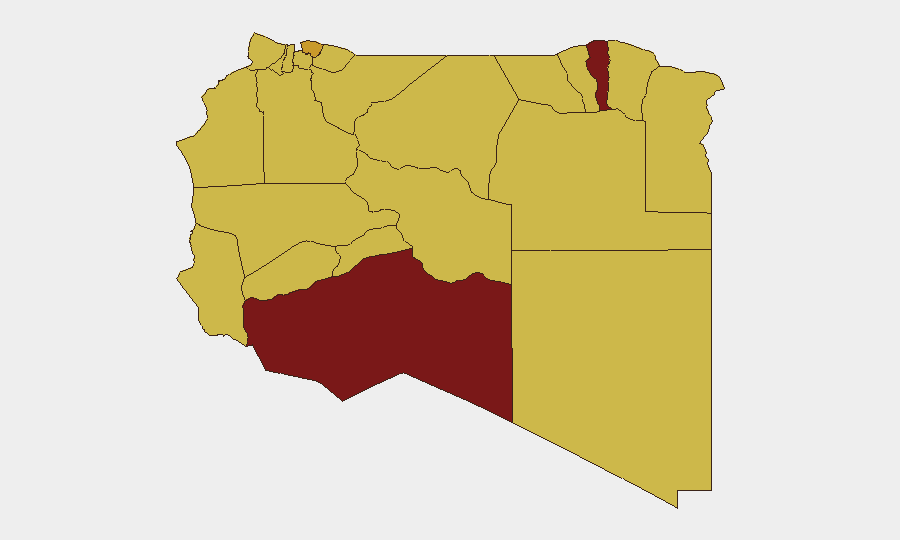
Libya remains at elevated composite threat level (#17 globally, 96/100) with significant fragmentation across political, security, and administrative institutions. The past 48 hours have been characterized by diplomatic tension, border enforcement measures, and institutional realignment discussions rather than reported armed clashes or mass violence. Tripoli continues as the primary risk driver, though southern regions—particularly Murzuq and Jabal al Akhdar—carry the highest localized threat scores. The trajectory suggests continued institutional friction and potential for localized enforcement actions, with limited near-term de-escalation signals.
Key Developments
- Tripoli (June 26): Heightened political and security tension documented amid mixed signals from government, media, and international actors regarding institutional unification efforts; no discrete violent incidents independently verified in open sources for the past 24–48 hours.
- National level / Border enforcement (June 25–26): Both Tripoli-aligned and eastern House of Representatives–appointed authorities formalized entry restrictions targeting Sudanese, Eritrean, Ethiopian, and Somali nationals, signaling tightened border controls and elevated regional diplomatic friction.
- Benghazi / Eastern Libya (June 24–26, ongoing): Benghazi-associated authorities undertook administrative sanctions and entry controls against certain nationals; reported as part of sub-national governance disputes contributing to localized friction.
- Washington, D.C. / Libyan defense establishment (June 26): Libyan defense undersecretary conducted high-level visit with U.S. AFRICOM deputy commander Christopher Boulos to discuss security cooperation and military unification—reflects institutional restructuring rather than acute incident but signals ongoing shifts in Libya's security architecture and international alignments.
- Tripoli (June 26, ongoing context): U.S.-backed institutional unification initiative continues as focus of political maneuvering among Tripoli-based factions; heightened political uncertainty noted with implications for security force alignments in the capital.
Highest-Risk Areas
Murzuq (risk 97.5) and Jabal al Akhdar (87.5) carry the highest sub-national threat scores, driven primarily by historical armed-group presence, smuggling networks, and weak state capacity in Libya's southern interior. Tripoli (72.5) remains the political and administrative epicenter of fragmentation, where institutional disputes, security-force rivalry, and international diplomacy create sustained friction. The mid-tier risk belt—Sirte, Nalut, Ghat, and surrounding coastal/southwestern districts (67–69.5)—reflects ongoing border-control enforcement, localized governance disputes, and residual militant presence. Northern coastal and western border regions show similar elevated baselines, likely driven by migration pressures, fuel smuggling, and arms trafficking linked to regional instability in Tunisia and Sahel.
How GeoBit Would Assist
Security teams with personnel or assets in Libya should deploy Area-of-Interest (AOI) Monitoring & Early Warning capabilities focused on Tripoli, Benghazi, and key border crossings to detect shifts in checkpoint activity, administrative enforcement, or security-force positioning before they escalate to operational risk. Multi-language OSINT and social-media intelligence (X/Telegram/YouTube) should be run continuously against Tripoli and eastern government sources to track political messaging and security-establishment announcements that signal institutional moves or localized crackdowns. Routing & Network Analysis should be updated to reflect current border restrictions and entry bans, enabling duty-of-care teams to validate travel permissions and alternative routing for staff movements.
7-Day Outlook
Expect continued institutional and diplomatic maneuvering, with possible additional administrative enforcement actions or border-control tightening linked to the Sudan/East Africa regional dynamics. No large-scale armed escalation is signaled in available reporting, but localized incidents or enforcement operations in border zones and southern interior remain plausible. Political uncertainty in Tripoli will likely persist absent visible progress on unification talks.
Highest-Risk Areas — Ranked
| # | State / Region | Risk |
|---|---|---|
| 1 | Murzuq | 97.5 |
| 2 | Jabal al Akhdar | 87.5 |
| 3 | Tripoli | 72.5 |
| 4 | Sirte | 69.1 |
| 5 | Nalut | 67.5 |
| 6 | Ghat | 67.5 |
| 7 | Baladiyah Surman | 67.5 |
| 8 | Az Zawiya District | 67.5 |
| 9 | Wadi al Shatii | 67.5 |
| 10 | Wadi al Hayaa | 67.5 |
| 11 | Kufra | 67.5 |
| 12 | Nuqat al Khams | 67.5 |
Sources
Previous Daily Briefs
A new Libya brief is written every day — each with its own risk map and downloadable CSV. Here's the last week; use the calendar to go further back.
📅 Browse every day by calendar →
Highlighted days have a brief. Tap a day for that day's map & analysis, or “csv” for that day's dataset ($5).