Situation Summary
Libya remains at composite threat level #26 globally with 36 tracked security events, driven primarily by institutional instability, diplomatic friction, and localized cross-border incidents rather than active large-scale conflict. The past 48 hours show a pattern of political maneuvering—security leadership changes, ministry–industry tensions, and foreign-relations hardening—alongside minor criminal activity in border zones. No major violent escalations or coordinated attacks have been confirmed in the latest reporting cycle.
Key Developments
- Tripoli, 4 July: Prime Minister Abdulhamid Dbeibah convened a meeting with newly appointed Intelligence Service chief Abdulmajid Meliqta to review "latest political and security developments," signaling active reshaping of the national security apparatus and intelligence portfolio priorities.
- Tripoli, 4 July: UNSMIL convened a "Security Track" meeting under the Structured Dialogue framework to discuss security sector reform and electoral credibility, reflecting UN-brokered institutional work on stability rather than crisis response.
- National, 4 July: Government formally rejected Italian diplomatic engagement; concurrent reporting noted ministry–industry relation deterioration, indicating a pattern of tightened foreign relations and intra-governmental friction without confirmed violence.
- Judicial/Medical Sector, 3 July: A detention incident involving a judge and a doctor was recorded; specific location and investigative motive remain unclear, but the incident suggests either political purges or misconduct investigation activity in professional sectors.
- Tripoli, 2 July (evening): A fire at a security headquarters was reported; Libyan authorities initiated an investigation. Status as accidental or deliberate remains unconfirmed; incident flags potential infrastructure vulnerability.
- Chad–Libya Border, 2 July: Two abduction/hostage incidents involving Chadian nationals were reported in border-adjacent areas, continuing a pattern of cross-border criminal and irregular detention activity in southern Libya's frontier zones.
- Libya–Tunisia Border, 2 July: A southern Tunisia earthquake was felt in Libyan border regions, briefly affecting infrastructure perception and travel risk; no major damage inside Libya has been reported.
Highest-Risk Areas
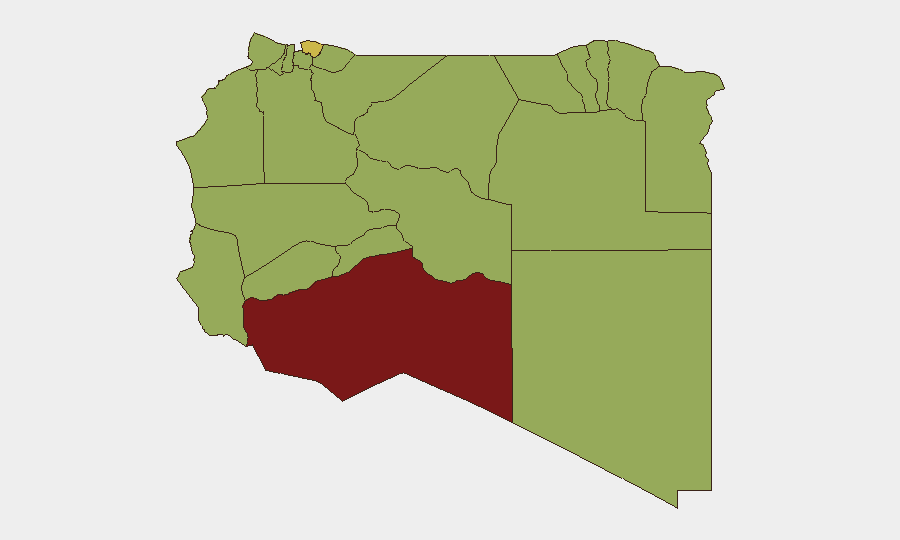
Murzuq (80.3) stands as the single highest-risk sub-national zone, driven by its position in Libya's southern periphery—a region historically associated with smuggling networks, cross-border incursions, and weak state control. Tripoli (63.6), the capital, ranks second, reflecting political volatility, institutional tensions, and concentration of government targets and foreign missions. Kufra (51.9) and Nalut (50.3) follow, with elevated scores likely reflecting border proximity, trafficking vulnerability, and limited security force reach. The clustering of multiple regions at 50.3 suggests a broad baseline of instability across Libya's periphery and interior, with southern and western border zones particularly exposed to transnational criminal and irregular armed activity.
How GeoBit Would Assist
Security teams with personnel or assets in Libya should prioritize AOI Monitoring & Early Warning on Murzuq and Tripoli with persistent, real-time alerting on detention, armed activity, and infrastructure incidents. Network & Actor Analysis combined with OSINT fusion (social media, Telegram, local media) would flag emerging ministerial or factional tensions before they escalate into operational risk. Routing & Network Analysis and satellite imagery would enable alternative travel planning and site-security assessments in high-risk zones, particularly for movements in or near Tripoli and the southern border corridor.
7-Day Outlook
Institutional reshaping under Dbeibah and the new intelligence chief will likely continue with further security-sector announcements or minor personnel changes. Political friction with Italy and within domestic ministries may harden further, but armed escalation remains unlikely in the near term. Cross-border detention incidents in the south are expected to persist; personnel transit near Chad–Libya boundaries should assume elevated baseline risk.
Highest-Risk Areas — Ranked
| # | State / Region | Risk |
|---|---|---|
| 1 | Murzuq | 80.3 |
| 2 | Tripoli | 63.6 |
| 3 | Kufra | 51.9 |
| 4 | Nalut | 50.3 |
| 5 | Ghat | 50.3 |
| 6 | Baladiyah Surman | 50.3 |
| 7 | Az Zawiya District | 50.3 |
| 8 | Wadi al Shatii | 50.3 |
| 9 | Wadi al Hayaa | 50.3 |
| 10 | Nuqat al Khams | 50.3 |
| 11 | Jafara | 50.3 |
| 12 | Murqub | 50.3 |
Sources
Previous Daily Briefs
A new Libya brief is written every day — each with its own risk map and downloadable CSV. Here's the last week; use the calendar to go further back.
📅 Browse every day by calendar →
Highlighted days have a brief. Tap a day for that day's map & analysis, or “csv” for that day's dataset ($5).
Atlas — our AI intelligence desk — emails them this snapshot personally. Nothing else, no list.