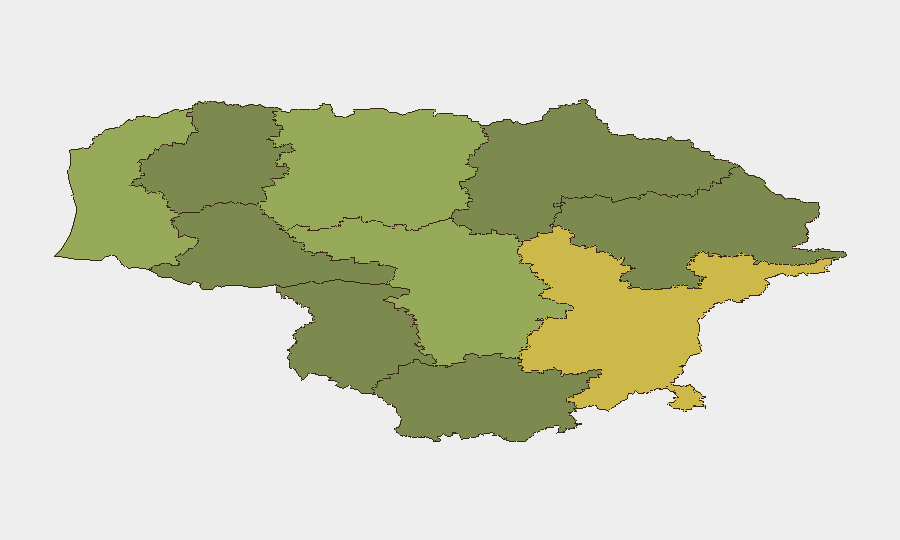
Situation Summary
Lithuania remains a low-absolute-threat environment (global rank #124) but faces elevated hybrid-threat pressure and transnational security complications as of mid-August 2026. The past 48 hours have surfaced three concurrent developments: confirmation of Lithuanian suspects in a German explosive-drone incident, disclosure of a concealed border-tunnel incursion and leadership resignation at the State Border Guard Service, and reported four-fold rise in illegal crossing attempts from Belarus. These signal interconnected risks spanning terrorism/violent extremism, organized migration pressure, and state-level hybrid activity.
Key Developments
- Vilnius / Leipzig (Germany nexus) – 19 August – Lithuanian Prosecutor General Nida Grunskienė confirmed that suspects with Lithuanian ties are under investigation for connection to an explosive-laden drone that struck aircraft at Leipzig Airport in early August; DNA from the drone matches material linked to prior incendiary-parcel cases handled by Vilnius District Court, indicating an active transnational terrorism network with Lithuanian nodes now subject to joint UK/Netherlands/Latvia/German investigation.[9][14]
- Vilnius District Court – 19 August – Live judicial proceedings are underway on incendiary parcels shipped from Lithuania internationally, with a separate pre-trial investigation involving approximately ten wanted suspects; both cases are now linked to the Leipzig explosive-drone plot, establishing a domestic terrorism/violent-extremism prosecution pipeline.[9][14]
- Lazdijai District, Lithuania–Belarus border – incident 26 July, disclosed 18–19 August – Border guards discovered an 11-meter tunnel under the border near Kapčiamiestis; four migrants were detained, but approximately 20 additional migrants emerged, overwhelming the guard contingent and forcing withdrawal; the concealed incident triggered resignation of State Border Guard Service Chief Rustamas Liubajevas on 18–19 August when disclosed by Interior Minister Martynas Katelynas.[3]
- Lithuania–Belarus border (multiple sectors) – 16 August report (covering 1–16 August) – Border service recorded 152 illegal crossing attempts in the first 16 days of August, approximately four times higher than earlier periods, indicating sustained migration-pressure and hybrid-activity campaign from Belarus-side actors.[4]
- Lithuanian border / national – 19 August – Baltic media report official warnings urging citizens not to panic over potential Russian "provocations," reflecting heightened concern about hybrid threats (drones, undersea infrastructure targeting, shadow-fleet activity, and organized migrant pressure) across the Baltic region.[5][10][12]
- Vilnius, Kaunas, Palanga, Elektrėnai – 18 August crime roundup – Police logged multiple serious incidents: vehicle theft and recovery across jurisdictions, suspected arson in Elektrėnai municipality, and fraud extraction (>€10,000) in Vilnius, illustrating ongoing organized and opportunistic crime activity.[1]
Highest-Risk Areas
Vilnius County (risk 68) and Kaunas County (risk 58) are the primary drivers of national risk, reflecting concentration of transnational crime, terrorism-investigation activity, and organized fraud in the two largest urban centers. The border regions—particularly Lazdijai District's approach to Belarus—show acute hybrid-threat vulnerability, evidenced by the tunnel discovery and sustained migration pressure. Klaipeda County (risk 52) likely reflects maritime-route and logistics vulnerabilities associated with shipping and port activity; secondary tier counties (Siauliai, Panevezys, Taurage) signal distributed organized-crime and smuggling networks.
How GeoBit Would Assist
Security teams should deploy AOI Monitoring & Early Warning on the Lithuania–Belarus border (Lazdijai, Vilnius, and Kaunas sectors) to track migration flows, tunnel construction, and organized-movement patterns in near real time. Network & Actor Analysis and OSINT fusion capabilities would map the transnational terror-finance and logistics ties linking Lithuanian suspects to the Leipzig incident and international cells. Routing & Network Analysis supports alternative-journey planning for personnel and supply chains bypassing high-risk border and urban sectors.
7-Day Outlook
Migration and hybrid-activity pressure from Belarus is likely to persist through August; the 152 crossing attempts in 16 days suggest sustained coordination. Judicial proceedings on incendiary parcels and the Leipzig investigation will remain active, creating secondary security complexity for organizations with exposure in Vilnius or Eastern Europe more broadly. Border-leadership transition and operational learning from the Lazdijai tunnel incident may create short-term procedural friction at crossing points.
Highest-Risk Areas — Ranked
| # | State / Region | Risk |
|---|---|---|
| 1 | Vilnius County | 68 |
| 2 | Kaunas County | 58 |
| 3 | Klaipeda County | 52 |
| 4 | Siauliai County | 42 |
| 5 | Panevezys County | 38 |
| 6 | Taurage County | 35 |
| 7 | Utena County | 33 |
| 8 | Alytus County | 32 |
| 9 | Telsiai County | 28 |
| 10 | Marijampole County | 25 |
Sources
Previous Daily Briefs
A new Lithuania brief is written every day — each with its own risk map and downloadable CSV. Here's the last week; use the calendar to go further back.
- August 17, 2026
- August 15, 2026
- August 13, 2026
- August 11, 2026
- August 9, 2026
- August 7, 2026
- August 5, 2026
📅 Browse every day by calendar →
Highlighted days have a brief. Tap a day for that day's map & analysis, or “csv” for that day's dataset ($5).
Atlas — our AI intelligence desk — emails them this snapshot personally. Nothing else, no list.