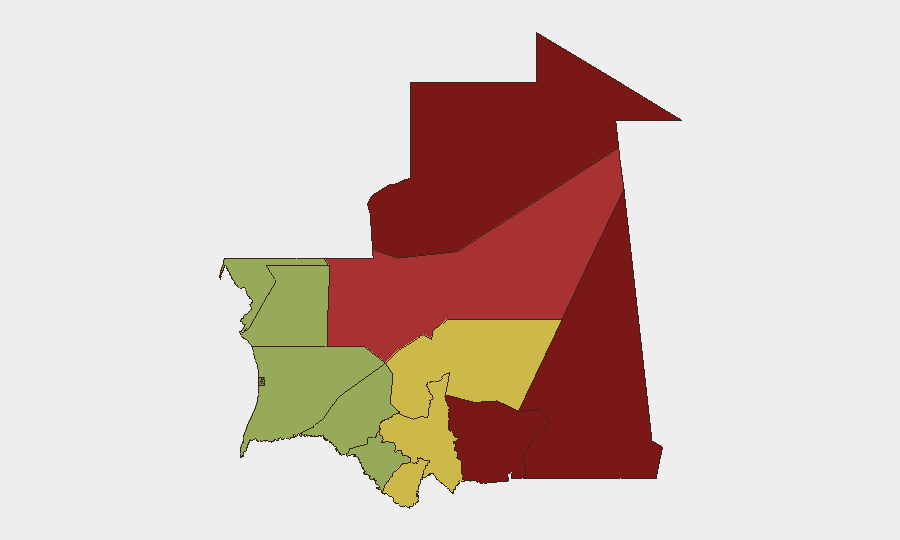
Situation Summary
Mauritania remains a low-frequency threat environment at the national level (composite threat score 7; rank #139 globally), with no major security incidents recorded in the current 24–48-hour window. However, sub-national risk is heavily concentrated in the Saharan northeast and east—particularly Tiris Zemmour (risk 95), Hodh Ech Chargui (85), and Hodh El Gharbi (80)—where terrorism, armed smuggling, and transnational militant activity persist. The capital and coastal zones remain relatively stable, though governance and transparency concerns continue to generate organized political dissent.
Key Developments
- Maritime migrant rescue, Nouadhibou (16–17 August 2026): Mauritanian coast guard recovered 42 irregular migrants (32 Gambians, 10 Senegalese, including four women and three children) from a disabled vessel off the northern coast. The boat was towed to Nouadhibou port. This reflects ongoing maritime irregular migration pressure in northern waters, consistent with regional smuggling patterns.
- Anti-corruption sit-in, Nouakchott (17 August 2026): The opposition alliance "Forces du Salut" organized a peaceful sit-in at the Inspection générale de l'État demanding public disclosure of names of corrupt officials and increased state transparency. The protest was non-violent and geographically contained to the capital's administrative district.
- No active conflict, terrorism, or civil unrest alerts: As of 17–18 August 2026, no discrete terrorism incidents, armed clashes, major civil disorder, or critical infrastructure disruption have been reported within Mauritania's borders or territorial waters in the current cycle.
Highest-Risk Areas
The top five regions—Tiris Zemmour, Hodh Ech Chargui, Hodh El Gharbi, Adrar, and Tagant—account for the overwhelming majority of Mauritania's composite risk and are characterized by remote desert terrain, porous borders with Algeria and Mali, and persistent activity by transnational armed groups (including ISIS and AQIM affiliates). The ranking reflects chronic undergovernance, weapons trafficking, and militant recruitment networks rather than active large-scale conflict in the current period. Southern border regions (Guidimaka, Assaba, Gorgol) present secondary but measurable risk from cross-border criminal and smuggling activity. The capital and coastal areas (Dakhlet Nouadhibou, Brakna, Trarza) remain lower-risk zones, though maritime irregularity and governance challenges warrant routine monitoring.
How GeoBit Would Assist
Security teams with personnel or assets in Mauritania should deploy AOI (area-of-interest) monitoring and early warning on Tiris Zemmour and the eastern border zones to detect cross-border militant movement, weapons transit, and terrorist propaganda. OSINT fusion (X/Telegram, Arabic-language sources, radio SIGINT) and network analysis of opposition groups and state actors provide low-cost, persistent visibility into political tensions and governance risks in Nouakchott. Maritime tracking and satellite imagery analysis over Nouadhibou and northern waters support duty-of-care monitoring of maritime irregular migration routes and coastal security incidents that may affect port operations or offshore personnel.
7-Day Outlook
Near-term trajectory remains stable at the national level, with no indicators of imminent escalation in terrorism, major civil unrest, or political instability. Regional risk in the Saharan northeast will persist as a chronic, low-frequency but high-impact threat; routine OSINT and early-warning monitoring is warranted for organizations with operations or supply chains dependent on eastern border corridors. Maritime migration pressure off Nouadhibou is likely to continue seasonally.
Highest-Risk Areas — Ranked
| # | State / Region | Risk |
|---|---|---|
| 1 | Tiris Zemmour | 95 |
| 2 | Hodh Ech Chargui | 85 |
| 3 | Hodh El Gharbi | 80 |
| 4 | Adrar | 78 |
| 5 | Tagant | 68 |
| 6 | Guidimaka | 65 |
| 7 | Assaba | 62 |
| 8 | Gorgol | 58 |
| 9 | Trarza | 55 |
| 10 | Inchiri | 52 |
| 11 | Brakna | 48 |
| 12 | Dakhlet Nouadhibou | 45 |
Sources
Previous Daily Briefs
A new Mauritania brief is written every day — each with its own risk map and downloadable CSV. Here's the last week; use the calendar to go further back.
- August 16, 2026
- August 14, 2026
- August 12, 2026
- August 10, 2026
- August 8, 2026
- August 6, 2026
- August 5, 2026
📅 Browse every day by calendar →
Highlighted days have a brief. Tap a day for that day's map & analysis, or “csv” for that day's dataset ($5).
Atlas — our AI intelligence desk — emails them this snapshot personally. Nothing else, no list.