Situation Summary
Poland remains a moderate-risk environment (rank #115 globally, composite score 7) with security stress concentrated in the capital region but distributed across multiple threat vectors—cyber, border management, organized crime, and civil unrest. The past 48 hours have surfaced a spike in discrete incidents spanning infrastructure cyberattacks, smuggling interdiction, and a significant fire in central Warsaw, alongside ongoing judicial and political friction. The country's proximity to Belarus and Ukraine, combined with active cybercriminal targeting of Polish institutions and users, sustains elevated baseline risk despite overall national stability.
Key Developments
- Warsaw, Targówek district | 22 July, late evening – A large fire at an auto workshop and showroom on ul. Krasnobrodzka required 38 fire service units and caused localized traffic disruption; cause under investigation.
- National | 22 July – Central Office for Combating Cybercrime dismantled a teenager-run DDoS-for-hire operation (nine suspects, ages 12–16); 13 computers and 9 mobile phones seized. Signals organized juvenile cybercriminal infrastructure.
- National | 22–23 July – Internal Security Agency (ABW) detained five individuals for attempted illegal transfer of sensitive goods to Russia; framed as security-related smuggling with ongoing investigation.
- National | 22 July – Daily police report: 16,982 interventions, 632 suspects apprehended in flagrante, 429 wanted persons detained, 343 impaired drivers, 69 road accidents (5 fatalities, 80 injuries). Reflects steady operational demand and traffic hazard.
- Poland–Belarus border | Effective 20 July (announced within 48h) – Ministry of Interior extended temporary, area-specific suspension of asylum claims for a further 60 days, citing border-security and irregular-crossing prevention.
- National | Last 48 hours – Minister for Digital Affairs reiterated recent cyberattacks on University of Warsaw IT infrastructure, Polish Space Agency, Polish Anti-Doping Agency, and firm EuroCert (PESEL and ID data compromised). Underscores persistent targeting of public and quasi-public institutions.
- National | Last 48 hours – Active cybercriminal groups actively phishing Gmail users in Poland; elevated email-borne malware and credential-harvesting risk for corporate and individual users.
- National | Within 48 hours – Council of Ministers approved draft amendments to Anti-Terrorism Act and special legislation for 2027 World Scout Jamboree security, signaling institutional response to evolving terrorism and mass-gathering risk assessment.
Highest-Risk Areas
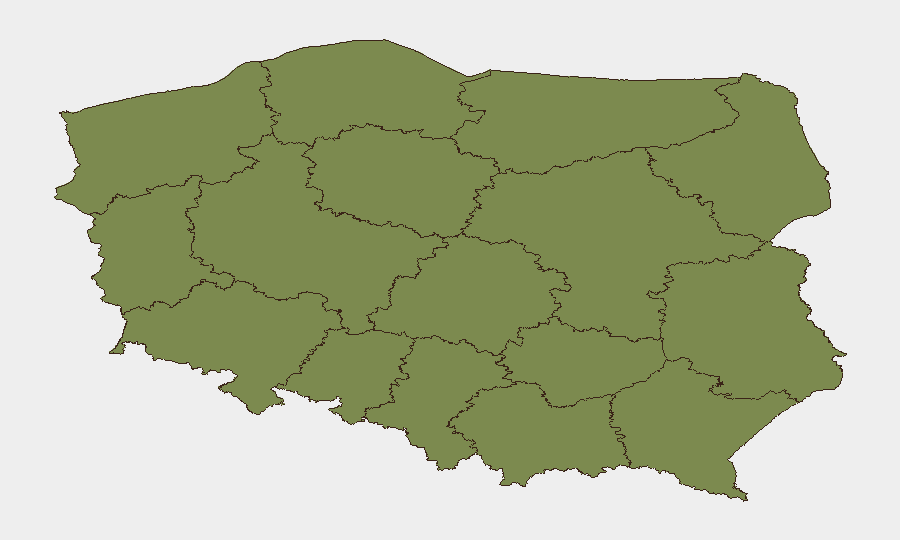
Masovian Voivodeship (Warsaw and surroundings) dominates sub-national risk at 31.4—a 7.5× multiplier over the second-ranked region—reflecting the concentration of national political, economic, and digital infrastructure in the capital, plus corresponding targeting by cybercriminals, smuggling networks, and actors with institutional or geopolitical motive. Silesian Voivodeship (4.2) and Łódź Voivodeship (3.2) represent secondary urban-industrial risk zones; all other regions cluster at 1.4. Warsaw's role as seat of government, financial hub, and critical IT infrastructure explains the disparity. The recent fire, cyberattacks on national agencies, and smuggling interdiction all center on or radiate from the capital region.
How GeoBit Would Assist
Security teams would deploy Intel Sweep and X/Telegram OSINT for real-time detection of emerging cyber campaigns targeting Polish corporate email and institutional systems; AOI Monitoring & Early Warning on Masovian Voivodeship and the Poland–Belarus border to flag irregular activity and attempted contraband flows; and Network & Actor Analysis to correlate juvenile cybercriminal infrastructure, smuggling networks, and state-adjacent threats. GIS & Spatial Analysis would support risk-weighted asset routing and facility-security posture in high-concentration zones.
7-Day Outlook
Near-term risk trajectory remains elevated but not rapidly escalating. Cyber targeting of Polish institutions and users will likely persist; border-management tensions and smuggling interdiction may spike around the extended asylum suspension. The adoption of amended anti-terrorism legislation suggests official expectation of sustained or evolving terrorism risk, particularly around the 2027 Jamboree. No imminent systemic destabilization is signaled, but operational friction and discrete incident frequency warrant sustained monitoring.
Highest-Risk Areas — Ranked
| # | State / Region | Risk |
|---|---|---|
| 1 | Masovian Voivodeship | 31.4 |
| 2 | Silesian Voivodeship | 4.2 |
| 3 | Łódź Voivodeship | 3.2 |
| 4 | Warmian-Masurian Voivodeship | 1.4 |
| 5 | Subcarpathian Voivodeship | 1.4 |
| 6 | Podlaskie Voivodeship | 1.4 |
| 7 | Lublin Voivodeship | 1.4 |
| 8 | West Pomeranian Voivodeship | 1.4 |
| 9 | Lubusz Voivodeship | 1.4 |
| 10 | Lower Silesian Voivodeship | 1.4 |
| 11 | Pomeranian Voivodeship | 1.4 |
| 12 | Kuyavian-Pomeranian Voivodeship | 1.4 |
Sources
Previous Daily Briefs
A new Poland brief is written every day — each with its own risk map and downloadable CSV. Here's the last week; use the calendar to go further back.
📅 Browse every day by calendar →
Highlighted days have a brief. Tap a day for that day's map & analysis, or “csv” for that day's dataset ($5).
Atlas — our AI intelligence desk — emails them this snapshot personally. Nothing else, no list.