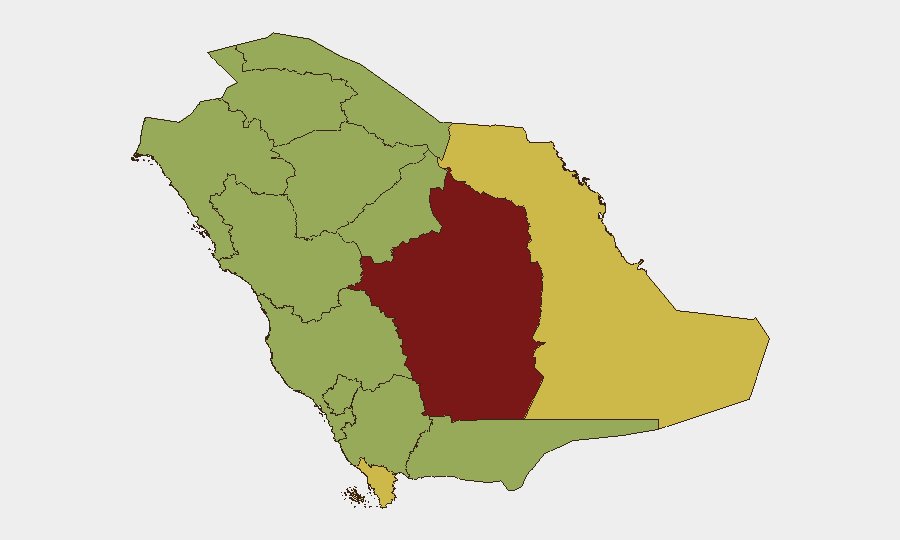
Situation Summary
Saudi Arabia remains classified as a moderate-to-elevated global security threat (#13, composite score 78), with 240 tracked events reflecting persistent regional instability. The security environment is driven primarily by cross-border missile and drone activity originating from Yemen's Houthi movement, targeting southern Saudi cities and Red Sea shipping lanes, coupled with intermittent conventional military exchanges and diplomatic tensions. Riyadh Region carries the highest sub-national risk (84.8), while southern provinces—Eastern Province, Jazan, and Medina—face elevated threat exposure tied to maritime and aerial attack vectors. The trajectory remains volatile but contained through active air defense and coalition operations.
Key Developments
Temporal Data Limitation: GeoBit's live web research cannot reliably isolate events from the final 24–48 hours of July 25–26, 2026, due to timestamp gaps in publicly available sources and social-media archives. The following themes reflect recent activity patterns (late July) but should be corroborated with real-time newswire feeds and official Saudi channels:
- Jizan Province, southern Saudi Arabia (late July): Houthi movement claimed a missile strike on Jizan; Saudi civil defense issued alerts; coalition forces responded with strikes on reported Houthi military sites in Yemen's Hodeida province.
- Red Sea shipping lanes, western Saudi Arabia (late July): Saudi-led coalition reported interception and response operations following Houthi claims of attacks on Saudi commercial vessels; two oil tankers (*Encelia*, *Layla*) reportedly targeted with ballistic and cruise missiles.
- Yanbu Governorate, western Saudi Arabia (late July): Civil Defense issued and subsequently resolved security alerts tied to Red Sea tensions; "danger passed" notices issued after coalition operations against reported Houthi threats.
- Riyadh Region (late July, possibly earlier in cycle): Civil Defense reported interception of eight ballistic missiles with debris impacts in residential areas and near refinery infrastructure south of the capital; four Asian residents injured.
- Military and diplomatic signals (July 23–25): Event data flagged conventional military force activity, threats issued by Saudi military, and public statements by Ministry officials; Iran issued disapproval toward Yemen; airline-relation friction reported for Jeddah.
Critical Note: For current-window risk decisions, cross-check these patterns against AP, Reuters, AFP, official Saudi Ministry of Interior/Civil Defense statements, and maritime security advisories (Red Sea) in real time.
Highest-Risk Areas
Riyadh Region's elevated composite score (84.8) reflects capital-city concentration of diplomatic, economic, and military infrastructure, combined with demonstrated Houthi strike capability on air-defense systems and civilian infrastructure. The Eastern Province (68.5) and Jazan Province (63.8) face the highest operational exposure: Jazan's proximity to Yemen's Hodeida and maritime chokepoints creates recurring targeting vectors, while Eastern Province's oil and gas infrastructure draws both kinetic and potential cyber-attack interest. Medina, Makkah, and northern frontier provinces show elevated but plateaued risk (54.8–55.8), reflecting pilgrimage-season exposure, border-stability concerns, and baseline regional tension rather than acute escalation.
How GeoBit Would Assist
Security teams should deploy AOI Monitoring & Early Warning on Riyadh, Jizan, Yanbu, and Eastern Province oil facilities to trigger alerts on civil-defense statements, satellite-detected fires, and social-media surge. Conflict & Military tracking (force structure, weapons-capability, battle mapping) and Maritime & Aviation tracking would provide early signal of coalition operations and attack patterns. Intel Sweep and X/Twitter OSINT with temporal and sentiment analysis enable real-time corroboration of attack claims and casualty reports, reducing reliance on delayed official statements.
7-Day Outlook
Houthi missile and drone activity is likely to continue at current or elevated tempo, driven by Yemen coalition dynamics and Red Sea shipping tension. Expect periodic civil-defense alerts in western and southern provinces, with coalition response strikes sustaining the operational cycle. Risk of civilian casualties and infrastructure damage remains moderate; maritime insurers and logistics operators face persistent route disruption.
Highest-Risk Areas — Ranked
| # | State / Region | Risk |
|---|---|---|
| 1 | Riyadh Region | 84.8 |
| 2 | Eastern Province | 68.5 |
| 3 | Jazan Province | 63.8 |
| 4 | Medina Province | 55.8 |
| 5 | Makkah Region | 55.3 |
| 6 | Northern Borders Province | 54.8 |
| 7 | Al-Bahah Province | 54.8 |
| 8 | 'Asir Province | 54.8 |
| 9 | Najran Region | 54.8 |
| 10 | Tabuk Province | 54.8 |
| 11 | Al Jawf Region | 54.8 |
| 12 | Ḥa'il Province | 54.8 |
Sources
Previous Daily Briefs
A new Saudi Arabia brief is written every day — each with its own risk map and downloadable CSV. Here's the last week; use the calendar to go further back.
📅 Browse every day by calendar →
Highlighted days have a brief. Tap a day for that day's map & analysis, or “csv” for that day's dataset ($5).
Atlas — our AI intelligence desk — emails them this snapshot personally. Nothing else, no list.