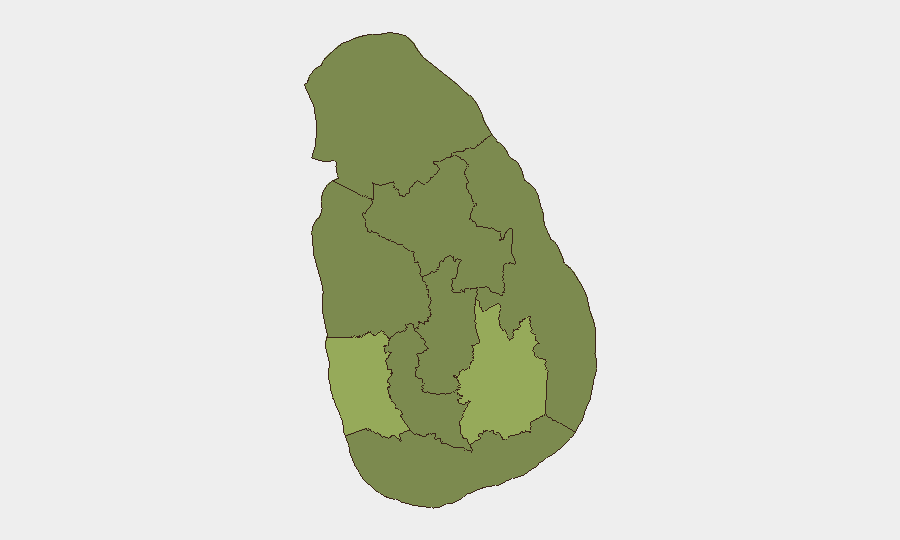
Situation Summary
Sri Lanka's security environment remains fractured across institutional, judicial, and civil-military lines. Over the past 48 hours, multiple high-level actors—including the Chief Justice, Ministry, Police, and military factions—have issued conflicting public statements and demonstrations, signaling deep governance tension. Uva Province dominates sub-national risk (55.5), more than a third above the national average, while Western and Northern provinces remain elevated. The composite national threat score of 37 reflects institutional instability rather than a single dominant threat vector.
Key Developments
- Judicial-Executive Clash (2026-07-04, Colombo region). Chief Justice issued public statement; Colombo authority rejected a judicial order same day. A lawyer invoked conventional military force language in judicial context. These signals indicate breakdown in rule-of-law deference and potential for institutional paralysis affecting corporate compliance and contract enforcement.
- Police Investigation & Ministry Contradiction (2026-07-04–05). Police announced investigation while Ministry issued contradictory public statement. No location specified in signals, but suggests investigative authority fragmentation at national level, complicating corporate reporting obligations and transparency.
- Military Demonstrations (2026-07-04). Both military-initiated and anti-military street rallies occurred same day; SRI LANKA authority also demonstrated *against* military. Dual mobilization suggests factional or hierarchical breakdown within armed forces or civilian-military relations. No casualty data in signals; location unconfirmed.
- Threats Against Judicial System (2026-07-04). Unattributed threat against judicial system recorded. Combined with Chief Justice statement and Colombo rejection, indicates potential security risk to court operations, legal professionals, and corporate legal proceedings.
- Media & Human Rights Rejection (2026-07-04). Human rights group rejected media reporting; Iranian entity disapproved Tamil-related messaging. These are lower-order signals but reflect polarization and potential disinformation/counter-narrative environment.
- Business Disapproval Signal (2026-07-04). Unspecified disapproval registered in business sector. Likely reflects investor or corporate concern over governance instability; context required.
Highest-Risk Areas
Uva Province (55.5) is the dominant hotspot—more than 40% above national average and significantly above Western/Northern provinces. Drivers are unclear from event signals alone but may reflect historic Tamil-Muslim tensions, land disputes, or localized state capacity gaps. Western Province (40.5), encompassing Colombo and its hinterland, concentrates institutional actors and thus institutional risk; the judicial-executive clash signals map here. Northern Province (39.6) historically reflects post-conflict residue and community tensions. Together, these three provinces account for the measurable deviation from the global baseline.
How GeoBit Would Assist
Security teams should deploy Intel Sweep and X/Twitter OSINT (geotagged, last-48-hour filter) across Colombo, Kandy, Jaffna, and Galle to surface eyewitness confirmation of military movements and protest locations. Network & Actor Analysis would map judicial-executive-police relationships to predict which institutional actors control enforcement and permitting. Early Warning & Prediction and AOI Monitoring focused on Uva Province would alert to local escalation before it reaches national media, enabling precautionary asset repositioning.
7-Day Outlook
Institutional tension is likely to persist or deepen absent mediation or leadership clarity; the volume and speed of contradictory statements (four in 48 hours) suggest crisis-mode decision-making. Security incidents (protest violence, administrative disruption, or isolated threats) may spike in Uva and Western provinces as factions mobilize. Corporate teams should prepare contingency protocols for legal-process delays, local movement restrictions, and staff safety in higher-risk districts.
Highest-Risk Areas — Ranked
| # | State / Region | Risk |
|---|---|---|
| 1 | Uva Province | 55.5 |
| 2 | Western Province | 40.5 |
| 3 | Northern Province | 39.6 |
| 4 | North Central Province | 27.4 |
| 5 | North Western Province | 25.5 |
| 6 | Central Province | 25.5 |
| 7 | Eastern Province | 25.5 |
| 8 | Sabaragamuwa Province | 25.5 |
| 9 | Southern Province | 25.5 |
Sources
Previous Daily Briefs
A new Sri Lanka brief is written every day — each with its own risk map and downloadable CSV. Here's the last week; use the calendar to go further back.
📅 Browse every day by calendar →
Highlighted days have a brief. Tap a day for that day's map & analysis, or “csv” for that day's dataset ($5).
Atlas — our AI intelligence desk — emails them this snapshot personally. Nothing else, no list.