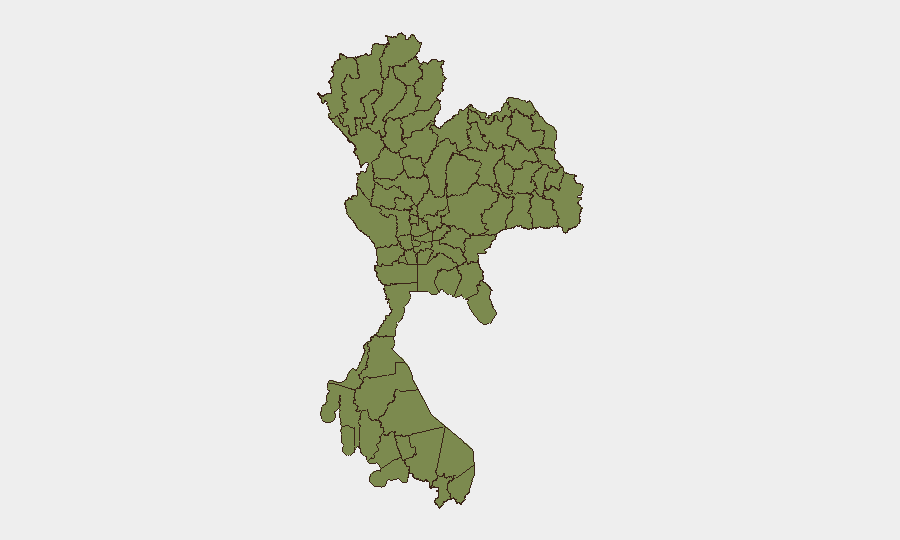
Situation Summary
Thailand's security environment remains stable at the national level (rank #76 globally, composite threat score 21) but exhibits acute geographic fragmentation, with Bangkok and the southern deep-south provinces (Narathiwat, Chiang Rai, Trang) accounting for the majority of tracked threat events. Active law-enforcement operations against organized crime, cryptocurrency theft rings, and ongoing counterinsurgency follow-up in Narathiwat dominate the current threat picture. No major civil unrest, mass-casualty events, or infrastructure collapse has occurred in the past 48 hours; the risk trajectory remains localized rather than escalatory.
Key Developments
- Narathiwat Province, Ra-ngae District (July 24–25): Security forces sustained manhunt and investigative operations following the July 22 checkpoint attack (five paramilitary rangers killed, six civilians injured); authorities recovered an abandoned pickup truck and shifted investigative focus to motorcycle scouts suspected of conducting pre-attack surveillance and guiding assailants.
- Bangkok, Huai Khwang District (July 20–21): Police conducted a narcotics raid on an illegal pub, arresting 11 suspects and seizing drugs and assets; incident reflects routine organized-crime enforcement in the capital consistent with Bangkok's elevated threat ranking.
- Bangkok, Airport Rail Link (July 24): Engineers resolved a faulty track switch at Khlong Tan maintenance depot that had disrupted service; normal 05:30–00:00 schedule restored, reducing travel-risk friction for corporate and passenger movements.
- Thailand, Nationwide (July 24–25): Department of Special Investigations continued enforcement under "Operation Silent Vault," pursuing cryptocurrency-theft and money-laundering charges tied to 2,000 illegal Bitcoin miners linked to Chinese organized crime and corrupt Thai officials; electricity theft valued at approximately 22 million baht monthly.
- Northeast Thailand, Mekong River Zone (July 20–21): Authorities issued flood alerts across five provinces following elevated discharge from Laos's Nam Theun 1 dam; forecasts indicated 1.3-metre Mekong River rise with associated humanitarian and displacement risk.
Highest-Risk Areas
Bangkok dominates the sub-national risk profile (score 33.5), driven by organized-crime enforcement, drug trafficking networks, and urban policing activity. Narathiwat Province (18.7) remains the second-highest-risk zone due to ongoing paramilitary-insurgent clashes and the July 22 checkpoint attack aftermath; Chiang Rai (13.4) and Trang (11.6) provinces follow, reflecting persistent deep-south instability and cross-border trafficking patterns. The remaining top-ten regions exhibit moderate to low risk; stability decreases southeastward and along border zones but does not indicate imminent escalation outside current operational areas.
How GeoBit Would Assist
Corporate security teams would leverage AOI Monitoring & Early Warning for persistent, real-time watch of Bangkok and Narathiwat high-risk clusters, with automated alerting on police operations, paramilitary activity, or civil disorder. Network & Actor Analysis would map organized-crime nodes (cryptocurrency rings, drug distribution cells) and their operational patterns to support asset-protection and supply-chain routing. Routing & Network Analysis would enable alternative-journey planning around Bangkok and southern provinces to reduce exposure to enforcement sweeps, checkpoints, or armed-group activity.
7-Day Outlook
Narathiwat's manhunt operations are expected to persist for 5–10 days as security forces pursue remaining suspects and conduct cordon-and-search activity; civilian and corporate traffic in Ra-ngae District should anticipate heightened checkpoints and delays. Bangkok's organized-crime enforcement and cryptocurrency investigation will continue unabated, with occasional raids and arrests; no indication of broader civil unrest or policy disruption. Flood risk in the Northeast will recede as Mekong levels normalize; regional travel and logistics should stabilize by early August.
Highest-Risk Areas — Ranked
| # | State / Region | Risk |
|---|---|---|
| 1 | Bangkok | 33.5 |
| 2 | Narathiwat Province | 18.7 |
| 3 | Chiang Rai Province | 13.4 |
| 4 | Trang Province | 11.6 |
| 5 | Samut Prakan Province | 9.3 |
| 6 | Nonthaburi Province | 5.7 |
| 7 | Trat Province | 5.5 |
| 8 | Pathum Thani Province | 4.4 |
| 9 | Ranong Province | 3.9 |
| 10 | Phichit Province | 3.9 |
| 11 | Bueng Kan Province | 3.5 |
| 12 | Nong Khai Province | 3.5 |
Sources
Previous Daily Briefs
A new Thailand brief is written every day — each with its own risk map and downloadable CSV. Here's the last week; use the calendar to go further back.
📅 Browse every day by calendar →
Highlighted days have a brief. Tap a day for that day's map & analysis, or “csv” for that day's dataset ($5).
Atlas — our AI intelligence desk — emails them this snapshot personally. Nothing else, no list.