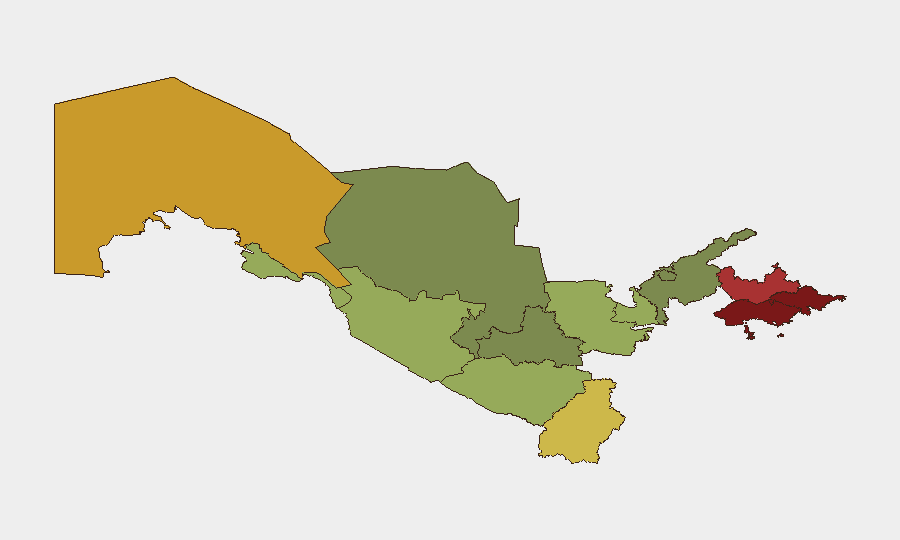
Situation Summary
Uzbekistan remains a low-threat environment globally (ranked #194), with a composite threat score of 2 across seven tracked events. However, sub-national risk is concentrated in the Fergana Valley and eastern regions—Andijan, Fergana, and Namangan regions account for the highest threat levels (scores 88, 82, and 78 respectively). Recent event signals include military-related public statements and a reported conventional military exchange with Congo on 28 June; the substantive drivers and context of these signals remain unclear from available open sources. No confirmed security incidents, civil unrest, infrastructure disruptions, or travel emergencies were reported in Uzbekistan during the 24–48 hours preceding this brief.
Key Developments
- 24 June 2026 · National-level export policy: Uzbek authorities tightened administrative controls over cellulose and cotton export licensing in response to international sanction-risk concerns; this reflects regulatory tightening rather than a security event.
- 24 June 2026 · Infrastructure · Urgench–Khiva corridor: State media confirmed the start of construction on a 35 km, four-lane toll road connecting Urgench and Khiva; no disruptions or safety incidents reported at opening.
- 28 June 2026 · Event signal · Military activity: GEOBIT event feeds recorded a "Conventional Military Force" signal involving Uzbekistan and Congo; no open-source corroboration or public statement from either government was available as of publication time.
- 27–28 June 2026 · Event signal · Diplomatic statements: Portugal issued public statements related to Uzbekistan on 27–28 June; content and context not yet clarified in available English-language media.
- 28 June 2026 · Event signal · Institutional disapproval: A religious/Christian-affiliated actor or organization issued a disapproval statement directed at Uzbekistan; substantive grievance not clarified in available sources.
Assessment: The absence of corroborated incident reporting, combined with low national-level threat scores, suggests no active security emergencies affecting international operations or travel in Uzbekistan at present. The event signals flagged above reflect diplomatic and military signal activity that warrants monitoring for clarification but do not yet indicate operational risk escalation.
Highest-Risk Areas
The Fergana Valley—comprising Andijan (88), Fergana (82), and Namangan (78) regions—remains the primary locus of sub-national risk in Uzbekistan, driven historically by militant activity, cross-border smuggling, ethnic tensions, and limited state capacity in remote areas. Karakalpakstan (72) and Surxondaryo Region (65) represent secondary risk concentrations in the southwest and southeast borders respectively. Central and western regions (Samarqand, Bukhara, Navoiy, Xorazm) remain lower-risk. Corporate assets and personnel in the Fergana Valley should prioritize local threat awareness and maintain liaison with regional security contacts; those in Tashkent and other major urban centers face substantially lower incidence of violence or organized crime.
How GeoBit Would Assist
A corporate security team operating in Uzbekistan should employ AOI Monitoring & Early Warning (persistent watch on Fergana Valley and border regions with alert triggers), multi-language OSINT & event-feed fusion (to clarify the military and diplomatic signals currently flagged), and alternative routing & network analysis (to maintain safe travel corridors in higher-risk regions). Conflict & terrorism search and regime-stability monitoring would support long-term strategic planning for operations in Central Asia.
7-Day Outlook
No imminent escalation is forecast. Continued diplomatic and military signal activity involving Uzbekistan and external actors warrants 24–72 hour monitoring for clarification; the absence of corroborated incident reporting suggests signaling rather than active kinetic operations. The Fergana Valley risk profile is expected to remain elevated but stable.
Highest-Risk Areas — Ranked
| # | State / Region | Risk |
|---|---|---|
| 1 | Andijan Region | 88 |
| 2 | Fergana Region | 82 |
| 3 | Namangan Region | 78 |
| 4 | Republic of Karakalpakstan | 72 |
| 5 | Surxondaryo Region | 65 |
| 6 | Qashqadaryo Region | 58 |
| 7 | Sirdaryo Region | 55 |
| 8 | Jizzakh Region | 48 |
| 9 | Xorazm Region | 45 |
| 10 | Bukhara Region | 42 |
| 11 | Navoiy Region | 38 |
| 12 | Samarqand Region | 35 |
Sources
Previous Daily Briefs
A new Uzbekistan brief is written every day — each with its own risk map and downloadable CSV. Here's the last week; use the calendar to go further back.
📅 Browse every day by calendar →
Highlighted days have a brief. Tap a day for that day's map & analysis, or “csv” for that day's dataset ($5).