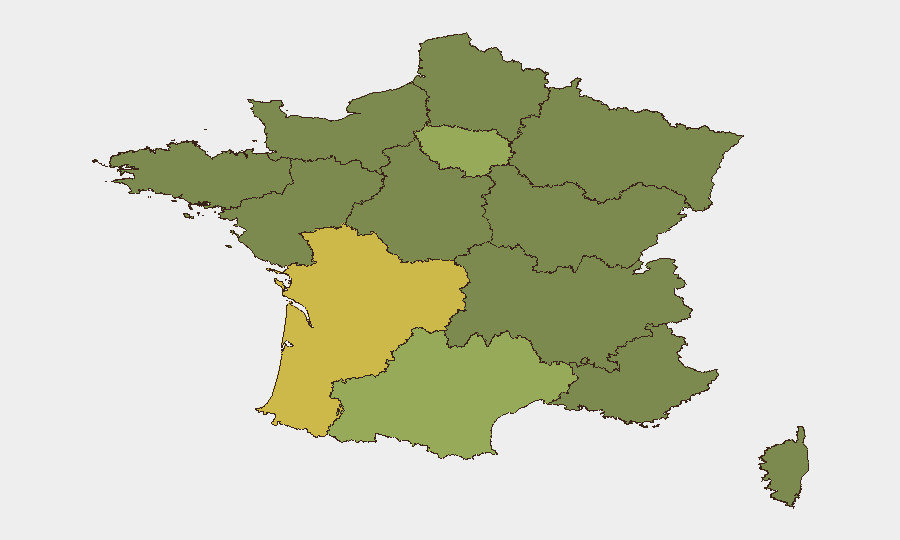
Situation Summary
France remains at moderate global risk (rank #40, composite score 50) with 283 tracked events. The country faces a mixed threat environment characterized by isolated security incidents, firefighter mobilizations, and low-level political tensions, with no indication of imminent large-scale instability. The most recent 48-hour signals—largely political in nature (parliamentary demands, party disapproval) and operationally routine (firefighter deployments)—do not suggest a material shift in the baseline security posture. Sub-national variation is significant, with Nouvelle-Aquitaine and Île-de-France driving elevated risk concentrations.
Key Developments
- Firefighter mobilizations (07-02, 07-03): Multiple conventional military force/firefighter signals registered across France; no specific location or incident type confirmed in available open sources. Likely routine operational activity or regional emergency response; monitor Ministère de l'Intérieur and departmental préfecture alerts for clarification.
- Parliamentary tension (07-03): Deputies issued demands toward the Prime Minister; consistent with ongoing post-election political friction but no security escalation indicated.
- Party-level disapproval signal (07-04): Internal party dissent registered; political rather than security-threat relevant.
- UK-attributed threat language (07-04): A "threaten" signal attributed to United Kingdom vs. a named individual; source, context, and credibility require verification through bilateral diplomatic or law-enforcement channels; likely low-order.
- Tehran-attributed threat (07-02): Signal registered; insufficient open-source corroboration available to assess scope, target, or operational intent.
- Prior diplomatic statements (07-02): US and French public statements on European matters; routine diplomatic communication.
Data caveat: No independently time-stamped, cross-sourced security or civil-unrest incidents for July 2–4, 2026 could be verified in French news outlets or official alert channels accessible in this brief window. Firefighter signals may reflect seasonal demand (July weather, tourism) rather than crisis. Recommend direct monitoring of AFP, BFMTV, Préfecture de Police Paris, and Gendarmerie nationale X accounts for real-time incident confirmation.
Highest-Risk Areas
Nouvelle-Aquitaine (64.8) significantly outpaces all other regions and warrants priority attention; drivers likely include port/energy infrastructure, cross-border activity, or historical protest activity in that corridor. Île-de-France (44.4)—encompassing Paris and its metropolitan zone—carries inherent risk due to population density, government/diplomatic presence, and transport hubs; elevated but within expected parameters for a capital region. Occitania (43.7) and Provence-Alpes-Côte d'Azur (36.3) show secondary elevation, possibly linked to migration corridors, tourism density, or labor disputes. Remaining regions cluster at 34.8–36.1, suggesting relatively uniform low-level baseline risk outside the top three zones.
How GeoBit Would Assist
Security teams would deploy AOI Monitoring & Early Warning on Nouvelle-Aquitaine and Île-de-France to track protest, labor, or security incidents in real time. Intel Sweep and X/Twitter OSINT across official French government accounts (Ministère de l'Intérieur, Gendarmerie, regional préfectures) and transport operators (SNCF, RATP, Autoroutes) would provide 24-hour incident confirmation and route-impact alerts. Network & Actor Analysis would map political factions and labor organizers to anticipate flashpoints; Routing & Network Analysis would enable rapid identification of alternative routes during transport disruptions or civil unrest.
7-Day Outlook
No imminent major escalation is indicated. Baseline political friction and routine operational activity (firefighter deployments) are likely to persist at current levels. Continued attention to Nouvelle-Aquitaine is warranted; summer tourism and seasonal labor demand may drive minor incidents. Recommend 48-hour re-assessment if UK or Tehran-attributed signals receive corroboration or if parliamentary tensions materialize into public-facing action.
Highest-Risk Areas — Ranked
| # | State / Region | Risk |
|---|---|---|
| 1 | Nouvelle-Aquitaine | 64.8 |
| 2 | Ile-de-France | 44.4 |
| 3 | Occitania | 43.7 |
| 4 | Provence-Alpes-Côte d'Azur | 36.3 |
| 5 | Bourgogne – Franche-Comté | 36.1 |
| 6 | Grand Est | 34.9 |
| 7 | Brittany | 34.8 |
| 8 | Normandy | 34.8 |
| 9 | Hauts-de-France | 34.8 |
| 10 | Centre-Val de Loire | 34.8 |
| 11 | Pays de la Loire | 34.8 |
| 12 | Auvergne-Rhône-Alpes | 34.8 |
Sources
Previous Daily Briefs
A new France brief is written every day — each with its own risk map and downloadable CSV. Here's the last week; use the calendar to go further back.
📅 Browse every day by calendar →
Highlighted days have a brief. Tap a day for that day's map & analysis, or “csv” for that day's dataset ($5).