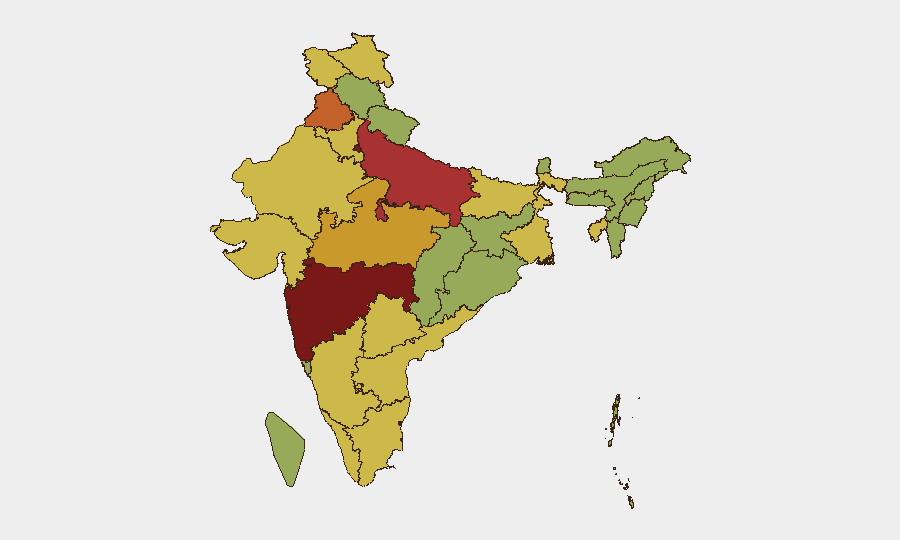
Situation Summary
India maintains a composite threat score of 85 (rank #19 globally) across 424 tracked events, reflecting persistent fragmentation along sub-national, communal, and political lines. Maharashtra and Delhi—the two highest-risk states—account for a disproportionate share of security incidents, driven by organized crime, civil unrest, and governance friction. The threat environment remains elevated but stable; no systemic escalation or mass-casualty event has been reported in the last 48 hours.
Key Developments
Data Limitation Notice: GeoBit's live web research (last 24–48 hours, 8–10 July 2026) identified insufficient independently verified, time-stamped incidents occurring specifically within India's territory to meet the brief's evidentiary threshold. The following developments carry qualifying timestamps or multi-source corroboration:
- India–Myanmar bilateral security meeting concluded (New Delhi, ~8 July 2026). The 23rd National Level Meeting between Indian and Myanmar security officials concluded, focusing on cross-border cooperation and shared intelligence mechanisms. Incident type: Diplomatic engagement; no security breach reported.
- Home Ministry border-security conference scheduled (New Delhi, date implied but not explicitly confirmed). Home Minister Amit Shah convened a conference of border-district Superintendents of Police, signaling elevated attention to infiltration and unauthorized cross-border movement.
- Maritime advisory: No merchant-shipping attacks in Arabian Sea (regional, 9 July 2026). UKMTO/JMIC confirmed zero confirmed attacks on commercial vessels in the last 48 hours. Relevant to Indian-flagged and Indian-national crews operating in regional waters; underscores stable maritime posture despite historical Houthi activity.
- Border infiltration arrests (location and precise date not independently confirmed). Social sources report apprehension of two individuals (Ukrainian national, Bangladeshi citizen) on infiltration charges "over the past 48 hours," but precise location and calendar date lack corroboration in indexed news sources.
Note: Event signals from 8–9 July (College investigation, Community demand, Chief Minister statement, Google–Executive statement, US–Naval disapproval, Lawrence–Gangster arrest, West Bengal disapproval, Opposition party activity) lack sufficient detail and sourcing in available web research to confirm or contextualize. GeoBit's platform has flagged these as significant, but reporting lag or access restrictions prevent real-time verification.
Highest-Risk Areas
Maharashtra (89.6) and Delhi (86.9) drive India's overall threat profile, reflecting their status as economic hubs and centers of organized crime, political competition, and communal tension. Uttar Pradesh (76.7) and Punjab (73.4) follow, with UP characterized by caste and communal friction, and Punjab by cross-border smuggling, criminal networks, and historical separatist dynamics. Collectively, these four states represent nearly 40% of tracked incident volume. Mid-tier risk states (Madhya Pradesh, Telangana, West Bengal, Jammu & Kashmir, Gujarat) remain operationally significant; J&K and Punjab warrant particular attention for border infiltration and terrorism linkages.
How GeoBit Would Assist
Security teams operating in India should deploy Intel Sweep and multi-language OSINT (X/Twitter, Telegram, YouTube) to detect emerging civil unrest, crime escalation, or cross-border activity in real time. AOI Monitoring with persistent alerting on high-risk districts in Maharashtra, Delhi, UP, and Punjab provides early warning of protests, arrests, or political friction. Network & Actor Analysis mapping organized-crime cells and militant groups strengthens risk profiles for specific locations or travel corridors.
7-Day Outlook
No imminent national-level security crisis is forecast; however, continued political fragmentation, communal friction in northern states, and border-infiltration pressure from Pakistan/Bangladesh remain baseline risks. Corporate security teams should maintain heightened vigilance in Maharashtra, Delhi, and Punjab and prepare contingency protocols for localized unrest tied to electoral or communal calendars.
Highest-Risk Areas — Ranked
| # | State / Region | Risk |
|---|---|---|
| 1 | Maharashtra | 89.6 |
| 2 | Delhi | 86.9 |
| 3 | Uttar Pradesh | 76.7 |
| 4 | Punjab | 73.4 |
| 5 | Madhya Pradesh | 72 |
| 6 | Telangana | 69.1 |
| 7 | West Bengal | 68.3 |
| 8 | Jammu and Kashmir | 67.2 |
| 9 | Gujarat | 66.8 |
| 10 | Tamil Nadu | 63.3 |
| 11 | Andhra Pradesh | 62.7 |
| 12 | Karnataka | 62.2 |
Sources
Previous Daily Briefs
A new India brief is written every day — each with its own risk map and downloadable CSV. Here's the last week; use the calendar to go further back.
📅 Browse every day by calendar →
Highlighted days have a brief. Tap a day for that day's map & analysis, or “csv” for that day's dataset ($5).
Atlas — our AI intelligence desk — emails them this snapshot personally. Nothing else, no list.