Situation Summary
Iran remains GeoBit's highest-ranked global threat (composite score 100; 1,169 tracked events), but near-term security dynamics have shifted materially following the U.S.–Iran ceasefire agreement and Strait of Hormuz blockade lift on June 18. The dominant risk vectors have moved from large-scale military escalation and maritime conflict toward medium-term political uncertainty, compliance enforcement, and sub-national instability in resource-rich and border regions. The 60-day interim framework creates both a tactical de-escalation window and structural vulnerability to policy reversal or localized security incidents.
Key Developments
- Strait of Hormuz & Southern Ports (June 18, 2026): U.S. formally lifted its naval blockade; multiple Iranian and international tankers (3.8M+ barrels total) transited without interference under new memorandum of understanding. Iranian Supreme National Security Council confirmed merchant vessels will face zero tolls for 60 days and traffic will increase gradually under Iranian military supervision.
- Tehran (June 18, 2026): Supreme Leader Ayatollah Mojtaba Khamenei publicly endorsed direct U.S. negotiations, a notable policy signal reported by state media. Iran reaffirmed commitment not to acquire nuclear weapons and agreed to on-site dilution of nuclear material under IAEA supervision.
- Global Oil Markets (June 18, 2026): Brent crude fell below USD 79/bbl following agreement announcement; analysts attribute decline to anticipated increased Iranian exports and easing of supply constraints tied to prior blockade.
- Tel Aviv–Tehran Relations (June 16–17, 2026): Israel conducted conventional military exercises; Iran issued demands and reduced diplomatic relations signaling continued underlying tension despite U.S.–Iran ceasefire.
- Journalist Detention (June 18, 2026): Iranian administration arrested a journalist; minimal additional detail available, but incident signals continued domestic information-control activity parallel to external de-escalation.
- Tanker Incident (June 17, 2026): Captain arrested in connection with tanker operation; context remains unclear but reflects ongoing maritime enforcement activity.
Highest-Risk Areas
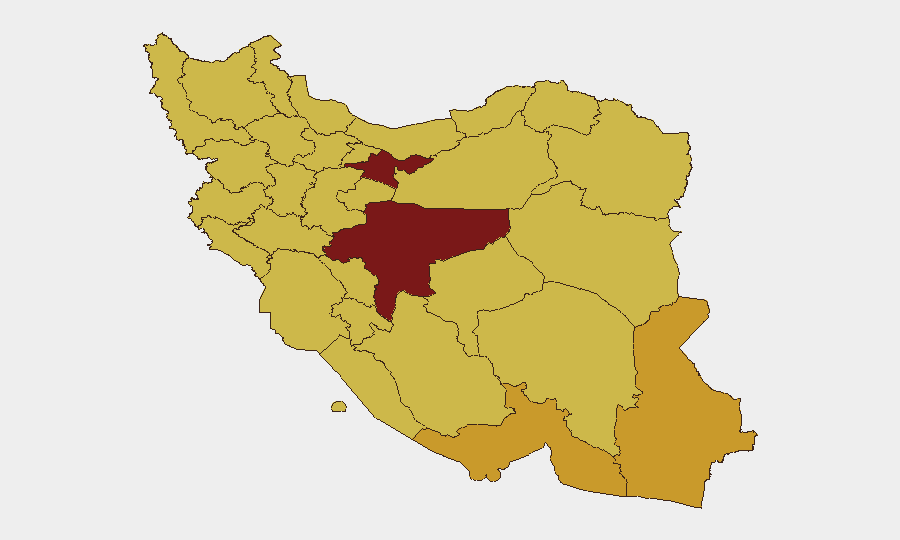
Isfahan and Tehran Provinces (risk scores 100 and 98) drive the national ranking, followed by a cluster of southern and eastern border regions—Hormozgan, Sistan and Baluchestan, Fars, and Kermanshah (scores 70–72). Isfahan's industrial and nuclear infrastructure, combined with Tehran's concentration of government, media, and foreign nationals, present both operational complexity and political sensitivity. Southern and southeastern provinces remain vulnerable to smuggling, cross-border militia activity, and maritime disputes. Border regions (Sistan and Baluchestan, Kerman, East Azerbaijan) face persistent non-state actor presence and limited government capacity, particularly relevant for personnel transit or supply-chain routing.
How GeoBit Would Assist
Security and risk teams should deploy AOI Monitoring & Early Warning on Isfahan, Tehran, Hormozgan, and key border crossings to detect policy reversals, military movement, or localized unrest during the 60-day interim period. Maritime & Aviation tracking combined with Economic & Trade monitoring will allow real-time visibility of tanker flows, sanctions enforcement changes, and shipping-insurance impacts as blockade-lift terms evolve. Network & Actor Analysis and Regime-Stability search will help teams distinguish genuine de-escalation from tactical repositioning and anticipate inflection points before 60 days expire.
7-Day Outlook
The immediate outlook (next 7 days) remains tactically stable: maritime traffic normalization will continue, political rhetoric is expected to soften, and large-scale military activity is unlikely. However, the underlying Israel–Iran tensions, journalist detention, and tanker enforcement activity indicate that localized friction points remain. Personnel and asset managers should treat the current window as a planning opportunity to relocate non-essential staff, validate supply chains, and pre-position contingency protocols ahead of the June 60-day review point.
Highest-Risk Areas — Ranked
| # | State / Region | Risk |
|---|---|---|
| 1 | Isfahan Province | 100 |
| 2 | Tehran Province | 98 |
| 3 | Hormozgan Province | 72.1 |
| 4 | Sistan and Baluchestan Province | 71.7 |
| 5 | Fars Province | 70.7 |
| 6 | Kermanshah Province | 70.7 |
| 7 | Alborz Province | 70.6 |
| 8 | Gilan Province | 70.5 |
| 9 | Khuzestan Province | 70.2 |
| 10 | Kerman Province | 70.2 |
| 11 | Markazi Province | 70.2 |
| 12 | East Azerbaijan Province | 70.1 |
Sources
Previous Daily Briefs
A new Iran brief is written every day — each with its own risk map and downloadable CSV. Here's the last week; use the calendar to go further back.
📅 Browse every day by calendar →
Highlighted days have a brief. Tap a day for that day's map & analysis, or “csv” for that day's dataset ($5).