Situation Summary
Lithuania remains a low-threat environment at the national level (global rank #124, composite score 10), with no tracked discrete security events in the current reporting cycle. However, recent disclosures and ongoing investigations reveal persistent vulnerabilities in critical infrastructure perimeter security, border control operations under migrant pressure, and investigative ties to transnational terrorism cases. The security posture is stable but requires vigilance at sub-national level, particularly in Vilnius and Kaunas counties.
Key Developments
- Kupiškis energy terminal drone intrusion (21 August disclosure, 15 August incident date). Public Security Service detected and detained a Lithuanian national operating an unauthorized unmanned aircraft in a restricted zone near a liquid energy products terminal in central Lithuania. Administrative case filed for UAV regulation violation; no sabotage or payload indicated, but incident exposes critical infrastructure monitoring gaps.
- Lithuanian–Belarusian border migrant confrontation (21 August reporting update, 15 August incident). Approximately 20 migrants discovered in tunnel under border fence near Vilnius County engaged border guards; one officer lightly injured during alleged forced-entry attempt. Investigation expanded to include both migrant actions and border-surveillance protocol review; case demonstrates sustained migrant pressure on frontier.
- Prosecutor General links Leipzig airport drone terrorism case to Lithuania (20–21 August statement). Nida Grunskienė confirmed that the explosive-laden drone incident at Leipzig/Halle Airport (Germany) involves investigative linkage to Lithuanian suspects and ongoing joint prosecution efforts. Multiple suspects in court; indicates transnational terrorism infrastructure extends into Lithuanian jurisdiction.
- Multiple crime and public-order incidents reported (21 August disclosures). Lithuanian press documented traffic accident involving child injuries, arson case, intoxicated assault, attempted vehicle theft escalating to suspected homicide, burglary, and retail assault—all reported by law enforcement on 21 August. Incidents are localized but reflect routine criminal-justice activity with no systemic security implications.
- Ongoing border-guard labor and disciplinary crisis (18–21 August reporting). Court proceedings and union statements continue regarding prior migrant shooting incident and officer welfare concerns; reflects institutional stress within border security apparatus under sustained frontier pressure.
Highest-Risk Areas
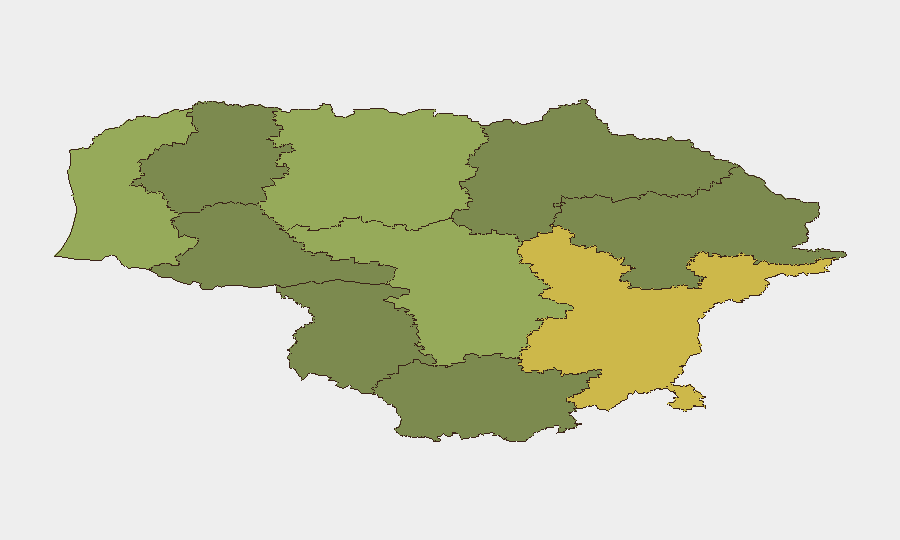
Vilnius County dominates sub-national risk (score 68), driven by critical infrastructure concentration, border proximity, and migrant/trafficking transit routes. Kaunas County (58) and Klaipeda County (52) follow, with Klaipeda's risk partly attributable to port-security and maritime-access concerns. Rural counties (Utena, Alytus, Marijampolė at 33, 32, 25 respectively) show lower scores, reflecting sparse critical assets and lower operational footprint. Risk clustering near Vilnius and western energy/port corridors suggests targeted monitoring of infrastructure perimeters and transit nodes.
How GeoBit Would Assist
Corporate security teams should deploy AOI Monitoring & Early Warning on critical facilities (energy terminals, ports, border checkpoints) to detect unauthorized personnel, vehicles, and unmanned systems in real time. OSINT Fusion & Corroboration across Lithuanian media, official statements, and cross-border intelligence feeds provides early signal of migrant surge cycles and smuggling-route changes. Border & Disputed-Territory Search combined with Network & Actor Analysis helps identify transnational terrorism and smuggling networks with Lithuanian nodes, as exemplified by the Leipzig airport case linkage.
7-Day Outlook
No acute security deterioration is expected in the near term. Migrant pressure on the Belarusian border will likely persist at current levels, with routine enforcement and investigative activity. Attention should remain on critical infrastructure perimeter security protocols and drone-interdiction readiness, particularly near energy and transportation assets in Vilnius and Kaunas counties, to prevent escalation or successful penetration.
Highest-Risk Areas — Ranked
| # | State / Region | Risk |
|---|---|---|
| 1 | Vilnius County | 68 |
| 2 | Kaunas County | 58 |
| 3 | Klaipeda County | 52 |
| 4 | Siauliai County | 42 |
| 5 | Panevezys County | 38 |
| 6 | Taurage County | 35 |
| 7 | Utena County | 33 |
| 8 | Alytus County | 32 |
| 9 | Telsiai County | 28 |
| 10 | Marijampole County | 25 |
Sources
Previous Daily Briefs
A new Lithuania brief is written every day — each with its own risk map and downloadable CSV. Here's the last week; use the calendar to go further back.
- August 19, 2026
- August 17, 2026
- August 15, 2026
- August 13, 2026
- August 11, 2026
- August 9, 2026
- August 7, 2026
📅 Browse every day by calendar →
Highlighted days have a brief. Tap a day for that day's map & analysis, or “csv” for that day's dataset ($5).
Atlas — our AI intelligence desk — emails them this snapshot personally. Nothing else, no list.