Situation Summary
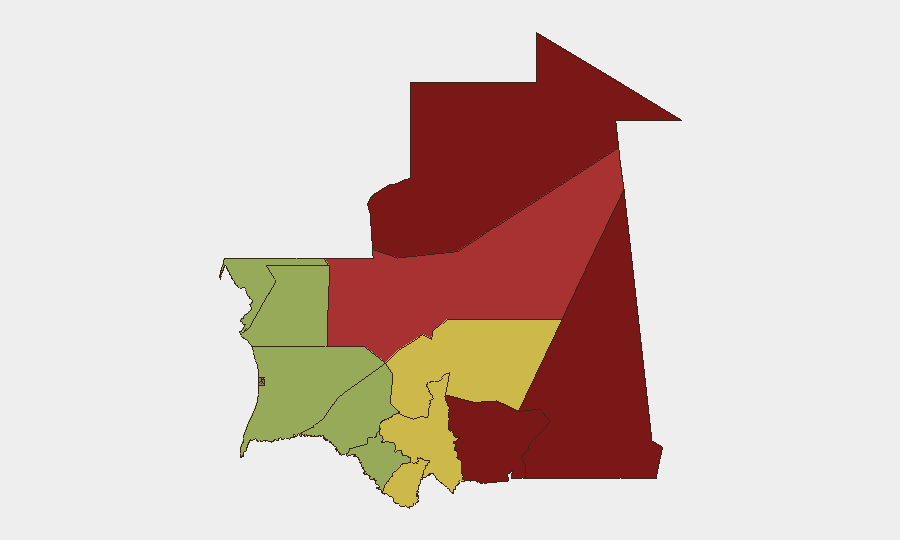
Mauritania remains under elevated structural risk, particularly in its northern and eastern border regions, with the U.S. government maintaining a Level 3 "Reconsider Travel" advisory and Western governments flagging terrorism and banditry as persistent threats. The country's national threat score (7/100) reflects a relatively contained operational environment in populated areas, though sub-national risk varies significantly—northern governorates such as Tiris Zemmour (risk 95) and Hodh Ech Chargui (risk 85) face active armed group presence and limited state control. No major security incidents have been reported in the past 48 hours; the operational picture remains stable in Nouakchott and other southern urban centers.
Key Developments
- Nouakchott, Atlantic offshore zone – night of 19–20 August 2026 (reported 21 August). Mauritania's coastguard rescued over 300 migrants, including approximately 40 children, from an overloaded vessel in distress off the coast. The operation underscores ongoing irregular maritime migration flows and the humanitarian and security exposure of Mauritania's Atlantic approaches.
- Nationwide travel advisory posture – current as of 22 August 2026. U.S. and German foreign ministries maintain active warnings against all travel north of the Tropic of Cancer and within 60 miles of the Mali and Algeria borders, citing active armed groups and inadequate state presence. These advisories are reviewed regularly and remain in effect.
- No discrete attacks or major unrest reported in the past 48 hours. Open-source monitoring shows no confirmed terrorist attacks, armed clashes, civil disturbances, or infrastructure incidents in Mauritania proper during 21–22 August 2026.
Highest-Risk Areas
Northern and eastern border regions dominate Mauritania's sub-national risk profile. Tiris Zemmour (risk 95) and Hodh Ech Chargui (risk 85) face the highest composite threat due to al-Qaeda and ISIS-affiliated armed group activity, trafficking networks, and minimal governmental security presence—a pattern consistent with broader Sahel instability. Hodh El Gharbi (risk 80) and Adrar (risk 78) present similar constraints, including porous borders with Mali and Algeria and limited formal law enforcement. Southern and coastal regions (Dakhlet Nouadhibou, Brakna, Trarza) carry significantly lower but non-negligible risk, primarily from petty crime and maritime-related incidents. Risk concentrates heavily in the north and east; southern urban centers, especially Nouakchott, remain relatively secure by regional standards.
How GeoBit Would Assist
Security teams with personnel or assets in Mauritania should prioritize AOI Monitoring & Early Warning on the Mali and Algeria border corridors and key routes to Nouakchott to detect armed group movement or conflict escalation in real time. Conflict & Military tracking and Network & Actor Analysis can map known armed group positions, supply lines, and leadership networks across northern governorates to support route planning and facility-siting decisions. OSINT fusion across Arabic and French media, radio SIGINT, and multi-language sentiment analysis will detect localized crime, unrest, or police/military activity that does not surface in English-language reporting—critical for day-to-day operational awareness in Nouakchott and secondary cities.
7-Day Outlook
No escalation in terrorist or criminal activity is anticipated in the near term. Structural risks in northern and border regions will remain elevated and unchanged; southern and coastal areas should expect continued low-level maritime migration incidents and petty crime. Duty-of-care teams should maintain standing alerts for any armed group incursion into central or southern Mauritania and monitor Franco-Mauritanian or U.S.-Mauritanian counterterrorism operations for spillover effects.
Highest-Risk Areas — Ranked
| # | State / Region | Risk |
|---|---|---|
| 1 | Tiris Zemmour | 95 |
| 2 | Hodh Ech Chargui | 85 |
| 3 | Hodh El Gharbi | 80 |
| 4 | Adrar | 78 |
| 5 | Tagant | 68 |
| 6 | Guidimaka | 65 |
| 7 | Assaba | 62 |
| 8 | Gorgol | 58 |
| 9 | Trarza | 55 |
| 10 | Inchiri | 52 |
| 11 | Brakna | 48 |
| 12 | Dakhlet Nouadhibou | 45 |
Sources
Previous Daily Briefs
A new Mauritania brief is written every day — each with its own risk map and downloadable CSV. Here's the last week; use the calendar to go further back.
- August 20, 2026
- August 18, 2026
- August 16, 2026
- August 14, 2026
- August 12, 2026
- August 10, 2026
- August 8, 2026
📅 Browse every day by calendar →
Highlighted days have a brief. Tap a day for that day's map & analysis, or “csv” for that day's dataset ($5).
Atlas — our AI intelligence desk — emails them this snapshot personally. Nothing else, no list.