Situation Summary
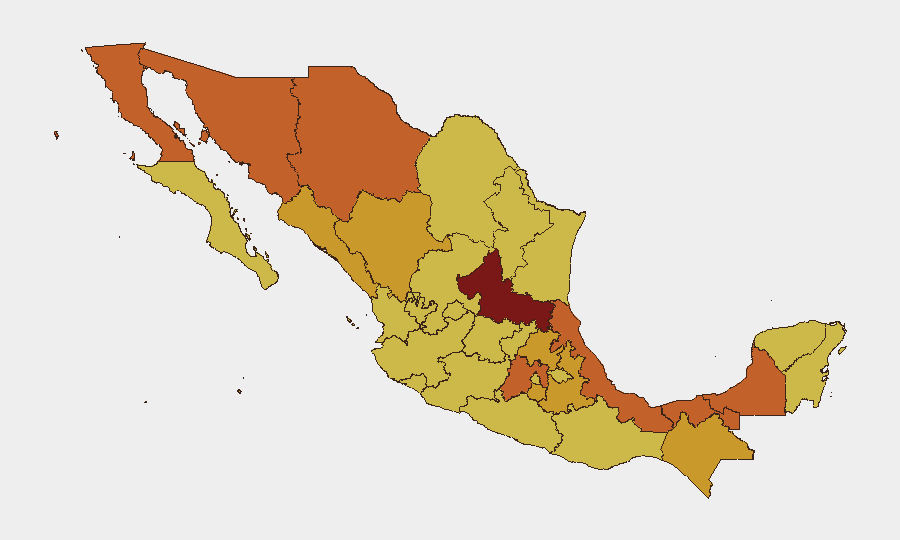
Mexico remains the third-highest threat environment globally (composite score 100), driven primarily by persistent insurgency and cartel activity across 908 tracked events. The security picture is spatially fragmented: twelve states score above 71 on the composite risk scale, with San Luis Potosí (100) representing the acute pole of threat. In the last 48 hours, a mass-casualty vehicle ramming in Cabo San Lucas has elevated public-order risk in a major tourism corridor and triggered national-level security response, signaling both incident-specific volatility and underlying crowd-management vulnerabilities during high-profile events.
Key Developments
- Cabo San Lucas, Baja California Sur – 25 June 2026, evening: A black sedan rammed into a crowd of World Cup fans on Lázaro Cárdenas Boulevard near the marina, injuring at least 17 people (one critically); driver detained. Video evidence shows preceding crowd engagement with the vehicle before acceleration into pedestrians, indicating volatile conditions in densely packed celebration zones.
- Los Cabos municipality – 26 June 2026: Municipal authorities announced elevated patrol and crowd-control operations in resort and bar districts following the ramming, with security cordons and traffic restrictions in place around the Centro/marina zone, indicating short-term travel and assembly risk.
- Los Cabos corridor – 26 June 2026: Authorities signaled ongoing review of traffic and pedestrian-flow controls across the Cabo San Lucas–San José del Cabo corridor, with likely short-notice road closures and checkpoints expected.
- National level – 26 June 2026: Mexican Football Federation issued formal statement on the Cabo incident, calling for clarification of security responsibilities and signaling that the ramming is being treated as a national-level security concern with implications for future fan-zone and event policing.
- Event signals (26 June): Platform tracking identified multiple administrative, governance, and law-enforcement events nationally, including government sanctions, physical assault on officials, cartel-administration force incidents, and arrest/detention activity, reflecting continued operational tempo across criminal and state actors.
Highest-Risk Areas
San Luis Potosí (100) and Chihuahua (75.4) anchor the top tier, followed by a dense cluster in the 73–75 range encompassing State of Mexico, Baja California, Campeche, Sonora, Veracruz, and Tabasco. The ranking reflects sustained cartel operational capacity, territorial control disputes, and state-level governance fragility in these zones. Notably, Baja California—which contains the Cabo San Lucas ramming site—ranks fourth (74.4) on the composite scale; the 25–26 June incident underscores how high-profile tourism corridors remain permeable to both criminal and mass-casualty threats despite coastal resort branding.
How GeoBit Would Assist
Security teams with personnel or assets in Mexico should leverage AOI Monitoring & Early Warning to establish persistent watch over high-traffic tourism and commercial zones (e.g., Cabo San Lucas, Cancún, major city centers) with automated alerting on crowd density, vehicular anomalies, and incident clustering. Intel Sweep and multi-language OSINT fusion (X/Telegram, local media, radio SIGINT) provide real-time event corroboration and local-language rumor tracking critical for distinguishing signal from noise in fragmented subnational contexts. Routing & Network Analysis enables rapid alternative-journey planning when road closures or security cordons are announced, mitigating travel delays and exposure.
7-Day Outlook
The Cabo San Lucas ramming will sustain heightened police presence and traffic controls in Los Cabos through the immediate aftermath; similar World Cup fan gatherings elsewhere (Cancún, Mexico City, Guadalajara) may see precautionary security uplift. Underlying cartel and insurgent tempo—evidenced by 26 June event signals—is expected to continue at baseline levels, with San Luis Potosí, Chihuahua, and State of Mexico remaining focus areas for ground-level violence and governance disruption.
Highest-Risk Areas — Ranked
| # | State / Region | Risk |
|---|---|---|
| 1 | San Luis Potosí | 100 |
| 2 | Chihuahua | 75.4 |
| 3 | State of Mexico | 75 |
| 4 | Baja California | 74.4 |
| 5 | Campeche | 73.7 |
| 6 | Sonora | 73.2 |
| 7 | Veracruz | 73 |
| 8 | Tabasco | 73 |
| 9 | Durango | 72.7 |
| 10 | Sinaloa | 72.6 |
| 11 | Chiapas | 72 |
| 12 | Morelos | 71.9 |
Previous Daily Briefs
A new Mexico brief is written every day — each with its own risk map and downloadable CSV. Here's the last week; use the calendar to go further back.
📅 Browse every day by calendar →
Highlighted days have a brief. Tap a day for that day's map & analysis, or “csv” for that day's dataset ($5).