Situation Summary
Samoa remains a low-threat environment with no major security incidents, civil unrest, or infrastructure failures recorded in the last 24–48 hours (19–21 August 2026). The country's composite threat score of 21 places it at #80 globally, reflecting a stable baseline of routine street crime and petty theft concentrated in urban areas. No escalation in security posture is anticipated over the near term based on current indicators.
Key Developments
- No confirmed new security incidents in the last 24–48 hours (19–21 August 2026). Open-source monitoring across regional security assessments, local media, and social platforms identifies no fresh protests, civil unrest, violent crime, or infrastructure failures meeting incident-level criteria as of 21 August.
- Mid-August political-security case remains relevant for monitoring context (arrest reported 17–18 August). A 49-year-old suspect arrested in Falelauniu, Upolu, on charges of threatening the Prime Minister via social media is in custody pending a September court date. This case, though outside the strict 24–48h window, underscores the political sensitivity of online speech and warrants continued attention to social-media sentiment and official responses.
- Localized burglary pattern in Apia area noted through 19 August. Residents in Siusega and Ululoloa districts have reported increased residential break-ins; this reflects an ongoing rather than new trend and aligns with Tuamasaga's elevated risk ranking. No mass-casualty or organized crime escalation associated with the pattern.
- Tuamasaga district remains the primary locus of routine street crime. Apia and surrounding areas continue to experience isolated street crime (theft, petty assault) typical of urban centers in the South Pacific, with no reported new violent incidents as of 19 August.
Highest-Risk Areas
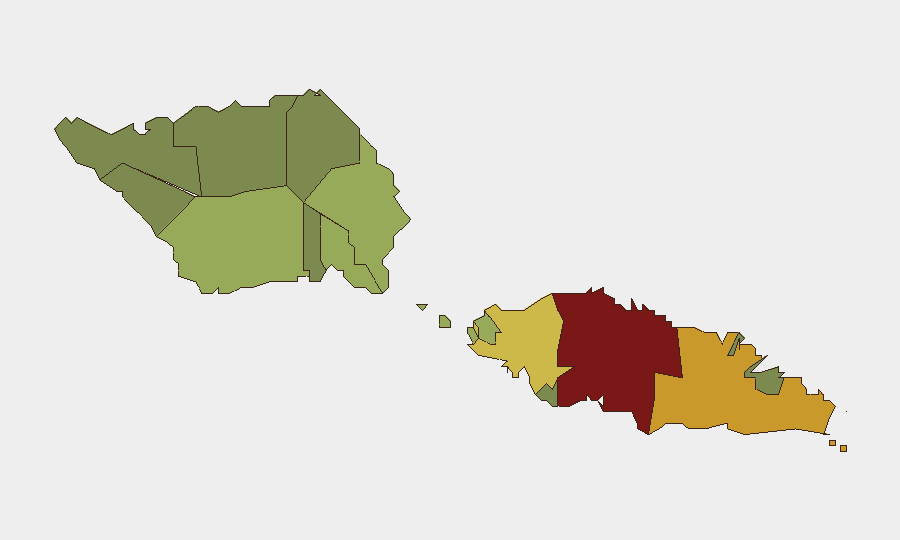
Tuamasaga (risk score 85) dominates the sub-national threat picture, driven by Apia's status as Samoa's capital and commercial hub; concentration of people, cash, and transient populations creates conditions for street crime and petty theft. Ātua (71) and Aʻana (62) follow as secondary risk zones, likely reflecting smaller population centers with less formal law-enforcement presence. The remaining districts (Aiga-i-le-Tai through Vaisigano) present materially lower risk and are suitable for standard travel and operations without elevated precautions beyond routine situational awareness.
How GeoBit Would Assist
Security teams with personnel or assets in Samoa should leverage Intel Sweep and multi-language OSINT fusion to track emerging political sentiment, social-media threats, and local crime trends—particularly in Tuamasaga—with real-time sentiment analysis flagging escalations in political speech or civil unrest before formal incidents occur. AOI Monitoring & Early Warning configured for Apia, key commercial corridors, and residential expat clusters would provide persistent watch-and-alert capability against localized crime spikes, demonstrations, or infrastructure failures. Routing & Network Analysis supports duty-of-care teams in identifying safe travel corridors and contingency routes within and between urban centers, reducing exposure to high-crime pockets.
7-Day Outlook
No material change in security posture is anticipated over the next seven days. Routine street crime and petty theft will likely persist at baseline levels in Tuamasaga; the mid-August political case will proceed through the judicial system without triggering broader unrest. Organizations should maintain standard host-nation awareness and crime-avoidance protocols.
Highest-Risk Areas — Ranked
| # | State / Region | Risk |
|---|---|---|
| 1 | Tuamasaga | 85 |
| 2 | Ātua | 71 |
| 3 | Aʻana | 62 |
| 4 | Aiga-i-le-Tai | 55 |
| 5 | Faʻasaleleaga | 48 |
| 6 | Palauli | 42 |
| 7 | Satupaʻitea | 38 |
| 8 | Gagaʻemauga | 35 |
| 9 | Gagaʻifomauga | 32 |
| 10 | Vaisigano | 28 |
| 11 | Vaʻa-o-Fonoti | 23 |
Sources
Previous Daily Briefs
A new Samoa brief is written every day — each with its own risk map and downloadable CSV. Here's the last week; use the calendar to go further back.
- August 19, 2026
- August 17, 2026
- August 15, 2026
- August 13, 2026
- August 11, 2026
- August 10, 2026
- August 9, 2026
📅 Browse every day by calendar →
Highlighted days have a brief. Tap a day for that day's map & analysis, or “csv” for that day's dataset ($5).
Atlas — our AI intelligence desk — emails them this snapshot personally. Nothing else, no list.