Situation Summary
Sudan remains in active civil war with a composite threat score of 100 (ranked #9 globally), driven by ongoing SAF–RSF conflict and secondary communal violence. Recent signals (21–22 June 2026) indicate escalating diplomatic friction between the Sudanese government and the UN Security Council, alongside internal military tensions and potential arrest operations. The security environment remains volatile across multiple sub-national regions, with North Kordofan State presenting the highest composite risk profile.
Key Developments
Diplomatic escalation (21 June 2026). The UN Security Council issued a public statement on Sudan, followed by reciprocal statements from Khartoum and coordinated UN disapproval signals. Context suggests deteriorating compliance with international humanitarian access or ceasefire commitments; specific incident details require real-time source corroboration not available in this brief's dataset.
Internal military tensions (19 June 2026). Sudan's government issued threats toward its own military apparatus, signaling potential command-and-control fractures or factional disputes within SAF leadership. This may indicate resource disputes, operational disagreements, or pressure on officers regarding war strategy or UN-mandated constraints.
Unconventional violence reported (19 June 2026). A signal coded as unconventional violence (excluding conventional armed clashes) was logged; specific location and method require downstream confirmation but suggest possible asymmetric tactics, looting, or civilian targeting.
Arrest/detention activity (20 June 2026). Sudanese authorities conducted arrest or detention operations on 20 June 2026. Without location detail, this may reflect security sweeps in Khartoum or opposition-controlled areas, or targeting of perceived collaborators with international bodies.
Egypt–Sudan tensions (19 June 2026). Sudan issued a public statement directed at Egypt, reflecting broader regional friction on border security, water rights, or refugee/combatant cross-border movement. This compounds internal conflict risk and may signal spillover into Kassala or Red Sea State.
Government disapproval signals (20 June 2026). Sudan's government issued disapproval statements (likely in response to UN or international criticism), indicating defiance of external pressure and reduced likelihood of near-term ceasefire negotiations.
Highest-Risk Areas
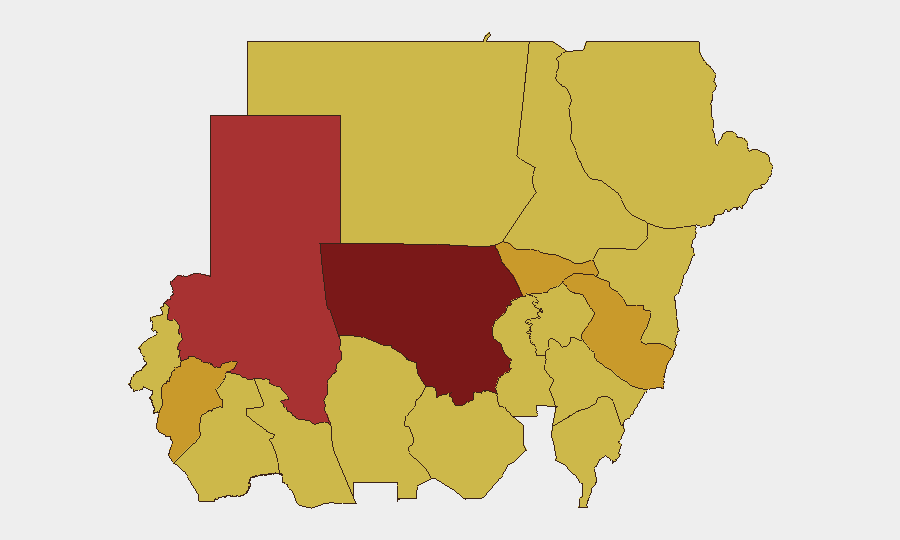
North Kordofan State (risk score 100) dominates the sub-national threat landscape, reflecting sustained SAF–RSF clashes, resource scarcity, and state-capacity collapse. North Darfur State (77.2) and the metropolitan Khartoum area (71.7) follow, with Darfur driven by ongoing genocide-risk dynamics and Khartoum by urban warfare, airstrikes, and arrest operations. A secondary tier of eight regions (Al Qadarif, Central Darfur, Blue Nile, River Nile, Aj Jazira, Red Sea, Kassala, Sennar, South Darfur) all score 70, indicating widespread instability across eastern, central, and southern Sudan. This geographic spread suggests SAF–RSF competition for territory and resources is now pan-Sudanese rather than localized.
How GeoBit Would Assist
AOI Monitoring & Early Warning with persistent geofencing of personnel or asset locations in high-risk states (Kordofan, Khartoum, Darfur) would provide real-time alerting on proximity to clashes, airstrikes, or roadblocks. Battle Mapping & Force Structure tracking would enable teams to monitor SAF and RSF unit movements, supply lines, and territorial control shifts. Routing & Network Analysis would support alternative journey planning for personnel transiting North Kordofan or Red Sea State, avoiding active conflict zones.
7-Day Outlook
Diplomatic deterioration and internal SAF tensions suggest reduced near-term ceasefire likelihood. North Kordofan and Khartoum should be assumed to remain under active military pressure over the next 7 days. Personnel in Kassala, Red Sea, and Aj Jazira states face heightened secondary risk from Egyptian border instability and localized communal violence.
Highest-Risk Areas — Ranked
| # | State / Region | Risk |
|---|---|---|
| 1 | North Kordofan State | 100 |
| 2 | North Darfur State | 77.2 |
| 3 | Al Khartum | 71.7 |
| 4 | Al Qadarif State | 71.7 |
| 5 | Central Darfur State | 71.7 |
| 6 | Blue Nile | 70 |
| 7 | River Nile State | 70 |
| 8 | Aj Jazira | 70 |
| 9 | Red Sea State | 70 |
| 10 | Kassala State | 70 |
| 11 | Sennar State | 70 |
| 12 | South Darfur State | 70 |
Sources
Previous Daily Briefs
A new Sudan brief is written every day — each with its own risk map and downloadable CSV. Here's the last week; use the calendar to go further back.
📅 Browse every day by calendar →
Highlighted days have a brief. Tap a day for that day's map & analysis, or “csv” for that day's dataset ($5).