Situation Summary
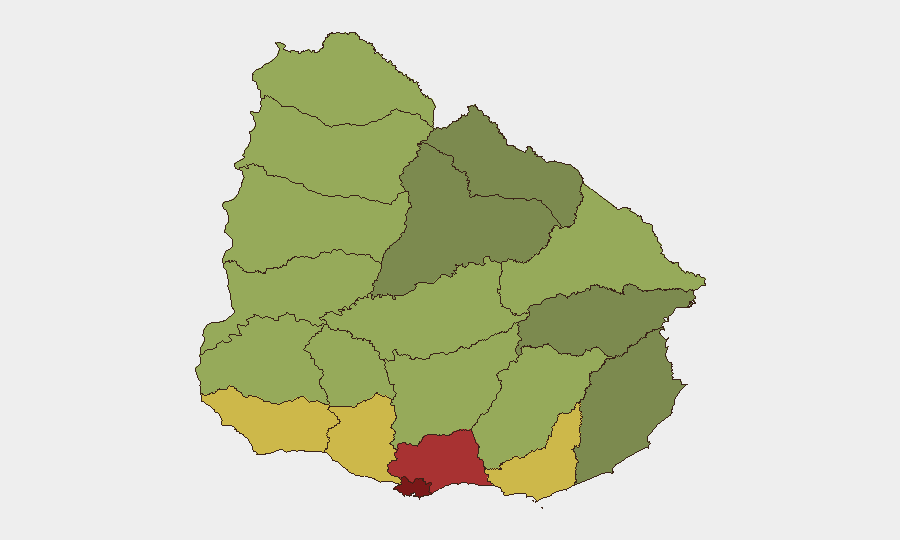
Uruguay maintains a stable security baseline with composite threat score 4 globally (#171 ranking) and no confirmed acute incidents in the last 24–48 hours. While regional disparities exist—Montevideo and Canelones departments significantly outrank others in risk—the country remains one of South America's lower-threat environments. Recent political and institutional activity at national level has not translated into verifiable security incidents or civil unrest.
Key Developments
No confirmed security incidents have been independently corroborated in Uruguay during the 24–48 hour window (June 29–July 1, 2026). Institutional and political signals (Senate statements, Presidential disapproval, mayoral communications on July 1; Paraguay-related statements on June 30) are present in event feeds but do not correspond to verified civil unrest, armed engagement, infrastructure disruption, or crime-wave activity at specific locations.
GeoBit's live web research confirms absence of time-stamped, multi-source corroborated security events meeting duty-of-care reporting thresholds. No travel advisories, mass-casualty incidents, or regional destabilization have been flagged by independent security feeds or diplomatic sources for the last 48 hours.
Highest-Risk Areas
Montevideo (risk 92) and Canelones (risk 78) together account for the majority of tracked threat events and composite risk. Both departments are urban/peri-urban zones with higher baseline crime density, organized activity, and institutional presence; Montevideo in particular concentrates government, finance, and diplomatic infrastructure. Maldonado (risk 68) and San José (risk 64) follow; Maldonado's risk profile reflects its coastal and tourism-sector dynamics, while San José's elevation reflects its proximity to Montevideo's orbit. Departments north and east of the metropolitan axis (Salto, Artigas, Paysandú, Flores, Florida) present materially lower composite scores, suggesting lower event frequency and threat concentration away from urban centers.
How GeoBit Would Assist
Intel Sweep and multi-language OSINT fusion (X/Twitter, Telegram, local news aggregation, sentiment analysis) enable continuous real-time monitoring for early signals of civil unrest, institutional instability, or crime escalation—critical for detecting shifts before they reach mass-casualty or infrastructure-impact thresholds. AOI (Area-of-Interest) Monitoring & Early Warning with persistent watch and alert thresholds on Montevideo, Canelones, and other high-risk departments allows security teams to filter noise and receive actionable alerts only when activity crosses predefined risk gates. Entity extraction and network analysis of institutional and political actors supports contextual understanding of government, judicial, and organized-crime network dynamics that may signal downstream security risk.
7-Day Outlook
No acute drivers are evident for near-term escalation. Institutional and political discourse at the national level should be monitored for downstream translation into civil mobilization, but current baseline suggests low probability of major security incident in the next 7 days. Continued routine monitoring of Montevideo and Canelones—particularly around infrastructure, transportation hubs, and commercial nodes—remains prudent for duty-of-care teams.
Highest-Risk Areas — Ranked
| # | State / Region | Risk |
|---|---|---|
| 1 | Montevideo | 92 |
| 2 | Canelones | 78 |
| 3 | Maldonado | 68 |
| 4 | San José | 64 |
| 5 | Colonia | 62 |
| 6 | Soriano | 58 |
| 7 | Río Negro | 56 |
| 8 | Salto | 54 |
| 9 | Artigas | 52 |
| 10 | Paysandú | 50 |
| 11 | Florida | 48 |
| 12 | Flores | 46 |
Sources
Previous Daily Briefs
A new Uruguay brief is written every day — each with its own risk map and downloadable CSV. Here's the last week; use the calendar to go further back.
📅 Browse every day by calendar →
Highlighted days have a brief. Tap a day for that day's map & analysis, or “csv” for that day's dataset ($5).