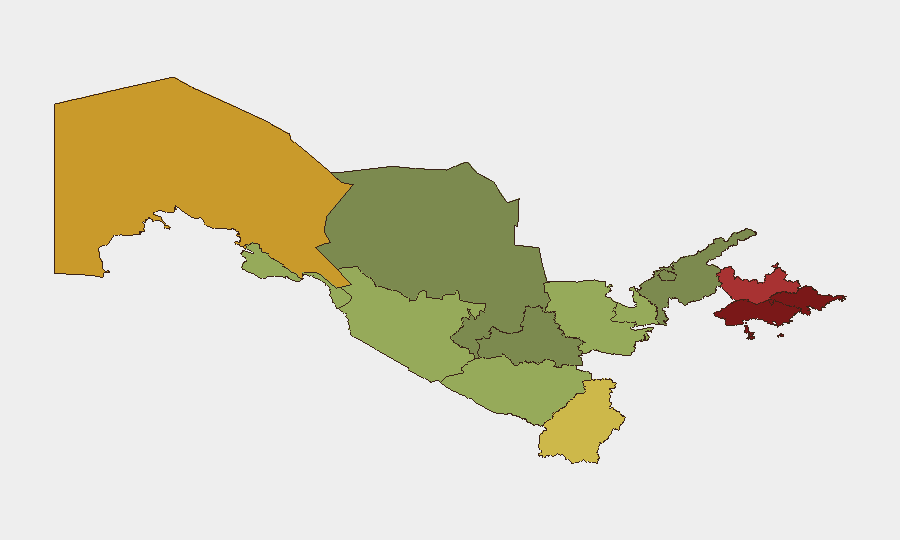
Situation Summary
Uzbekistan remains a low-threat environment at the national level (global rank #195, composite score 2), with no credible reports of significant security incidents, civil unrest, or infrastructure disruption in the last 24–48 hours. The country's overall stability is intact, though sub-national risk concentrations persist in the Fergana Valley region and peripheries. International event signals recorded in the platform reflect diplomatic and investigative activity rather than active security threats to personnel or assets on the ground.
Key Developments
No credible, multi-source security incidents have been confirmed in Uzbekistan during 28–29 June 2026. Global news aggregators, regional media services, travel-industry alerts, and OSINT feeds contain no reports of terrorist activity, protests, riots, major crime, or infrastructure failures during this window. The six recorded event signals in the GeoBit platform relate to diplomatic statements (Portugal), investigative actions (Colombia–Portugal nexus), and international military activity not directly involving Uzbekistan's territory or nationals. Standard operational security conditions prevail across major urban centers and transport corridors.
Highest-Risk Areas
The Fergana Valley—comprising Andijan (risk 88), Fergana (82), and Namangan (78) regions—remains the country's primary risk concentration, driven by historical jihadist recruitment networks, inter-community tensions, and porous borders with Tajikistan and Kyrgyzstan. Karakalpakstan (72) presents secondary risk related to resource scarcity, socioeconomic stress, and remote border management challenges. Surxondaryo (65) and Qashqadaryo (58) show elevated but manageable risk profiles. Central and western regions (Samarqand, Navoiy, Bukhara) remain substantially lower-risk and suitable for routine business operations.
How GeoBit Would Assist
Security teams with personnel or assets in Uzbekistan should employ AOI (Area of Interest) Monitoring & Early Warning on Fergana Valley cities (Andijan, Fergana, Namangan) and key border crossings to detect emerging protest activity, militant movement, or trafficking operations before they escalate. Intel Sweep and multi-language OSINT fusion (X/Telegram/local media) provide real-time baseline awareness of political statements, arrests, or security incidents that may signal shifting risk. Routing & Network Analysis enables security planners to identify alternative transport corridors and safe zones around high-risk regions should travel become necessary.
7-Day Outlook
No acute security threat indicators are present for the next seven days. The risk landscape will remain shaped by structural factors in the Fergana Valley rather than imminent incidents; routine monitoring should continue. Any spike in cross-border military activity from Tajikistan or Kyrgyzstan, or new international designations affecting Uzbek entities, would warrant rapid re-assessment and communication to in-country teams.
Highest-Risk Areas — Ranked
| # | State / Region | Risk |
|---|---|---|
| 1 | Andijan Region | 88 |
| 2 | Fergana Region | 82 |
| 3 | Namangan Region | 78 |
| 4 | Republic of Karakalpakstan | 72 |
| 5 | Surxondaryo Region | 65 |
| 6 | Qashqadaryo Region | 58 |
| 7 | Sirdaryo Region | 55 |
| 8 | Jizzakh Region | 48 |
| 9 | Xorazm Region | 45 |
| 10 | Bukhara Region | 42 |
| 11 | Navoiy Region | 38 |
| 12 | Samarqand Region | 35 |
Sources
Previous Daily Briefs
A new Uzbekistan brief is written every day — each with its own risk map and downloadable CSV. Here's the last week; use the calendar to go further back.
📅 Browse every day by calendar →
Highlighted days have a brief. Tap a day for that day's map & analysis, or “csv” for that day's dataset ($5).